


The Taipei City Government yesterday introduced a new numbering system for the city's road names in a bid to help foreigners identify and remember street names more easily.
"What we're doing here is something meaningful and innovative," said Taipei City Mayor Ma Ying-jeou (
"We're not stupid. We're not changing all the street names. Instead we're giving nicknames to some major roads ? We hope the new system will help expatriates and especially foreign tourists find it easier to identify and remember the street names in Taipei."
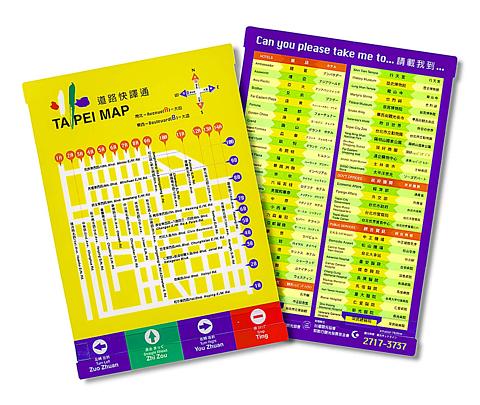
Starting in late June, the city's 10 major east-west roads -- from Hoping Road to Mintsu Road -- will have a number and be known as a boulevard. For instance, Nanjing Road will be known as 7B.
The 14 major north-south roads -- from Huanho Road to Keelung Road -- will also have numbers and be known as avenues. For example Chungshan Road will be 6A under the new system.
Ma said the new system is not intended to trouble to city residents.
"They [city residents] don't have to worry about having to memorize the new names because they don't find Chinese road names confusing and hard to remember," he said.
The new system was first proposed by Stanley Yen (
"I often receive complaints in my office about the city's confusing road names. As Taipei sees a growing number of international visitors, we would like to create a traveler friendly and barrier free city for them," he said.
To help foreigners who don't speak or read Chinese to better get around in the city, Yen said, the association will team up with the city's transportation and civil affairs bureaus to publish a total of 100,000 plastic reference maps and distribute them to the city's 60,000 taxi drivers.
The reference maps contain a simplified city map with old and new street names on one side and major tourist attractions and landmarks printed in Chinese, English and Japanese on the other.
Kai Wiechmann, a traveling photographer from Germany, said the new initiative appears to be a good idea for a first-time and short-term visitor such as him.
"I think it might help foreign travelers a lot," he said. "I personally haven't had much trouble finding my way around since I was here last Thursday. The only difficulty I have is the language."
Matthew Tamney, a business owner who has been in Taiwan for about 11 years, also approved of the new system. "It's very much similar to that in New York City where I'm originally from. I hope it works just as well," he said. "The new system makes it easier to remember street names, most of which contain directions, making it confusing at first."
Vitas Raskevicius, a Canadian university teacher who has been living here for about three years, said the new system simply did not make sense.
"This is a practical issue. I don't see how any additional names can be of any use," he said. "A new system is bound to contribute to confusion, and there's too much trouble to learn all the new names." He also hit out at the current confusing spelling system.
"The city should be embarrassed about the spelling," he said. "It's ridiculous to have such inconsistency in the English transcription of the street names. What they should have done is to keep the names and just spell them consistently."

SILENCING CRITICS: In addition to blocking Taiwan, China aimed to prevent rights activists from speaking out against authoritarian states, a Cabinet department said The Ministry of Foreign Affairs (MOFA) yesterday condemned transnational repression by Beijing after RightsCon, a major digital human rights conference scheduled to be held in Zambia this week, was abruptly canceled due to Chinese pressure over Taiwanese participation. This year’s RightsCon, the world’s largest conference discussing issues “at the intersection of human rights and technology,” was scheduled to take place from tomorrow to Friday in Lusaka, and expected to draw 2,600 in-person attendees from 150 countries, along with 1,100 online participants. However, organizers were forced to cancel the event due to behind-the-scenes pressure from China, the ministry said, expressing its “strongest condemnation”
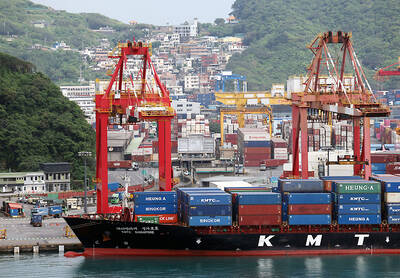
Taiwan’s economy grew far faster than expected in the first quarter, as booming demand for artificial intelligence (AI) applications drove a surge in exports, spilling over into investment and consumption, the Directorate-General of Budget, Accounting and Statistics (DGBAS) said yesterday. GDP growth was 13.69 percent year-on-year during the January-to-March period, beating the DGBAS’ February forecast by 2.23 percentage points and marking the most robust growth in nearly four decades, DGBAS senior official Chiang Hsin-yi (江心怡) told a news conference in Taipei. The result was powered by exports, which remain the backbone of Taiwan’s economy, Chiang said. Outbound shipments jumped 51.12 percent year-on-year to
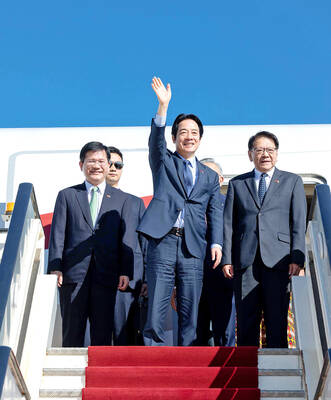
DELAYED BUT DETERMINED: The president’s visit highlights Taiwan’s right to international engagement amid regional pressure from China President Willaim Lai (賴清德) yesterday arrived in Eswatini, more than a week after his planned visit to Taiwan’s sole African ally was suspended because of revoked overflight permits. “The visit, originally scheduled for April 22, was postponed due to unforeseen external factors,” Lai wrote on social media. “After several days of careful arrangements by our diplomatic and national security teams, we successfully arrived today.” Lai said he looked forward to further deepening Taiwan-Eswatini relations through closer cooperation in the economy, agriculture, culture and education, as well as advancing the nation’s international partnerships. The president was initially scheduled to arrive in time to celebrate
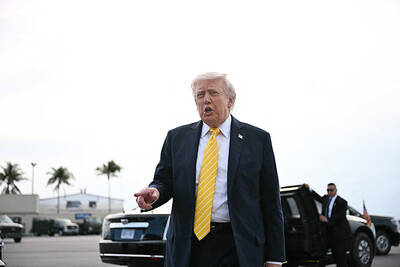
Iran’s Islamic Revolutionary Guard Corp (IRGC) yesterday said the US faced a choice between an “impossible” military operation or a “bad deal” with Tehran, after US President Donald Trump disparaged Iran’s latest peace proposal. Negotiations between the two countries have been deadlocked since a ceasefire came into effect on April 8, with only one round of direct peace talks held so far. Iran’s Tasnim and Fars news agencies reported that Tehran had submitted a 14-point proposal to mediator Pakistan, but Trump was quick to cast doubt on it. “I will soon be reviewing the plan that Iran has just sent to us, but


 RSS
RSS