


To help stem a serious enterovirus outbreak (腸病毒), Department of Health Director-General Lee Ming-liang (李明亮) yesterday launched a "wash your hands" campaign.
The campaign features a catchy song which, it is hoped, will help children to remember how to wash their hands properly.
There have been five deaths and 26 serious cases of enterovirus infection already this year, with more cases expected as the outbreak peaks.
Lee showed around 100 kindergarten children the correct way to wash their hands and joined in singing with Department of Health (DOH) officials, puppeteers and other performers.
The song details the five stages in the correct washing of hands: wetting hands, thoroughly rubbing hands with soap, cleaning hands with tap water, cleaning the tap, and drying your hands after.
"Many people don't know the right way to wash their hands," said the director-general of the Center for Disease Control (CDC) Twu Shiing-jer (
"Washing hands properly can not only prevent enterovirus infections, but also other gastrointestinal diseases and flu."
"Adults also need to wash their hands frequently, it's not something that only children have to do," Twu said.
Lee said washing hands was an easy thing to do but was vitally important in the prevention of disease and infection.
"We are running this campaign to make people aware of the importance of washing hands," Lee said.
Enterovirus infection is most easily avoided by washing hands, especially after using the bathroom, something children often fail to do and which explains their high infection rate.
DOH officials also reminded parents and care-givers to wash toys and teddy bears. "Children's toys are a common media for contagion, especially furry teddy bears."
According to the DOH, the present enterovirus outbreak is peaking at the moment. The CDC has declared 10 regions in Taiwan to be emergency areas.
The number of enterovirus infections confirmed as "serious" so far this year is 26, five of which have resulted in death. The victims were between the ages of one and three-and-a-half.
The most dangerous strain of enterovirus (EV71), has caused nine of the most serious cases this year, including one death. DOH officials said EV71 appeared to be making a comeback this year, after the summer 1998 outbreak, which caused 34 deaths.

National Taiwan University (NTU) yesterday said it disqualified a person from an entrance examination for using AI smart glasses to cheat, along with two others for making untruthful statements in their curriculum vitae. The three applicants were given null scores, Taiwan’s highest-ranked university said, calling on prospective students to be honest in the admissions process. NTU registrar Lee Hung-sen (李宏森) said that the cheating applicant wore a hat and thick-rimmed glasses to the second written exam for medical school, claiming that they felt cold. Suspicions were aroused when the applicant stared oddly at the test for long stretches while steadily bringing the paper
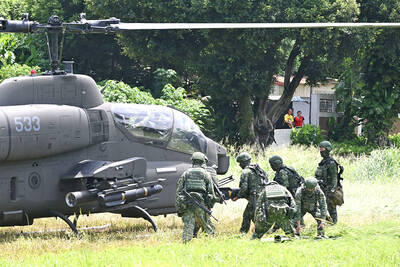
MILITARY ISSUES: A partisan divide between the Cabinet and the legislature ‘raised questions about Taiwan’s ability to adequately fund its defense,’ the report said Taiwan’s defense budget, military personnel numbers and resilience are challenges to its ability to meet national defense goals, the US Naval Institute said in a report published on Tuesday. In response to the perception of a growing military threat posed by China, Taiwan has embarked on an effort to enhance the capabilities needed to deter an attempt by Beijing to annex the nation by force, the institute said in the US Congressional Research Service report, titled Taiwan: Defense and Military Issues, which was filed on Thursday last week. Taiwan’s defense budget increased by about 7.5 percent from 2024 to last year, it
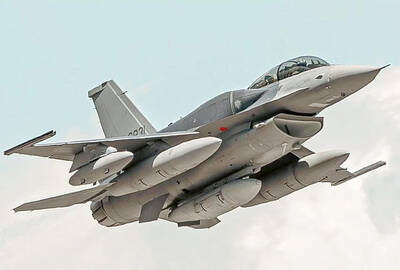
66 FIGHTER JETS: The aircraft is likely undergoing preparations for its transfer to Taiwan — a significant step forward in the nation’s modernization program, a lawmaker said The first of Taiwan’s order of F-16V Block 70 aircraft has been sighted in Texas ahead of delivery, Democratic Progressive Party (DPP) Legislator Wang Ting-yu (王定宇) said. Taiwan’s first F-16V Block 70 two-seat aircraft, tail number 6831, was seen flying from Lockheed Martin’s production facility in Greenville, South Carolina, to Naval Air Station Joint Reserve Base Fort Worth in Texas, Wang wrote on Facebook yesterday. The plane is likely undergoing preparations for its transfer to Taiwan, marking a significant step forward in the Republic of China Air Force’s modernization program, Wang said, citing military analysts. The F-16V Block 70 is a new-build version
NOT JUST NUMBERS: What matters to intelligence work is crucial, reliable information, so even a few credible leads can be highly valuable to national security, a legislator said The National Security Bureau (NSB) yesterday said it has finished the establishment of an information-reporting channel for Chinese nationals, the aim of which is to broaden intelligence gathering on China’s political, military, economic and social developments. Chinese nationals can submit information on the Web page, https://report.nsb.gov.tw, the NSB said in a statement. The move aims to expand the bureau’s diverse intelligence sources and is pursuant to the National Intelligence Services Act (國家情報工作法), it said, adding that it referenced practices adopted by intelligence agencies in the US, the UK and Israel. An increasing number of people are approaching Taiwanese agencies to provide information, as


 RSS
RSS