


First Lady Wu Shu-chen (
Tainan Deputy County Commissioner Lin Wen-ting (
Tainan County Commissioner Chen Tang-shan (
But the deputy commissioner said Wu tried to influence the process because she favored another person for the county post.
Both President Chen Shui-bian's (陳水扁) camp and Wu claimed such charges were groundless.
The festive ambiance of the inaugural events was nearly spoiled by the unexpected change in the Cabinet lineup Friday.
Chen Tang-shan's refusal caught the new government by surprise, forcing a hasty search for a replacement. As it turned out, National Cheng Kung University President Weng Cheng-i (翁政義) assumed the position without much time to ponder his decision.
The scenario was reportedly attributed to the disparate opinions on the replacement for the Tainan county commissioner, with Wu allegedly insisting that DPP lawmaker Su Huan-chih (
"Why is it that [the pick of an acting county magistrate] has anything to do with me? ... How could I intervene in such a matter?" Wu said. "How could I have any say about it, when Lin I-hsiung (
In the process of forming the Cabinet, President Chen invited three current county chiefs to join the new government, while leaving the problem of succession to those stepping up.
Current regulations state that the final decision is in the hands of the interior ministry.
While Chen Tang-shan had insisted on Lin, the DPP was also considering others, such as Su.
Poor coordination over the issue led to confusion, yet after a May 17 meeting of DPP factions, a consensus was reached that Chen would step in.
However, a day later, after a meeting with President Chen, Su emerged as the favored candidate.
Wu acknowledged she had became acquainted with Su when he worked at Chen's law firm from 1983 to 1984, but she insisted this association did not mean she had exerted any influence on the selection of the acting commissioner.
"Why am I embroiled in such hot water? It is not worthwhile for me to comment on such nonsense," she said.
Vice Minister of the Interior-designate Lee Yi-yang (
"Wu has never meddled in Chen's administration, no matter what Chen's position is," Lee said.
"The first lady is renowned for standing aloof from politics, not to mention not sticking her foot into personnel arrangements." Lee said the rumors were spread with malicious intent.
In response to the controversy, Su said on Friday that he simply abided by the president's choice. "Both President Chen and Chairman Lin approached me during the process when they were determining the candidate, but Wu has never been in touch with me," Su said.
"Lin's charge is absurd, and such an allegation has tarnished the name of the DPP and the first lady," he added.

‘NO SECURITY RISK’: The Railway Bureau reassured the public that the technicians’ activities were limited to technical guidance and did not involve sensitive systems The Railway Bureau yesterday said it had invited eight Chinese technicians to assist with an airport MRT construction project. The bureau issued the confirmation after an Internet user said Chinese nationals had entered the construction zone of Taiwan Taoyuan International Airport’s Terminal 3 project. They asked why “individuals from an enemy state” were allowed access to such a major national infrastructure project, which raised serious concerns over Taiwan’s industrial safety, sensitive systems and information security. The bureau’s Northern Region Engineering Branch Office said subcontractor Taiwan Handle Industrial Co (台灣手把工業) of the Taoyuan airport MRT’s “Contract No. CU05 Project A14 Station Civil, MEP &

A US uncrewed surface vessel (USV) encountered multiple Chinese warships during an autonomous transit of the Taiwan Strait, US defense company Seasats said in a statement on Wednesday. Seasats announced that a Lightfish USV had completed the first autonomous transit of the Taiwan Strait. Over five days, the USV traversed the entire length of the Strait while constantly monitoring surface vessel traffic, the company said. The Lightfish encountered multiple Chinese warships, one of which was a Chinese People’s Liberation Army Navy (PLAN) Type 056 corvette, it said. The Chinese vessels were operating “well within Taiwan’s exclusive economic zone without transmitting their identity via the
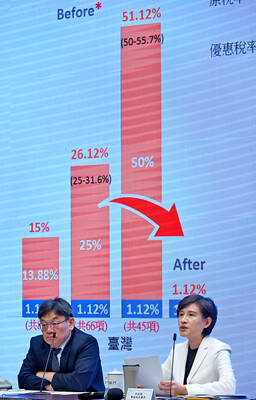
GREATER REACH? Auto parts and wood products would face tariffs of up to 15%, matching those targeting the EU, Japan and South Korea, Vice Premier said The US has announced that preferential tariff treatment for Taiwan’s non-semiconductor Section 232 goods would take effect retroactively from May 1, the Executive Yuan said yesterday. The US government yesterday posted a notice on the Federal Register’s public inspection Web site previewing tariff concessions for Taiwan under a memorandum of understanding (MOU) on Taiwan-US investment after two months of negotiations. The MOU signed on Jan. 15 stipulated three major preferential tariff arrangements: a 15 percent “reciprocal” tariff rate for Taiwan without stacking most-favored nation (MFN) rates; preferential Section 232 treatment for semiconductors and related products; and preferential Section 232 treatment for non-semiconductor

TIT-FOR-TAT: The US allegedly revoked the visa of a Chinese national working at Xinhua News Agency in the US in response to Beijing’s expulsion of Vivian Wang The Presidential Office yesterday condemned China for expelling a New York Times correspondent from Beijing following the newspaper’s interview with President William Lai (賴清德), saying the move highlighted Beijing’s suppression of press freedom and its threat to international news media. Taiwan has noted a series of recent incidents in which Beijing used similar tactics to “threaten and pressure international media outlets and journalists,” Presidential Office spokeswoman Karen Kuo (郭雅慧) said in a statement. “This concerns not only press freedom and freedom of expression, but also the safety of journalists, and Taiwan and relevant partners are paying close attention to the situation,” she


 RSS
RSS