


As tomorrow is the deadline for independent presidential candidates to hand over the required 224,000 signatures for the March election, independent presidential candidate Hsu Hsin-liang (許信良) yesterday handed over the first batch of signatures to the Central Election Commission (CEC中選會).
Chu Hui-liang (
"Hsu has already collected more than 300,000 signatures," Chu said today they will hand over another 100,000 signatures and give out the rest of the signatures on the last day. Chu called for more signatures so as to avoid overlapping or duplicating signatures with other candidates.
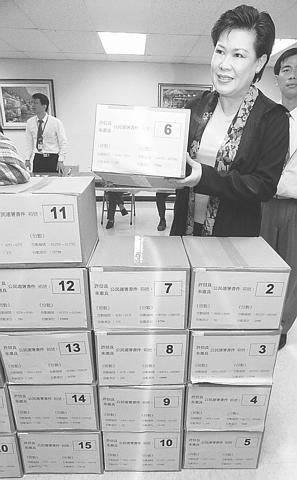
PHOTO: CHEN CHENG-CHANG, TAIPEI TIMES.
According to election regulations, overlapping signatures are nullified for both sides. If too many signatures overlap it could result in a politician losing his or her candidacy.
The Taiwan Independence Party's candidate Cheng Pang-cheng (
An official of the party said the Cheng-Huang ticket has suffered insufficient resources partly because they were the latest to join the election campaign.
The official said pressure from pro-independence party elders, who have called on support for DPP presidential candidate Chen Shui-bian (
While the Cheng camp is worried about insufficient support, an aide to independent presidential candidate James Soong (
The official said they are worried that the exposure of all their signatures may bring trouble to some of their supporters, although they didn't provide any details as to why this was so. The Soong camp yesterday called a meeting to decide how many signatures they should hand over.
In related news, although signature drives are not required for presidential candidates nominated by major parties, the KMT is undertaking a signature drive for its candidate Lien Chan (
"This is a test of mobilization," said KMT spokesman Huang Hwei-chen (
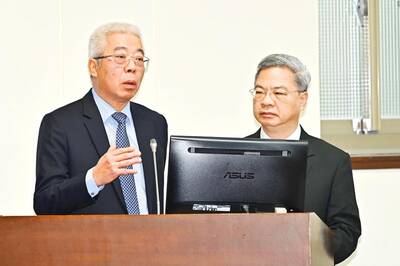
Taiwan has arranged for about 8 million barrels of crude oil, or about one-third of its monthly needs, to be shipped from the Red Sea this month to bypass the Strait of Hormuz and ease domestic supply pressures, CPC Corp, Taiwan (CPC, 台灣中油) said yesterday. The state-run oil company has worked with Middle Eastern suppliers to secure routes other than the Strait of Hormuz, through which about 20 percent of the world’s oil and liquefied natural gas typically passes, CPC chairman Fang Jeng-zen (方振仁) said at a meeting of the legislature’s Economics Committee in Taipei. Suppliers in Saudi Arabia have indicated they
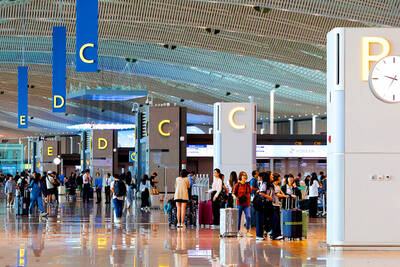
South Korea has adjusted its electronic arrival card system to no longer list Taiwan as a part of China, a move that the Ministry of Foreign Affairs said would help facilitate exchanges between the two sides. South Korea previously listed “Taiwan” as “Taiwan (China)” in the drop-down menus of its online arrival card system, where people had to fill out where they came from and their next destination. The ministry had requested South Korea make a revision and said it would change South Korea’s name on Taiwan’s online immigration system from “Republic of Korea” to “Korea (South),” should the issue not be
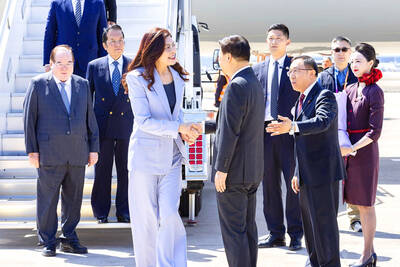
CCP ‘PAWN’? Beijing could use the KMT chairwoman’s visit to signal to the world that many people in Taiwan support the ‘one China’ principle, an academic said Chinese Nationalist Party (KMT) Chairwoman Cheng Li-wun (鄭麗文) yesterday arrived in China for a “peace” mission and potential meeting with Chinese President Xi Jinping (習近平), while a Taiwanese minister detailed the number of Chinese warships currently deployed around the nation. Cheng is visiting at a time of increased Chinese military pressure on Taiwan, as the opposition-dominated Legislative Yuan stalls a government plan for US$40 billion in extra defense spending. Speaking to reporters before going to the airport, Cheng said she was going on a “historic journey for peace,” but added that some people felt uneasy about her trip. “If you truly love Taiwan,

Tainan, Taipei and New Taipei City recorded the highest fines nationwide for illegal accommodations in the first quarter of this year, with fines issued in the three cities each exceeding NT$7 million (US$220,639), Tourism Administration data showed. Among them, Taipei had the highest number of illegal short-term rental units, with 410. There were 3,280 legally registered hotels nationwide in the first quarter, down by 14 properties, or 0.43 percent, from a year earlier, likely indicating operators exiting the market, the agency said. However, the number of unregistered properties rose to 1,174, including 314 illegal hotels and 860 illegal short-term rental


 RSS
RSS