


Declassification and release of archive documents from the United States today, shows that Taiwan attempted to build nuclear weapons, despite government denials and US government opposition.
These formerly confidential files detail how the US State Department used its diplomatic influence and intelligence sources to promote non-proliferation and halt Taiwan's secretive nuclear weapons program.
But what the US government failed to do, the evidence suggests, was stop Taiwan from giving up entirely its ambition and ability to develop weapons of mass destruction.
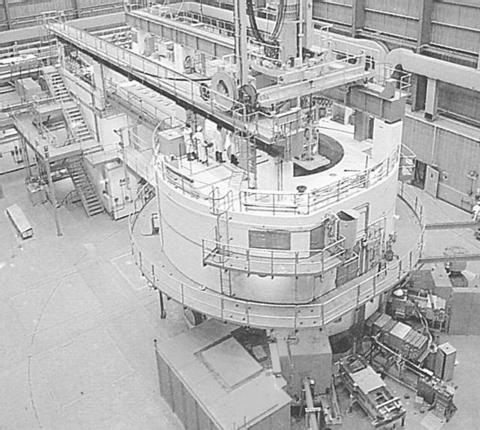
SOURCE: THE ATOMIC ENERGY COUNCIL
The story begins in 1964, after China conducted its first nuclear test. Shortly afterward, Taiwan launched its own nuclear weapons program, dubbed the "Hsinchu Project."
There is contention over who was the principal figure behind the programme. Wu Ta-you (
This view was contradicted by National Taiwan University professor of history, Hsu Cho-yun, in a 1966 interview at the US Embassy in Taipei, who said Chiang Kai-shek was the motivating force.
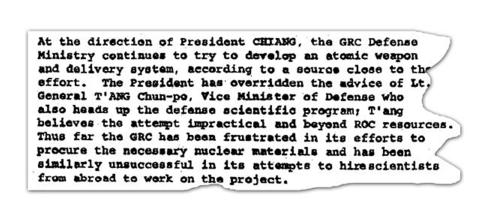
"At the direction of President Chiang, the Chungshan Institute of Science and Technology, which superintends science research and development for the Ministry of National Defense, is continuing to push ahead with its program of developing an atomic weapon."
The quest for friends
Hsu said that Taiwan had difficulty finding nuclear materials for its research and its plans were often blocked.
Initially Taiwan asked the US and Israel for assistance, but the US flatly refused and Israel had its own security problems. Japan was approached but "reacted negatively, as it does to any effort to involve it in the development of nuclear weapons," an embassy document reported.
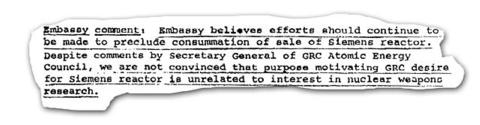
When Taiwan tried to buy a 50 megawatt heavy water nuclear power plant from the Federal Republic of Germany-based power company Siemens in 1967, the US issued a caution.
Nevertheless, that same year, the US' General Electric Corporation began construction of Taiwan's first nuclear power plant in the northeast part of the island.
Victor Cheng (
The US government later consented to support the sale of the German reactor, so that it would not appear to be contradicting itself and the reputation of the International Atomic Energy Agency to uphold safety standards.
"In view of unequivocal US statements of confidence in IAEA safeguard systems and US assurance to FRG [Federal Republic of Germany] that IAEA safeguards would not hinder German sales of nuclear equipment for peaceful purposes, the Department does not consider we should attempt to forestall sale through approach to either Siemens or FRG."
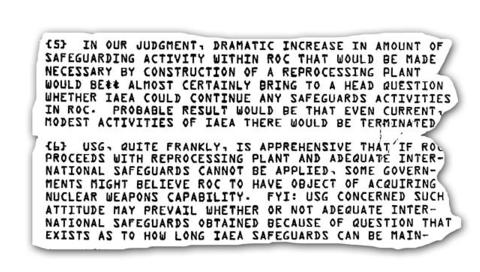
However, the telegram to the US embassy in Bonn added: "The Department (of state) intends to furnish FRG through other channels USG [US government] information on GRC purchase of Siemens reactor ... we are not yet convinced that purpose motivating GRC desire to buy Siemens reactor is unrelated to interest in nuclear weapons."
Intelligence information confirming this suspicion did get to the State Department, in December 1972, but by this time Taiwan's position in the international arena was already beginning to fade due to the emergence of China.
In 1971 Taiwan was pushed out of the United Nations and its continued participation in international organizations like IEAE was threatened.
After Taiwan lost its membership in the IEAE, a bilateral agreement with the United States -- which had backed efforts to build all three of the island's nuclear power plants -- continued to ensure that safety standards were being met.
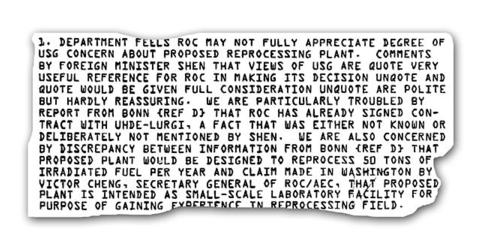
"We recently learned that the ROC is considering the purchase of the essential parts for nuclear materials and reprocessing plant from commercial sources in the FRG. Such a plant reprocesses spent reactor cores and also produces significant quantities of plutonium, an essential component of nuclear weapons," a Dec. 14, 1972 memorandum said.
Cheng was advised of the US concern and "described the proposed reprocessing plant as a small scale laboratory exercise designed to develop experience in the reprocessing field," the memorandum added.
Small-scale research
Cheng further downplayed the matter, saying the facilities would cost US$250,000 and would be used to reprocess small amounts of spent reactor cores on an "experimental basis."
The US immediately pointed out to Taiwan that, according to the IEAE, strict standards had to be enforced for such a transfer to take place and that, in principle, the IEAE opposed the transfer of reprocessing plants to a "non-nuclear weapons state."
The US then began plying pressure on Germany and other countries that would be involved in the process. The IEAE board of governors in China also said they would not approve of the transfer.
In January 1973, US Embassy officials in Taiwan spoke to the foreign minister and urged him not to go ahead with the purchase.
The foreign minister, Shen Chang-huan (
Shen denied the idea of building a reprocessing plant had been approved by Taiwan's government, and did not tell the US that Taiwan had already signed a contract with a German firm to purchase the reprocessing plant.
The US confronted Shen over the matter, after which he told the US embassy that Taiwan would not be involved in the construction of a reprocessing plant, a February, 1973, memorandum confirms.
The US continued to monitor Taiwan's attempts to go ahead and construct a reprocessing facility on its own, but documents do not detail how Taiwan achieved this feat.
According to research by David Albright and Corey Gay, published in a "Bulletin of Atomic Scientists" article, entitled "Taiwan Nuclear Nightmare Averted," Taiwan continued on its own.
Their findings show that Taiwan began work in 1969 on uranium fuel, a reprocessing facility, and a plutonium chemistry laboratory.
These facilities were built with the help of equipment from France, Germany, the US and other countries, the article said.
From 1972 to 1974 Taiwan purchased about 100 metric tons of South African uranium, it said. It was also discovered that in 1970 a "Hot Laboratory" was being built and was expected to be completed in 1976.
Cheng, the AEC's secretary-general claimed the lab could only produce about 15 grams of plutonium a year, far short of that needed for a nuclear weapon, the article said.
The CIA concluded in 1974 that "Taipei conducts its small nuclear program with a weapon option clearly in mind, and it will be in a position to fabricate a nuclear device after five years or so," Albright and Gay wrote.
Under increasing international pressure on Sept. 14, 1976, Chiang Ching-kuo, then premier, said Taiwan would not engage in any reprocessing activities. That was not, however, the case.
It wasn't until over 10 years later, however, after the defection of a locally-recruited Central Intelligence agent, that Taiwan's program was brought to a halt.
Colonel Chang Hsien-yi (
Taiwan's official position since then has been that it will not use its scientific abilities to build nuclear weapons. But experts note that if Taiwan wanted to it could develop these weapons quickly, possibly within a year.
1964
China conducts its first
nuclear test
1966
Local sources let US know
that Taiwan is pursuing a
nuclear weapons program
1967
Taiwan plans to purchase a
nuclear reprocessing
plant
from
Siemens in West Germany. The
US tries to block the sale then
backs down but retains
suspicions that Taiwan has
ulterior motives
1969
Taiwan begins work on a
reprocessing plant
1971
ROC is pushed out of the
United Nations by the People's
Republic of China
1972
The US State Department
learns that Taiwan intends to
purchase equipment for a
reprocessing plant from West
Germany
1973
After pressure from the US,
Taiwan's foreign minister says
the reprocessing plant will
not be built
1976
Reprocessing plant is
believed to be finished.
Premier Chiang Ching-kuo says
Taiwan will not engage in any
activities related to reprocessing
1979
US switches diplomatic
ties to China
1988
Deputy Director of nuclear
research, Chang Hsien-yi, flees
Taiwan handing over reams of
information to US officials
Taiwan puts to rest its ambitions
to build nuclear weapons
Taiwan puts to rest its ambitions to build nuclear weapons
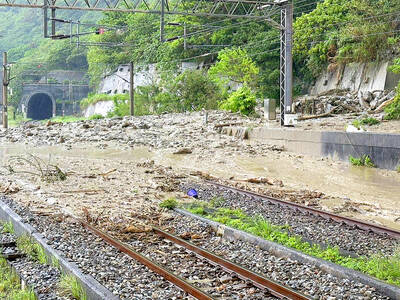
ROLLER-COASTER RIDE: More than five earthquakes ranging from magnitude 4.4 to 5.5 on the Richter scale shook eastern Taiwan in rapid succession yesterday afternoon Back-to-back weather fronts are forecast to hit Taiwan this week, resulting in rain across the nation in the coming days, the Central Weather Administration said yesterday, as it also warned residents in mountainous regions to be wary of landslides and rockfalls. As the first front approached, sporadic rainfall began in central and northern parts of Taiwan yesterday, the agency said, adding that rain is forecast to intensify in those regions today, while brief showers would also affect other parts of the nation. A second weather system is forecast to arrive on Thursday, bringing additional rain to the whole nation until Sunday, it
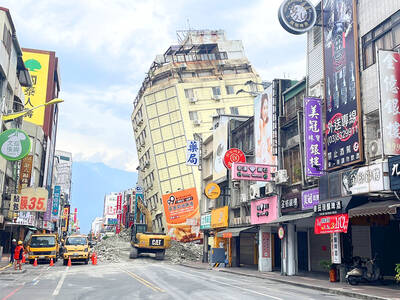
LANDSLIDES POSSIBLE: The agency advised the public to avoid visiting mountainous regions due to more expected aftershocks and rainfall from a series of weather fronts A series of earthquakes over the past few days were likely aftershocks of the April 3 earthquake in Hualien County, with further aftershocks to be expected for up to a year, the Central Weather Administration (CWA) said yesterday. Based on the nation’s experience after the quake on Sept. 21, 1999, more aftershocks are possible over the next six months to a year, the agency said. A total of 103 earthquakes of magnitude 4 on the local magnitude scale or higher hit Hualien County from 5:08pm on Monday to 10:27am yesterday, with 27 of them exceeding magnitude 5. They included two, of magnitude
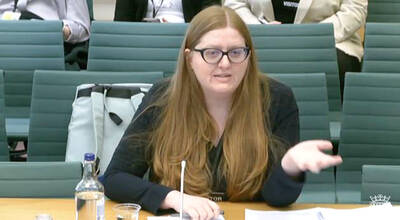
CONDITIONAL: The PRC imposes secret requirements that the funding it provides cannot be spent in states with diplomatic relations with Taiwan, Emma Reilly said China has been bribing UN officials to obtain “special benefits” and to block funding from countries that have diplomatic ties with Taiwan, a former UN employee told the British House of Commons on Tuesday. At a House of Commons Foreign Affairs Committee hearing into “international relations within the multilateral system,” former Office of the UN High Commissioner for Human Rights (OHCHR) employee Emma Reilly said in a written statement that “Beijing paid bribes to the two successive Presidents of the [UN] General Assembly” during the two-year negotiation of the Sustainable Development Goals. Another way China exercises influence within the UN Secretariat is

Taiwan’s first drag queen to compete on the internationally acclaimed RuPaul’s Drag Race, Nymphia Wind (妮妃雅), was on Friday crowned the “Next Drag Superstar.” Dressed in a sparkling banana dress, Nymphia Wind swept onto the stage for the final, and stole the show. “Taiwan this is for you,” she said right after show host RuPaul announced her as the winner. “To those who feel like they don’t belong, just remember to live fearlessly and to live their truth,” she said on stage. One of the frontrunners for the past 15 episodes, the 28-year-old breezed through to the final after weeks of showcasing her unique


 RSS
RSS