


Unless it is forgotten, past experience can act as a valuable guide for the future -- and in the wake of the 921 earthquake, such experience can provide a chance to fully examine Taiwan's existing emergency rescue system, analysts say.
That was the message at a public hearing held by DPP legislators Lin Cho-shui (
While the media has pointed its finger at the government's inability to take precautions against natural calamities since the 921 earthquake, Lin said the government's failure was in lacking efficient civil defense mobilization and a legal framework for disaster prevention and recovery.
Lin yesterday put forward a draft form of a civilian defense bill (
In Lin's version of the bill, two main articles stand out.
Article 4 states: during a state of emergency local county chiefs can demand military authorities in the area to support related rescue work.
Article 9 states: non-governmental rescue associations can also be given some authority in order to coordinate the relief process.
"After the 921 catastrophe, local governments are lying in a near-paralyzed state, with the current relief efforts being operated under a multi-organizational mechanism. Although the military's rescue work is somewhat efficient, they are still unfamiliar with the local environment. If local chiefs can exercise the right of command for the military's efforts, then to an extent it could solve these problems,'' Lin said.
Although President Lee Teng-hui (
"In particular, the Fire Administration has to bring nuclear disasters, earthquakes and chemical calamities into their routine practice of preparation, if it wants to upgrade its status as a so-called general agency of fire and rescue,'' said Lee.
Participants at the hearing unanimously agreed that the 921 earthquake reflected the fact that funding of relief organizations had been inadequate. Also, that there was a lack of professional specialists dedicated to relief efforts.
"To use the seriously damaged Chungliao township (中寮鄉) in Nantou County as an example: in peacetime, there were only seven staff members at the local fire department. On the day the earthquake hit, no more than four or five workers were actually on duty. Such a low level of professional personnel would never be capable of dealing with such a large scale catastrophe,'' said Chang Kuan-yung (張寬永), a construction engineering professor at National Taipei University of Tech-nology.
Chang also brought up the unpredictability of earthquakes and measures that need to be taken, especially in urban areas. "The government has to draw up rescue and evacuation routes, while at the same time building up all sorts of information and resource data banks, to be put in reserve for when they are needed.''
Chang said that according to government statistics the Fire Administration's expenses last year reached approximately NT$9,00 million. This figure is in stark contrast with the total losses from the 921 earthquake, which could reach NT$1 trillion.
"Taiwan is a small island, but with a fairly crowded population; so strengthening the functions of disaster-handling systems will be a necessary condition for reducing losses,'' said Tsai Ting-kui (
"Only by establishing a disaster-proof system can we avoid enormous, unnecessary social costs,'' he said.
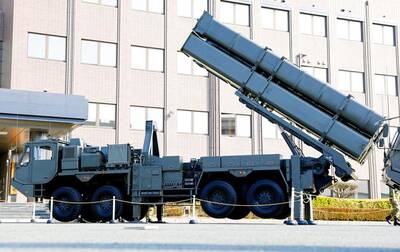
Japan has deployed long-range missiles in a southwestern region near China, the Japanese defense minister said yesterday, at a time when ties with Beijing are at their lowest in recent years. The missiles were installed in Kumamoto in the southern region of Kyushu, as Japan is attempting to shore up its military capacity as China steps up naval activity in the East China Sea. “Standoff defense capabilities enable us to counter the threat of enemy forces attempting to invade our country ... while ensuring the safety of our personnel,” Japanese Minister of Defense Shinjiro Koizumi said. “This is an extremely important initiative for
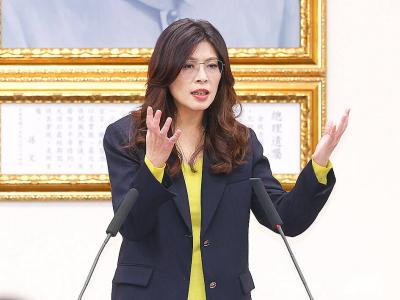
Chinese Nationalist Party (KMT) Chairwoman Cheng Li-wun (鄭麗文) today accepted an invitation from Chinese President Xi Jinping (習近平) to lead a delegation to China next month, saying she hopes to promote the peaceful development of cross-strait relations and bring stability to the Taiwan Strait. “I am grateful and happy to accept this invitation,” Cheng said in a statement from the KMT chairperson’s office. Cheng said she hopes both sides can work together to promote the peaceful development of cross-strait relations, enhance exchange and cooperation, bring stability to the Taiwan Strait and improve people’s livelihoods. At today's news conference, Cheng said any efforts to

MORE POPULAR: Taiwan Pass sales increased by 59 percent during the first quarter compared with the same period last year, the Tourism Administration said The Tourism Administration yesterday said that it has streamlined the Taiwan Pass, with two versions available for purchase beginning today. The tourism agency has made the pass available to international tourists since 2024, allowing them to access the high-speed rail, Taiwan Railway Corp services, four MRT systems and four Taiwan Tourist Shuttles. Previously, five types of Taiwan Pass were available, but some tourists have said that the offerings were too complicated. The agency said only two types of Taiwan Pass would be available, starting from a three-day pass with the high-speed rail and a three-day pass with Taiwan Railway Corp. The former costs NT$2,800

The nation’s fastest supercomputer, Nano 4 (晶創26), is scheduled to be launched in the third quarter, and would be used to train large language models in finance and national defense sectors, the National Center for High-Performance Computing (NCHC) said. The supercomputer, which would operate at about 86.05 petaflops, is being tested at a new cloud computing center in the Southern Taiwan Science Park in Tainan. The exterior of the server cabinet features chip circuitry patterns overlaid with a map of Taiwan, highlighting the nation’s central position in the semiconductor industry. The center also houses Taiwania 2, Taiwania 3, Forerunner 1 and


 RSS
RSS