


DPP presidential candidate Chen Shui-bian (
Meanwhile, DPP faction leaders have raised objections to Chen's likely choice of a running mate, Taoyuan County commissioner Annette Lu (
Chen began consulting party senior leaders on the issue yesterday in an apparent effort to convince them to support Lu as the party's vice presidential candidate.
However, he still refused to confirm publicly whether he has already made his choice.
"I certainly have a direction and a mindset for choosing my running mate, but the final decision will not be made right now," Chen told reporters after a meeting with party chairman Lin I-hsiung (林義雄).
At the same time, Lin explained that according to party regulations, the presidential candidate has the right to choose his or her own running mate. Lin also stressed that he would help Chen dispel potential prejudice among other party members.
"Chen did ask me about the `Chen-Lu' ticket, but he also mentioned other possible combinations. Lu is an excellent colleague, but the party also has many other fine choices. I think Chen has still not decided for the moment," Lin said.
Meanwhile, DPP faction leaders complained about Chen's decision- making process, saying that he should have consulted with them before leaking his choice to the media.
"The presidential election is not just Chen's personal business -- it is the task for the entire party. Therefore, Chen should not fail to consult with party leaders," said Yao Chia-wei (
New Tide Alliance leader Wu Nai-jen (
"I think until November at least, Chen should look for a proper choice outside the party. Whether we win or lose the presidential election may depend on three to five percent of the vote," Wu said.
"We cannot choose the wrong person as the party's vice presidential candidate. However, we will respect Chen's decision," he said.
DPP lawmaker Yeh Chu-lan (
"If Chen is ready to pick a running mate from inside the party, he should announce his decision as soon as possible to minimize potential opposition later on," she said.
Party leaders also criticized Lu's character, saying she was an assertive politician and not easy to work with.
"Lu always persists in her own opinions. Moreover, she may bring a lot of controversy and arguments to Chen's campaign," said DPP lawmaker Chou Po-lun (
Chou and colleague Chang Chun-hung (張俊宏), both leaders of the New Era Institute faction, said Chen should choose a better person, such as former Hsinchu County commissioner Feng Cheng-chung (范振宗) or former Taipei deputy mayor Chen Shih-meng (陳師孟), who served under Chen.
"If Chen wanted to get more Hakka votes, Feng is a good choice. Otherwise Chen Shih-meng is also an excellent candidate for representing mainlanders," Chang said.
Many senior party leaders appeared worried about Lu's style -- worries they expressed yesterday during both the party's weekly central standing committee meeting and at a separate meeting of Chen's campaign staff.
"Lu's ideology and political colors are right-wing, and she is a fundamentalist (independence advocate) on the cross-strait issue. These do not conform to Chen's `new middle way' platform," said Lin Feng-shi (林豐喜), a lawmaker and member of the party's Formosa faction.
Lu herself was unapologetic.
"The choice of the presidential candidate is Chen's right. Faction leaders should not be bringing their opposition to bear on him," she said.
"I have been around the world to fight for Taiwan's position in the international community. Anyone who says I'm difficult to get along with is being immature," she added.
Lu also said the party should poll the public to gauge support for who would be Chen's best choice.
The DPP is scheduled to hold a presidential campaign rally in Taoyuan Saturday, the day Chen had originally planned to announce Lu as his running mate.
Party leaders said that the number of supporters Lu is able to mobilize to join the rally may be a good indicator of her real power -- and, possibly, her chances of becoming Chen's running mate.

‘NO SECURITY RISK’: The Railway Bureau reassured the public that the technicians’ activities were limited to technical guidance and did not involve sensitive systems The Railway Bureau yesterday said it had invited eight Chinese technicians to assist with an airport MRT construction project. The bureau issued the confirmation after an Internet user said Chinese nationals had entered the construction zone of Taiwan Taoyuan International Airport’s Terminal 3 project. They asked why “individuals from an enemy state” were allowed access to such a major national infrastructure project, which raised serious concerns over Taiwan’s industrial safety, sensitive systems and information security. The bureau’s Northern Region Engineering Branch Office said subcontractor Taiwan Handle Industrial Co (台灣手把工業) of the Taoyuan airport MRT’s “Contract No. CU05 Project A14 Station Civil, MEP &

The National Chungshan Institute of Science and Technology yesterday showcased its locally developed variants of the Vision 60 robotic patrol dog, which it plans to deploy on the nation’s outlying territories in the South China Sea. The variants were produced under the Joint Lab project — created by the institute and domestic companies — and assembled with domestically produced motors, lenses and artificial intelligence (AI) systems alongside licensed tech from the US, Missile and Rocket Systems Research Division deputy director Jen Kuo-kang (任國光) told the media event at a military base in Taipei’s Dazhi (大直) area. Taiwan has built up its strengths

NOT IMMEDIATE: Taiwan has a chance to appeal the proposed 10 percent tariff before it starts, while other countries face a 12.5 percent tariff from the trade office Taiwan is among 60 economies determined by the US to have failed to impose or enforce a ban on the importation of goods produced with forced labor, according to a notice released on Tuesday by the Office of the US Trade Representative (USTR), which proposed imposing an additional 10 percent or more tariff on them. The USTR in a statement said that following an investigation, it had determined under Section 301 of the Trade Act of 1974 that the failure of the 60 economies to impose and effectively enforce a prohibition on the importation of goods produced with forced labor is
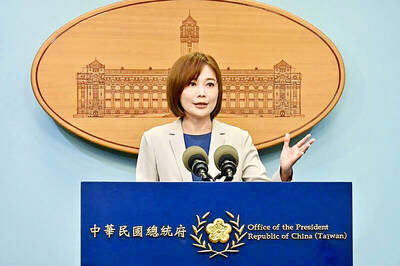
TIT-FOR-TAT: The US allegedly revoked the visa of a Chinese national working at Xinhua News Agency in the US in response to Beijing’s expulsion of Vivian Wang The Presidential Office yesterday condemned China for expelling a New York Times correspondent from Beijing following the newspaper’s interview with President William Lai (賴清德), saying the move highlighted Beijing’s suppression of press freedom and its threat to international news media. Taiwan has noted a series of recent incidents in which Beijing used similar tactics to “threaten and pressure international media outlets and journalists,” Presidential Office spokeswoman Karen Kuo (郭雅慧) said in a statement. “This concerns not only press freedom and freedom of expression, but also the safety of journalists, and Taiwan and relevant partners are paying close attention to the situation,” she


 RSS
RSS