


A watchmaker in Indonesia’s Bandung city thinks the next step in sustainability is a wristwatch with a strap made out of the complex root structure of a mushroom. Mycelium leather, as the material is known, is fibrous and tough yet pliable and waterproof, and has been touted as an environmentally-friendly alternative to synthetic products or natural leather made from animal hide.
Erlambang Ajidarma, head of research at Mycotech, the start-up supplying the mycelium leather to make the wrist straps, said his team was inspired by tempeh, a traditional Indonesian savory dish made by fermenting soybeans with fungus. “Finally we found one mushroom with a mycelium that can be made into binding material,” said Ajidarma, after testing several different types of mushrooms since 2016.
Now, the company grows the fungus on sawdust and then harvests the leather. After scraping off the sawdust, it is dried and then cut to various sizes, depending on the use. The process is tedious, taking around three weeks to make 10 square meters of material. But Ajidarma thinks it’s worth it.
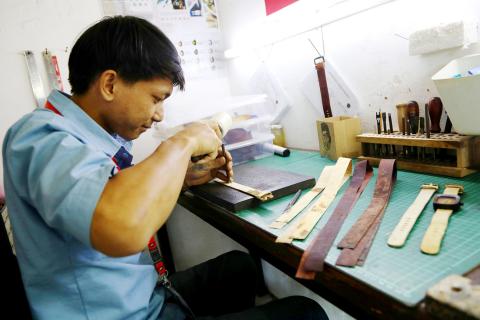
Photo: Reuters
照片:路透
It costs less to make mycelium leather than to make petroleum-based synthetic leathers, he says, and the mycelium manufacturing process produces a fraction of the carbon dioxide emitted by the cows killed to make real leather. Ajidarma’s team also uses dyes extracted from leaves, roots and food waste to color the mycelium leather, which they say absorbs dye faster than leather made from animal hide.
Watchmaking company Pala Nusantara cuts and sews the leather into the straps for its watches, which are made with a wooden bezel. The watches, priced between 900,000 and 1.3 million rupiah (US$64 and US$93), are mostly sold online, said Andang Maulana Syamsuri, managing director of Pala Nusantara. And at least one potential customer is interested. “I would be very interested in a watch made of natural material and plants because I’ve been allergic to a few that I bought in the past,” said a customer at a watch shop in Jakarta.
(Reuters)
印尼萬隆市的一名製錶師認為,利用某種蕈類複雜的根部結構製作錶帶,做成的腕錶是邁向永續發展的下一步。此材料被稱為「菌絲體皮革」,以纖維構成,而且耐用,同時容易彎折,還能防水,近來被譽為環境友善的替代材料,以取代合成皮或是動物獸皮製成的真皮。
Mycotech是一間供應菌絲體皮革以製作錶帶的新創公司,該公司的研究部門主管艾爾蘭邦‧阿吉達瑪表示,他的團隊是從傳統的印尼美味菜餚「丹貝」──利用真菌發酵的大豆製品──獲得啟發。阿吉達瑪表示,他們從二○一六年以來測試了好幾種不同蕈類,「我們終於找到一種菇類的菌絲體可以被做成接合用材料。」
今日,該公司在鋸木屑上種植這類真菌,再收成皮革。先將鋸木屑刮除後,真菌還要進行烘乾,再根據用途切割成不同大小。整個過程相當繁瑣,大概要三星期才能做出一塊十公尺見方的材料,但是阿吉達瑪認為辛苦是值得的。
他指出,製作菌絲體皮革的成本比以石油為原料的合成皮來得便宜,而且製造菌絲體的過程只會產生少許二氧化碳,遠比因為需要真皮而遭到殺害的牛隻少。阿吉達瑪的團隊也利用樹葉、樹根,以及廚餘中萃取出的染料為菌絲體皮革上色。他們表示,這種環保材質吸收染料的速度比動物皮更快。
製錶公司Pala Nusantara先對皮革進行切割,再將其縫製成錶帶,搭配木製邊框的手錶。該公司的常務董事安當‧毛拉納‧席厄姆蘇里表示,這些手錶訂價在九十萬到一百三十萬印尼盾(約為六十四美元到九十三美元,即新台幣一千九百元到兩千八百元)之間,大多數都在網路上販售。目前,起碼有一名潛在消費者對此有興趣。雅加達某間錶店裡的一位顧客表示:「我會對自然材料和植物製造的手錶相當有興趣,因為我以前買的幾支手錶都會讓我過敏。」
(台北時報章厚明譯)
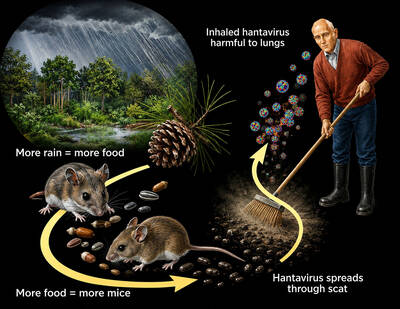
An outbreak aboard a cruise ship of a rare rodent-borne illness called hantavirus has left three passengers dead and sickened others, but global health officials say the risk to the general public remains low because the germ does not easily spread between people. “This is not the next COVID, but it is a serious infectious disease,” said Maria Van Kerkhove, director of epidemic and pandemic preparedness at the World Health Organization (WHO). “Most people will never be exposed to this.” The virus usually spreads when people inhale contaminated residue of rodent droppings. Hantaviruses have been around for centuries and are thought to

Have you ever wondered how people navigate the world when they can’t see a map? For individuals with visual impairments, conventional maps are nearly impossible to use. This is where tactile maps come in — essential tools that allow people to “see” the world through touch. A tactile map is specially designed with raised lines, textures, and symbols to represent geographical features such as roads, rivers, and buildings. Users explore it with their fingertips. However, these maps are not exclusively for people with visual disabilities. They serve as valuable multisensory learning tools that enhance spatial understanding for everyone, making

1. 他病了三天。 ˇ He has been sick for three days. χ He has been sick since three days. 註︰這裡現在完成時態 have / has been 表示從過去某一時日到現在的一段時間存在的行為或狀態,與它連用的時間副詞應為 「for +若干時」,如 for a year, for three hours 等,意思是歷時多少。 2. 他自從星期三以來都很忙。 ˇ He has been busy since Wednesday. χ He has been busy from Wednesday. 註︰「自從……以來」,該用 since。說從某一天(某一時刻)到某一天(某一時刻)才用 from,如 from Monday till Friday。 3. 房間角落裡散放著一些零星物件。 ˇ There were some odds and ends lying in the corner of the room. χ There were some odds and ends lying at the corner of the room. 註︰「在房間角落裡」該用介詞 in。例如: He stood in the corner. There is a lamp in the corner of the room. at the corner 指房子外部的拐角。例如: A little boy

A growing green movement allows hotel guests to fund tree planting projects simply by opting out of daily room cleans. This approach turns an ordinary hotel stay into a direct contribution to nature. Founded in the Netherlands, the nonprofit “Hotels for Trees” operates on the principle that one skipped cleaning equals one new tree. It has planted more than 750,000 trees since 2021. Similarly, Sarnia Hotels in Guernsey donates £2 per refused clean. Since 2024, over 3,300 services have been cancelled, raising sufficient money to plant 1,100 native trees and hedgerows. Simplicity has been central to this success.


 RSS
RSS