


Chuang-Wang Hsiu-chih, a midwife in Yuli Township, Hualien County, who delivered more than 8,000 children from the 1950s to the 1980s, kept a “delivery diary” in which she kept detailed information about all the children she helped deliver over more than 30 years. The diary, which still remains today, has become an important document for many people who want to find the correct details of their “Four Pillars of Destiny” — the eight characters, two each denoting a person’s year, month, day and hour of birth.
Chuang-Wang passed away in 2000, but her son Chuang Chi-hsiang inherited the diary and uses it to maintain the memory of his mother and her life’s work, while also helping many people to find the “secret code” of their life.
When Chuang-Wang first started out as a midwife, pregnant women didn’t go to hospitals to give birth because medical resources were scarce. Instead, they asked a midwife to come to their house. If the newborn’s parents or the midwife didn’t keep a detailed record of the date and time of birth, people would be unable to find their complete traditional birth data — the so-called Four Pillars of Destiny.
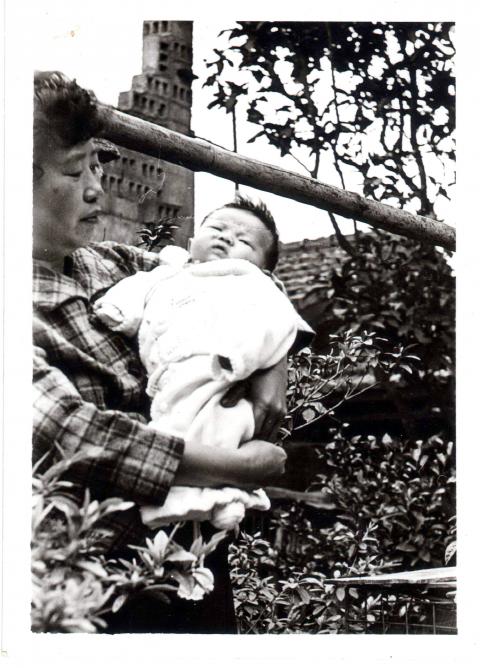
Photo courtesy of Chuang Chi-hsiang
照片:莊吉祥提供
When Chuang-Wang delivered a child, she would conscientiously write down the information about the newborn. Her first delivery was a baby girl born on March 14, 1952. By the end of her career in 1987, she had accumulated about 8,000 detailed entries in her delivery diary, recording even the hour and minute of each birth.
A Taiwanese tradition is to “match the Four Pillars of Destiny” when couples are planning to get married, but parents often forget the exact time of their children’s birth. When Chuang-Wang was still alive, people she had helped deliver often visited her to look for their birth data in her diary, and they never left disappointed. Chuang said his mother was always a very attentive person, and that allowed her to help many people to find the secret code of their life.
Chuang’s wife, Lee Yu-chin, said that not only were her mother-in-law’s nursing capabilities widely praised, she was also a warmhearted person. Lee says that Chuang-Wang once assisted a poor family, and when she noticed that they were destitute, she went home and ga-thered some of her children’s old clothes to give to them. Her generosity was often the talk of the town.
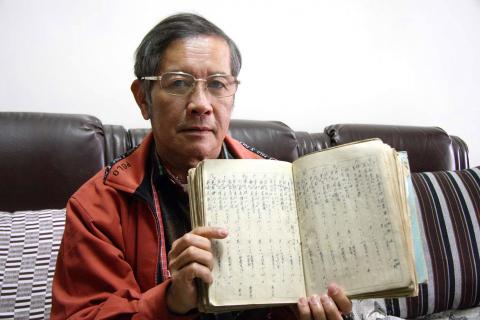
Photo: Yang Yi-chung, Liberty Times
照片:自由時報記者楊宜中
Chuang said that inheriting his mother’s delivery diary had helped him make many good friends. Regretfully, however, all his children now work in other parts of the country, and he could well be the last one in his family to inherit the diary.
Postscript: The author of this article, Yang Yi-chung, was also delivered by Chuang-Wang Hsiu-chih and his name is listed in the delivery diary.
(LIBERTY TIMES, TRANSLATED BY TAIJING WU)
在民國四零到七零年代接生超過八千名新生兒的花蓮縣玉里鎮產婆莊王琇枝,以一本「接生日記」詳細記錄了三十餘年自己所接生的新生兒資料,並妥善保存至今,成為許多想找自己詳細、正確生辰八字的寶典。
莊王琇枝已經在民國八十九年過世,但兒子莊吉祥仍繼承這本「接生日記」,以另一種形式繼承母親的接生歲月,也幫許多人尋回自己的「生命密碼」!
莊王琇枝開始當產婆的年代,因醫療資源的缺乏,一般產婦並非到醫院待產,而是請產婆到家中接生,因此,若新生兒父母沒有詳細記錄,或是產婆沒有資料,很多人就無法拼湊「完整」的生辰八字。
莊王琇枝當年接生時,總會細心的詳細記錄新生兒資料,第一筆接生紀錄是一九五二年三月十四日的一名女嬰,直到民國七十六年結束產婆生涯,接生日記累積共約有八千筆資料,連新生兒誕生的時、分都明確記載。
國人對於結婚有為新人「合八字」的習俗,但常有父母忘了子女出生的時辰,莊王琇枝仍在世時,就常有她接生過的人前來翻找接生日記,總能得到滿意的答案。莊吉祥說,母親就是這麼細心的人,也因此讓許多人找到了生命密碼。
莊吉祥的妻子李玉琴也說,婆婆除了護理技術獲肯定,還有一顆溫暖的心,她曾為一貧戶接生,見到產婦家徒四壁,除了不收費用,甚至還回家整理自己孩子的舊衣服,送去給這戶人家的孩子穿,地方上都傳頌著婆婆的義行。
莊吉祥說,傳承母親這本接生日記,他也結交了許多好朋友。遺憾的是,他的孩子們都在外地工作,這本接生日記,可能只能傳到他這代了!
後記:本篇報導的記者楊宜中也由莊王琇枝接生,名字也記載於「接生日記」中。
(自由時報記者楊宜中)
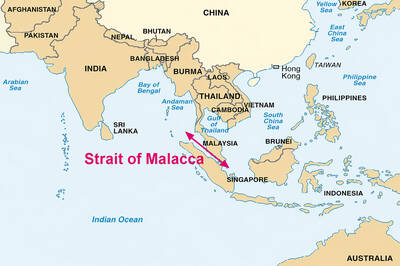
The closure of the Strait of Hormuz has forced policymakers in Asia to face questions over the security of other maritime chokepoints, including the Strait of Malacca, which is the world’s busiest waterway for international trade. WHAT IS THE MALACCA STRAIT? The 900km long Malacca Strait, bounded by Indonesia, Thailand, Malaysia and Singapore, provides the shortest sea route from East Asia to the Middle East and Europe. It carries nearly 22 percent of the world’s maritime trade, according to the Center for Strategic and International Studies (CSIS). This includes oil and gas shipments from the Middle East to the energy-hungry economies of China,

One reason pistachios have taken the food world by storm compared to other nuts is their soft, green color. When ground down into a cream or butter, the green hue __6__ nicely with golden pastries or dark-brown chocolate, making it perfect for Instagram photos and TikTok videos. Their labor-intensive cultivation and __7__ also contribute to their image as a premium ingredient. Thus, buying a pistachio-based product often feels like a __8__ treat. Pistachios also stand out for their distinct flavor and health __9__. They have a subtle, sweet, earthy flavor that goes well with both sweet desserts and

Cameras are everywhere — in our pockets, on our walls and even in space. They capture emotions, preserve history and reflect culture. Through these devices, photography is now essential to modern life, influencing how we perceive ourselves and the world. To understand the root of their power, let’s explore the camera’s remarkable journey. The story begins with the camera obscura, a dark room with a tiny hole. Light passing through the opening projected an inverted image on the opposite wall. Renaissance artists used this principle to paint accurate scenes. However, these images couldn’t be preserved as photographs. That changed

A: This year’s two most anticipated films have finally hit theaters in Taiwan. “Michael” premiered last Wednesday, while “The Devil Wears Prada 2” premiered this Wednesday ahead of its global release. B: Isn’t “Michael” the biopic about the late King of Pop Michael Jackson? A: Yup, it tells the story of Michael’s legendary life, from child star to global icon. And the role is in fact played by his nephew, Jaafar Jackson. B: Michael caused a sensation when touring Taiwan twice in 1993 and 1996. His classic hits, dance moves and music videos reshaped global pop culture at that time. A: I’m gonna


 RSS
RSS