


The Taiwan Fund for Children and Families (TFCF) recently published statistics showing that children between 11 and 15 received a total of almost NT$10 billion in gift money over the Lunar New Year.
This survey used questionnaires that were completed by 1,367 students from elementary and junior high schools.
Up to 94 percent of children receive red envelopes, in which parents put gift money, at Lunar New Year. On ave-rage, each child receives NT$6,274. The Ministry of Education’s statistics for 2009 state that there are 1.54 million students between 11 and 15 years old in Taiwan, so the total amount of gift money they received should be almost NT$10 billion!
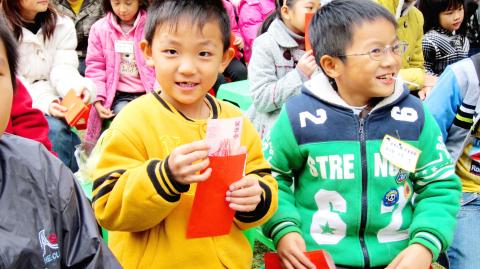
Photo: Su Fu-nan, LIBERTY TIMES 照片:自由時報記者蘇福男
About 80 percent of these children choose to save it. Hsiao Ru, a girl attending first year at junior high school, said, “I will save a part of my gift money, and spend the other part on books, game software, or anything else I fancy.” Hsiao Chi, a girl in her sixth year in elementary school, said, “I give all my gift money to my mother. She will save it toward my future school fees. Part of it, combined with another part from my younger sister, is used to sponsor a little girl in another country.”
The TFCF said that parents should teach children the right way to use money, and how to differentiate between the goods they need and those they want. By spending their money on what they need and saving the remainder, they could learn to share what they have and understand the concept of donation. Encouraging children to donate to others of the same age who are in difficulty will teach them to use their money in better ways.
The TFCF suggests that parents should not ask their children to save all their gift money. Instead, they should train them to think about how to manage their money while they use it, and make an appropriate plan for the money they receive, the fund said.
(LIBERTY TIMES, TRANSLATED BY TAIJING WU)
家扶基金會近日針對台灣一千三百六十七位國中及國小學童進行「壓歲錢與零用錢」問卷調查發現,全台灣十一至十五歲的孩子過年領到的壓歲錢總共將近一百億!
高達九成四的孩子在過年時可以領到壓歲錢,平均每個孩子可領到新台幣六千兩百七十四元,若以教育部二零零九年公布的一百五十四萬人計算,十一至十五歲學童的過年壓歲錢總和近新台幣一百億元!壓歲錢的用途,以儲蓄佔八成居多。
就讀國一的小如說:「我的壓歲錢一部分會存起來,一部分會拿來買書、遊戲軟體或自己想要的東西。」讀小六的小琪則說:「我的壓歲錢都會交給媽媽,媽媽會幫我把大部分的壓歲錢存起來當以後的學費,有一部分則是和妹妹一起拿來捐助認養國外的小女孩。」
家扶基金會呼籲,家長應教導孩子學習正確的金錢使用觀念,分辨究竟是「需要」或「想要」。在儲蓄及必要花費之外,也可以適時地將「捐款分享」的觀念帶進生活學習中,藉由誘導孩子幫助同齡的貧困弱勢孩子,讓孩子對金錢的運用及價值有更好的認識。
家扶基金會建議,家長不應一味地要求孩子把所有零用錢或壓歲錢存起來,而是應訓練孩子在使用金錢的過程中花點思考力,將所獲得的金錢做妥善的規劃安排。
(自由時報記者湯佳玲)

The debate surrounding Taipower’s recent corporate identity reboot has gone well beyond the design community. The controversy began after Taipower replaced the familiar “Taiwan Power Company” wording — widely regarded as the calligraphy of Yu You-ren (1879-1964), former Control Yuan president and master calligrapher — with a modern logotype by designer Aaron Nieh’s team, Aaron Nieh Workshop. Taipower said the change was not a wholesale replacement of old signage, but an “optimization of its identity system,” aimed at meeting the needs of digital media, electronic bills, apps, social media graphics and various small-format applications. Existing physical markings, such as building

Since 2005, the third Monday in January has come to be known as “Blue Monday.” In other words, that day is believed to be the most depressing day of the year. This concept seems logical at first. After all, Monday marks the start of the school or workweek after two days of rest and fun. Also, blue is a color that is often associated with sadness. Furthermore, in many parts of the world, January is a time when the weather is cold, rainy, and gloomy. But is there any scientific proof that this January day is truly sadder than any of

Continued from yesterday(延續自昨日) https://www.taipeitimes.com/News/lang For the most part, the idea of “Blue Monday” has been rejected as a myth. Some mental health experts also say there is a danger in labeling a certain day as the most depressing time of the entire year. Some argue that if people expect to feel sadder on the third Monday in January, this belief alone may increase their anxiety. One group that is worried about the negative effect of believing in Blue Monday is Samaritans. A mental health charity based in the UK, Samaritans is working to turn Blue Monday into “Brew Monday.” In this
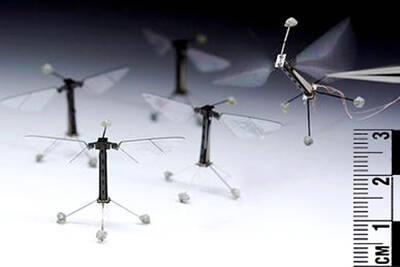
As bee populations around the world continue to decline at an alarming rate, scientists are developing an innovative solution: robotic bees. Recent advances at research institutions like Massachusetts Institute of Technology (MIT) in the US have produced tiny flying robots capable of performing pollination tasks similar to those of real bees. These tiny machines represent an impressive technological achievement. MIT’s latest models can hover in the air for over 1,000 seconds and perform complex movements, demonstrating the agility needed for successful pollination. The robots are designed to mimic the flight patterns of natural bees, offering potential support to agriculture


 RSS
RSS