

A Portuguese woman believed to be Europe’s oldest person and the second-oldest in the world celebrated her 115th birthday this month with her family, local media reported.
Maria de Jesus marked the occasion in her village of Corujo in central Portugal. Born Sept. 10, 1893, Maria de Jesus is classified as the oldest person in Europe and second oldest in the world after American Edna Parker, born April 20, 1893.
The US-based Gerontology Research Group tracks “supercentenarians,” or people over the age of 110, worldwide whose birth dates can be verified. De Jesus celebrated her birthday by eating her favorite Portuguese dessert, rice cake, local media said.
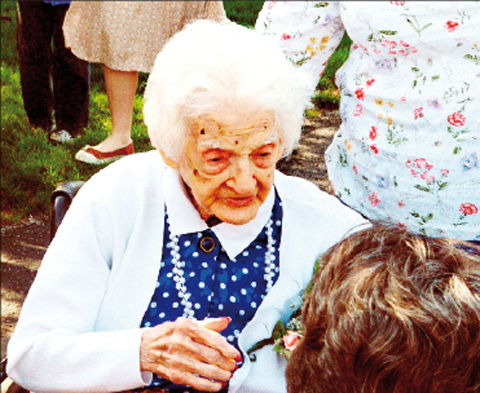
PHOTO: EPA
Born into a poor family, de Jesus lost the use of one of her eyes when she was a child and began working in the fields at the age of 12. She raised six children and was a widower at 57. De Jesus never attended school, said her 84-year-old daughter, Maria Madalena, according to Diario de Noticias.
For her 100th birthday, de Jesus said she wanted to learn to read and write. “A teacher came for a few months, but she never made it. You can’t teach an old dog new tricks,” said her daughter.
(AFP)
葡萄牙媒體報導,當地一位女士據信是全歐洲最高齡,也是全世界第二長壽的人瑞。這個月,她和她的家人一起慶祝她一百一十五歲的生日。
居住在葡萄牙中部高魯祖村的瑪莉亞.狄海蘇在當地慶祝生日。出生於一八九三年九月十日的瑪莉亞.狄海蘇被認定是歐洲最高齡,也是全球僅次於美國人愛德娜.帕克(出生於一八九三年四月二十日)的第二長壽人瑞。
美國老人醫學研究小組會追蹤世界各地出生日期可經驗證的「超百歲人瑞」─年齡超過一百一十歲者。葡萄牙媒體報導,狄海蘇以享用最愛的葡萄牙點心─米糕的方式慶生。
葡萄牙《新聞日報》報導,出生在貧寒家庭的狄海蘇,幼年就一眼失明,十二歲開始在田裡工作。她育有六名子女,五十七歲時成了寡婦。她八十四歲的女兒瑪利亞.瑪達利那說,狄海蘇從未上過學。
狄海蘇百歲生日時,她說她想學習閱讀和寫字。她女兒說:「老師來了幾個月,但她就是學不來,沒辦法,老狗學不會新把戲。」(法新社�翻譯:袁星塵)

A: In addition to the TOEIC Listening and Reading Test, some institutions also require staff to take the computer-based TOEIC Speaking and Writing Tests. B: I didn’t know that there are oral and written tests. What does the oral exam cover? A: The categories include: Read a text aloud, Describe a picture, Respond to questions, Respond to questions using information provided, and Express an opinion. The test takes about 20 minutes. B: And what about the writing exam? A: The categories include: Write a sentence based on a picture, Respond to a written request, and Write an opinion. The test lasts
1. 不該把一個生病的孩子獨自留在家裡。 ˇ It’s not advisable to leave a sick child all alone at home. χ It’s not advisable to leave an ill child all alone at home. 註︰ill 和 sick 都可用作補語形容詞,例如: 〔英語〕I have been ill/unwell for two weeks. 〔美語〕I have been sick for two weeks. 但作為修飾形容詞置於名詞之前時,英美都用 sick,不用 ill,如 a sick man /woman, a sick child 等。 2. 昨天整天都在下大雨。 ˇ Heavy rain fell all day long yesterday. ˇ There was heavy rain all day long yesterday. χ A great rain fell all day long yesterday. 註︰中文裡的「大」,不一定對應英語中的 big 或 great,試對照下列中英文: 大風:a strong / heavy wind、大雪:a heavy snow 3. 許多夜晚他餓著肚子去睡覺。 ˇ Many nights, he went to bed with an empty stomach. χ Many nights, he went to

★ Bilingual Story is a fictionalized account. 雙語故事部分內容純屬虛構。 Two red flares rose from the black sea. The men stopped eating beside their stranded tank and stared toward the water. The platoon leader shouted for everyone to get into position. Hsiung Chen-chiu climbed into Tank No. 66 and looked through the sight. Wooden boats crowded the darkness. Soldiers jumped into the water, holding rifles above their heads, and moved toward the beach. Hsiung was 18 years old. A few hours earlier, the biggest problem he had ever faced was a tank stuck in the sand. Tank No. 66 should have

Toxic chemicals from discarded electronic devices may be threatening endangered dolphins and porpoises in the South China Sea, according to a recent scientific study. Liquid crystal monomers (LCMs), chemicals widely used in smartphones, televisions and computer screens, were detected in several marine mammals. Scientists warned that these substances could pose risks to humans as well through contaminated seafood and water sources. The findings have raised concerns about the growing environmental harm caused by electronic waste worldwide. The chemicals were found in different parts of the animals’ bodies, including blubber, the liver, the kidneys, muscles and even brain tissue. After


 RSS
RSS