


As US troops rolled toward the Iraq border this week, they were given orders on two matters of decorum: no throwing of candy to Iraqi children and no displaying of flags -- regimental, state or even the American flag.
Military officials say that candy giveaways would draw swarms of children to the convoys, a dangerous proposition with thousands of trucks, Humvees and trailers barreling toward Baghdad.
As for the ban on flags, its effect was apparent in this camp on Wednesday, where no more than a handful of vehicles mustering for the invasion displayed any.
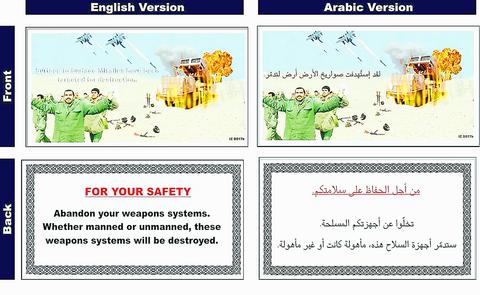
PHOTO: AFP
Officials say the flag could give the citizens of Iraq the wrong idea about the convoys of artillery, ammunition and soldiers. They are not, these officials say, an army of conquest, intent on claiming Iraqi land or treasure for the US, but a liberation force. They are concerned that streams of American flags would be seen as provocative.
"It's imposing enough that we're coming into another society," said Captain Frank Stanco, a commander with an artillery unit in the 101st Airborne Division. "I tell our soldiers we want to maintain our professionalism. We could be making history. I call it being quiet professionals."
In 1991, at the end of the Persian Gulf war, American military convoys entered Kuwait festooned with the stars and stripes after a quick rout of the Iraqi army occupying the country. Soldiers recall being greeted rapturously by the Kuwaitis.
On Wednesday afternoon, thousands of soldiers sat in long convoys, fully packed and waiting for orders to begin an invasion that would carry many of them 400 miles north to Baghdad. Only a handful of the vehicles flew American flags.
One of those was a "water buffalo" -- a truck towing potable water -- but the sergeant in charge of it shook his head and walked away when asked about the flag, which flew from a pole strapped to the side of the truck.
Another soldier waiting for the convoy to move, Specialist John Garcia, said he was ordered to take the flag off his Humvee for security reasons.
"They said it was because we would be an easy target," Garcia said. "It got me real upset. I had just bought that flag."
The no-flags order was passed along to the 101st Airborne by its commander, Major General David Petraeus, who said that the decision had been made by people higher up the command chain.
"It's the right thing to do," said Petraeus, a way of underscoring the American commitment to regime change for security and human rights, and not to the seizing of the country.
Spokesmen for the US Central Command in Qatar said on Wednesday that they were unable to provide information about the order.
The question of flag-flying provoked a small debate among artillerymen waiting to leave camp on Wednesday.
Garcia said he was angry that he had been ordered to take down his flag, and that so few countries were supporting the US and Britain in the military campaign.
"When they're in trouble, they don't call Russia, China, France, Turkey," said Garcia. "They call 911, the United States. That's why I put my flag on my Humvee."
Another soldier, Specialist Robert Bratton, said: "You can't blame them. You got a lot of Americans back in the states against it."
Sergeant Elmer Smith, said the US was seen as interfering in the affairs of too many countries.
Bratton said: "What's the reason we're fighting?"
Garcia answered, "I think Saddam Hussein got them weapons."
Bratton shook his head.
"I think it's oil," he said.
Smith offered his theory. "I think it's revenge for his father," he said.
To Stanco, who did not take part in the debate over the war's purpose, the flag issue reflected the complexity of the American task in Iraq. "We want to send the right statements," he said.

NO-LIMITS PARTNERSHIP: ‘The bottom line’ is that if the US were to have a conflict with China or Russia it would likely open up a second front with the other, a US senator said Beijing and Moscow could cooperate in a conflict over Taiwan, the top US intelligence chief told the US Senate this week. “We see China and Russia, for the first time, exercising together in relation to Taiwan and recognizing that this is a place where China definitely wants Russia to be working with them, and we see no reason why they wouldn’t,” US Director of National Intelligence Avril Haines told a US Senate Committee on Armed Services hearing on Thursday. US Senator Mike Rounds asked Haines about such a potential scenario. He also asked US Defense Intelligence Agency Director Lieutenant General Jeffrey Kruse

INSPIRING: Taiwan has been a model in the Asia-Pacific region with its democratic transition, free and fair elections and open society, the vice president-elect said Taiwan can play a leadership role in the Asia-Pacific region, vice president-elect Hsiao Bi-khim (蕭美琴) told a forum in Taipei yesterday, highlighting the nation’s resilience in the face of geopolitical challenges. “Not only can Taiwan help, but Taiwan can lead ... not only can Taiwan play a leadership role, but Taiwan’s leadership is important to the world,” Hsiao told the annual forum hosted by the Center for Asia-Pacific Resilience and Innovation think tank. Hsiao thanked Taiwan’s international friends for their long-term support, citing the example of US President Joe Biden last month signing into law a bill to provide aid to Taiwan,
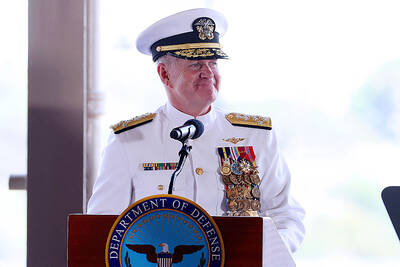
China’s intrusive and territorial claims in the Indo-Pacific region are “illegal, coercive, aggressive and deceptive,” new US Indo-Pacific Commander Admiral Samuel Paparo said on Friday, adding that he would continue working with allies and partners to keep the area free and open. Paparo made the remarks at a change-of-command ceremony at Joint Base Pearl Harbor-Hickam in Hawaii, where he took over the command from Admiral John Aquilino. “Our world faces a complex problem set in the troubling actions of the People’s Republic of China [PRC] and its rapid buildup of forces. We must be ready to answer the PRC’s increasingly intrusive and
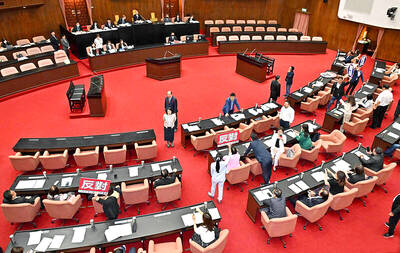
STATE OF THE NATION: The legislature should invite the president to deliver an address every year, the TPP said, adding that Lai should also have to answer legislators’ questions The Chinese Nationalist Party (KMT) yesterday proposed inviting president-elect William Lai (賴清德) to make a historic first state of the nation address at the legislature following his inauguration on May 20. Lai is expected to face many domestic and international challenges, and should clarify his intended policies with the public’s representatives, KMT caucus secretary-general Hung Meng-kai (洪孟楷) said when making the proposal at a meeting of the legislature’s Procedure Committee. The committee voted to add the item to the agenda for Friday, along with another similar proposal put forward by the Taiwan People’s Party (TPP). The invitation is in line with Article 15-2


 RSS
RSS