


Five China-developed artificial intelligence (AI) language models exhibit cybersecurity risks and content biases, an inspection conducted by the National Security Bureau (NSB) showed.
The five AI tools are: DeepSeek, Doubao (豆包), Yiyan (文心一言), Tongyi (通義千問) and Yuanbao (騰訊元寶), the bureau said, advising people to remain vigilant to protect personal data privacy and corporate business secrets.
The NSB said it, in accordance with the National Intelligence Services Act (國家情報工作法), has reviewed international cybersecurity reports and intelligence, and coordinated with the Ministry of Justice Investigation Bureau and the National Police Agency’s Criminal Investigation Bureau to conduct an inspection of China-made AI language models.
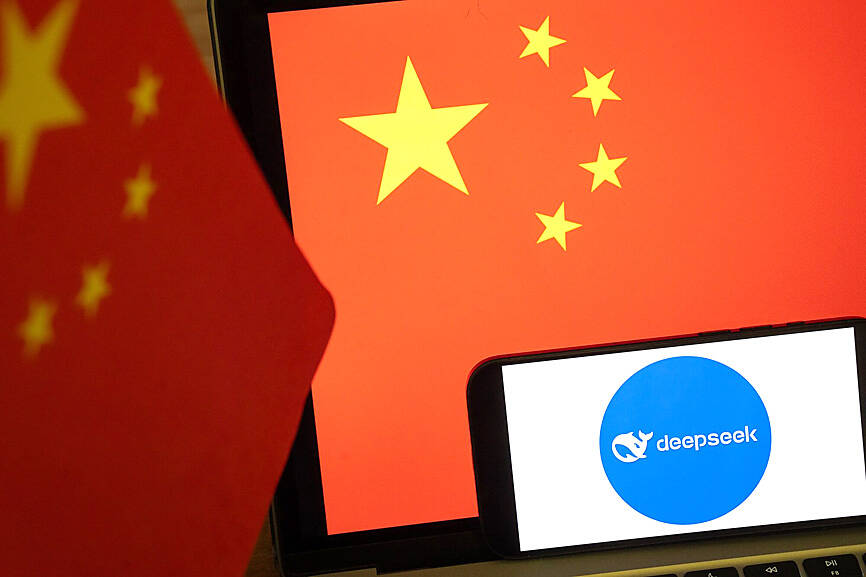
Photo: Bloomberg
The inspection consisted of two main parts: application security and generative content, it said.
For application security, the inspection team adopted the Basic Information Security Testing Standard for Mobile Applications v4.0 announced by the Ministry of Digital Affairs and evaluated the apps based on 15 indicators under five categories of security violations.
The five categories are: personal data collection, excessive permission usage, data transmission and sharing, system information extraction and biometric data access.
The inspection results showed that Tongyi violates 11 out of the 15 indicators, with Doubao and Yuanbao violating 10, Yiyan nine and DeepSeek eight.
Common security violations among the five China-made apps include requesting access to location data, collecting screenshots, forcing users to accept unreasonable privacy terms and harvesting device parameters.
For generative content, the inspection was conducted based on 10 indicators released by the Artificial Intelligence Evaluation Center.
The inspection results indicated that some content generated by the five AI language models is strongly biased and contains disinformation.
The models tend to adopt a pro-China political stance, have a cognitive bias in history, avoid the use of specific keywords that are considered sensitive, demonstrate risks of information manipulation and are able to launch remote code execution, the results showed.
First, when addressing topics concerning cross-strait relations, the South China Sea and international disputes, the generated content tends to adopt China’s official stance, such as “Taiwan is currently governed by the Chinese central government,” “there is no so-called head of state in the Taiwan area,” and “highlighting socialism with Chinese characteristics.”
Second, for narratives concerning Taiwan’s history, culture and politics, the five language models tend to generate disinformation with an aim to exert influence on users’ understanding of Taiwan’s background information, such as “Taiwan is not a country,” “Taiwan is an inalienable part of China,” and calling Taiwan “a province of China.”
Third, the generated content deliberately avoids the use of specific keywords, such as “democracy,” “freedom” and “human rights,” and mentioning the Tiananmen Square Massacre.
The results indicated that the data systems of those language models are subject to political censorship and control by the Chinese government.
Fourth, the models can easily generate highly inflammatory content, or defame people and spread rumors, with the risk of being exploited to disseminate illegal information.
Fifth, the models could launch remote code execution and exploitation under certain circumstances, increasing cybersecurity risks.
A wide range of countries, such as the US, Germany, Italy and the Netherlands, have already publicly issued warnings against or bans on some China-developed AI language models, and have even requested the removal of them from app stores, the NSB said.
The primary concern is that China-developed AI language models can identify users, collect conversation data and records, and transfer personal data back to China-based enterprise servers, it said.
China-based enterprises are obligated to turn over user data to Chinese authorities, as required by Beijing’s national intelligence and cybersecurity laws, it said.
The inspection results confirmed that widespread cybersecurity vulnerabilities and information distortion exist, it said, urging members of the public to avoid downloading Chinese-made apps.
The NSB said it would continue to improve information sharing with international friends and allies to stay abreast of transnational cybersecurity risks, and ensure Taiwan’s national security and digital resilience.
The use of DeepSeek has been banned from government devices and official premises since February over national security concerns.
However, there is no public sector ban on the other four Chinese apps, nor a ban on the private use of DeepSeek in Taiwan.
Additional reporting by CNA

The Tourism Administration yesterday announced that it would reward repeat international visitors with incentives of up to NT$8,000 to boost inbound tourism. The incentives are available to all international tourists, it said, adding that repeat visitors would be rewarded with NT$5,000 and would receive an additional NT$3,000 if they bring travel companions. The nation received 2,990,657 inbound visitors during the first quarter, marking a 3.8 percent increase from the same period last year, agency data showed. Japanese nationals are among groups visiting Taiwan the most. About 1.48 million Japanese tourists arrived last year, a year-on-year increase of more than 12

66 FIGHTER JETS: The aircraft is likely undergoing preparations for its transfer to Taiwan — a significant step forward in the nation’s modernization program, a lawmaker said The first of Taiwan’s order of F-16V Block 70 aircraft has been sighted in Texas ahead of delivery, Democratic Progressive Party (DPP) Legislator Wang Ting-yu (王定宇) said. Taiwan’s first F-16V Block 70 two-seat aircraft, tail number 6831, was seen flying from Lockheed Martin’s production facility in Greenville, South Carolina, to Naval Air Station Joint Reserve Base Fort Worth in Texas, Wang wrote on Facebook yesterday. The plane is likely undergoing preparations for its transfer to Taiwan, marking a significant step forward in the Republic of China Air Force’s modernization program, Wang said, citing military analysts. The F-16V Block 70 is a new-build version

‘BRAZEN’: The holiday did not stop China from activities that infringe on Taiwan’s maritime jurisdiction, but the CGA is ready to defend the nation, Kuan Bi-ling said Beijing is intensifying maritime pressure on Taiwan, but the nation will never yield, Ocean Affairs Council Deputy Minister Sung Chen-en (宋承恩) said. The Coast Guard Administration (CGA) has adopted a “shadowing and monitoring” approach to avoid falling into a Chinese trap to escalate tensions and deepen the conflict, Sung said in an interview published yesterday in the Chinese-language Liberty Times (the Taipei Times’ sister newspaper). China Coast Guard formations patrolling waters east of Taiwan, as well as official Chinese vessels entering areas around Itu Aba Island (Taiping Island, 太平島) and Pratas Islands (Dongsha Islands, 東沙群島) show Beijing’s attempts to significantly step up

Taiwanese aviator Roger Lin (林睿哲) returned to Taiwan on Saturday after completing a nine-day round-the-world journey in a single-engine aircraft, becoming the first Taiwanese pilot to achieve the feat. Lin departed on June 5 from Los Angeles, California, and continued through Alaska, Japan, Taiwan, the Philippines, Indonesia, Malaysia, Thailand, Nepal, Jordan, Norway, Iceland and Canada before landing at the Taipei International Airport (Songshan) via Los Angeles and Japan. Lin shared numerous photos and videos of his journey on a Facebook page titled “Pilot Roger’s Around the World Flight,” including a video showing his aircraft flying over the Danjiang Bridge and


 RSS
RSS