

US President Donald Trump should get the Nobel Peace Prize should he be able to convince Chinese President Xi Jinping (習近平) to abandon the use of force against Taiwan, President William Lai (賴清德) told a conservative US radio show and podcast in an interview.
The US is Taiwan’s most important international backer, despite the absence of formal ties, but since Trump took office earlier this year he has not announced any new arms sales to the nation.
Trump could meet Xi at the APEC summit in South Korea on Oct. 31 and Nov. 1.
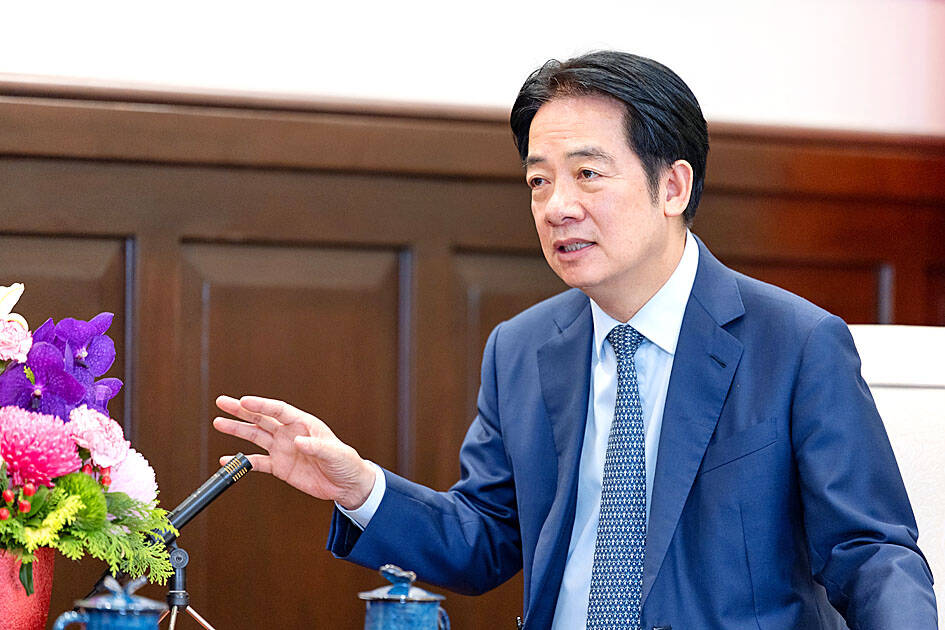
Photo: Screen grab from the Presidential Office’s Flickr page
Lai, speaking on The Clay Travis and Buck Sexton Show, which is carried on more than 400 talk radio stations, referred to comments Trump made in August, in which he said Xi told him China would not invade Taiwan while he was US president.
“We hope to continue receiving President Trump’s support. Should President Trump persuade Xi Jinping to permanently abandon any military aggression against Taiwan, President Trump would undoubtedly be a Nobel Peace Prize laureate,” Lai said.
Trump has said he deserves the accolade given to four of his White House predecessors. This year’s prize is to be announced in Norway on Friday.
Asked what he would tell the US president if he were to meet him, Lai said he would advise Trump to pay attention to Xi’s actions.
“I would advise him to pay particular attention to the fact that Xi Jinping is not only conducting increasingly large-scale military exercises in the Taiwan Strait, but is also expanding military forces in the East China Sea and South China Sea,” Lai said, according to a transcript of his remarks released by the Presidential Office yesterday.
China’s increasing military activities further and further from its own shores are not only a challenge for Taiwan, Lai added.
“The challenge extends beyond merely annexing Taiwan. Once Taiwan is annexed, China will gain greater strength to compete with the United States on the international stage, undermining the rules-based international order,” he said.
“Ultimately, this will also impact US homeland interests. Therefore, I hope President Trump will continue to uphold peace and stability in the Indo-Pacific,” he said.
Taiwan, along with major Western allies, has worked to address Washington’s concerns that it is not spending enough on its own defense — Lai has set a target of defense spending to reach 5 percent of GDP by 2030.
“I will tell them that Taiwan is absolutely determined to safeguard its national security,” Lai told the show, when asked about how he would show the US Taipei’s resolve to defend itself.
Lai also clarified a number of points to a US audience.
First, the Republic of China and the People’s Republic of China (PRC) are “not subordinate to each other. Taiwan is not a part of the PRC. China does not have the right to invade Taiwan,” he said.
Second, “China has been holding military exercises in the Taiwan Strait, undermining peace and stability in the region. So it is China, not Taiwan, that is disrupting the cross-strait status quo,” he said.
“The fact that the Taiwanese people seek to protect their sovereignty, and pursue a way of life based on democracy, freedom and human rights should not be seen as a provocation against China,” he said.
In addition, despite increasing threats from China, “Taiwan has not given up on seeking peace and mutual prosperity across the Strait. We understand that peace is priceless and that there are no winners in war,” as it is essential to global security and prosperity, he said.
“Our pursuit of peace is an ideal, not a fantasy,” he added, referencing his “Four Pillars of Peace and Action Plan” to strengthen national defense, build economic security, strengthen democratic partnerships, and engage in stable and principled cross-strait leadership.
On the topic of semiconductors, Lai said that despite Taiwan’s achievements in the global semiconductor industry, particularly in manufacturing, the US is the “leader in this ecosystem.”
Taiwan is willing to help the US “industrialize and become a global AI [artificial intelligence] hub,” and “make America great again,” he said.
Additional reporting by Hollie Younger
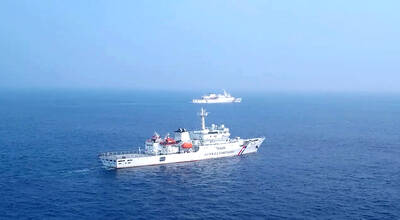
PATROL PARTNERS: The ‘Chiayi’ and the ‘Penghu’ departed for a two-day joint patrol of Palau’s exclusive economic zone, the CGA’s second diplomatic visit to the country The Coast Guard Administration (CGA) set a record for its southernmost deployment of a coast guard vessel as the vessels Chiayi and the Penghu reached Palau’s Pulo Anna Island on Saturday in a cooperative exercise between the two countries. The island, about 217 nautical miles (401km) southwest of Koror in the Palauan state of Sonsorol and 1,220 nautical miles from Taiwan’s southernmost point, Oluanpi (鵝鑾鼻), is the furthest south a CGA vessel has sailed. The two vessels are in Palau for the coast guard’s second diplomatic visit to the country. They docked at Malakal Harbor on Tuesday last week. The coast guard
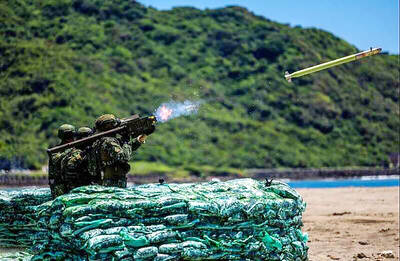
BATCH 1: The military has plans to assign the weapons to the army to defend Taiwan proper, as well as outlying islands and the navy for the Marine Corps, the official said Taiwan is to receive 500 Stinger missiles and 178 launchers from the US by the end of the year, the first batch under a planned two-stage acquisition totaling 2,621 missiles and 763 launchers, a defense official said yesterday on condition of anonymity. The portable missiles would play a vital role in the nation’s air defense capabilities, the source said. The army plans to deploy 2,235 missiles and 657 launchers to defend Taiwan proper and outlying islands, they said, citing military documents. The navy is allotted 295 missiles and 85 launchers to arm the Marine Corps and some surface vessels that lack air defense
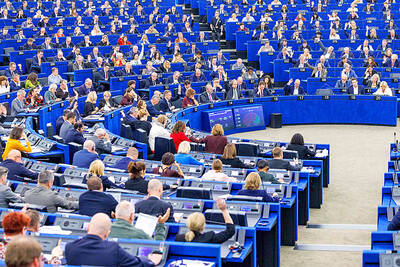
The European Parliament on Wednesday adopted a recommendation on EU-China political relations that rejected China’s efforts to restrict Taiwan’s participation in international organizations and exchanges. The recommendation, addressed to the European Council, the European Commission and EU High Representative for Foreign Affairs and Security Policy Kaja Kallas, includes several references to EU-Taiwan relations and expresses support for closer ties, saying they would bring positive benefits and have strategic importance. Describing Taiwan as a valuable partner in trade and technology, the European Parliament said it “rejects China’s attempts to coerce international organizations, third countries and other actors into restricting Taiwan’s international participation and
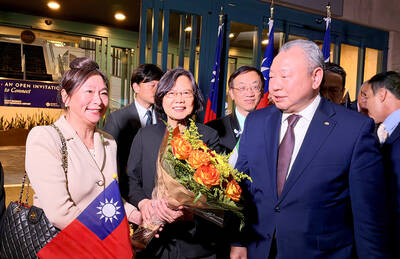
Former president Tsai Ing-wen (蔡英文) on Monday arrived in San Francisco, receiving a warm welcome from hundreds of overseas Taiwanese as she launched a week-long visit. Accompanied by Representative to the US Alexander Yui (俞大?), and head of Taiwan’s San Francisco office Wu Chih-hsiang (伍志翔), Tsai arrived at her hotel, waving, smiling and giving high-fives to Taiwanese compatriots amid cheers of “Taiwan’s democracy involves you and me” to welcome her to the San Francisco Bay Area. It is Tsai’s first visit to the US since she left office in May 2024 after serving two four-year terms as president. Tsai is today to deliver


 RSS
RSS