


Taiwan must be prepared to defend itself, Minister of Foreign Affairs Joseph Wu (吳釗燮) said yesterday after documents reportedly showed that Chinese President Xi Jinping (習近平) had considered invading the nation in the fall.
In a post on Facebook dated Thursday last week, exiled Russian dissident Vladimir Osechkin, who founded the France-based human rights group Gulagu Net, referenced the documents, which are purportedly leaked Russian intelligence.
“Xi Jinping was at least considering taking over Taiwan in the fall — he needs his own little victory to get re-elected for a third term — there the struggle within the elite is colossal,” Osechkin wrote, citing the documents.
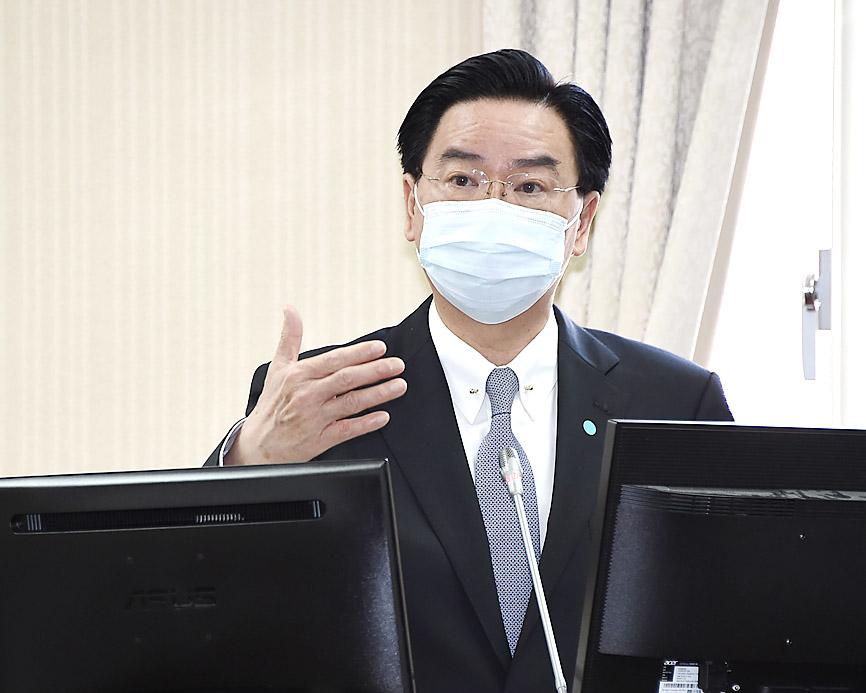
Photo: Tu Chien-jung, Taipei Times
“Now, after the Ukrainian events, this window of opportunity has been closed to him, which gives the United States the opportunity to both blackmail Xi and negotiate with its competitors on favorable terms,” he wrote, quoting what the documents showed was an analyst writing for the Russian Federal Security Service.
Wu told reporters: “I cannot ascertain [the documents’] veracity, but we must be prepared to defend ourselves regardless of if or when China intends to attack.”
Separately, Ministry of National Defense spokesman Major General Shih Shun-wen (史順文) declined to comment on the matter, saying only that the military continues to monitor Chinese actions closely and is preparing as necessary to defend national security.
At a meeting of the legislature’s Foreign Affairs and National Defense Committee yesterday, Chinese Nationalist Party (KMT) Legislator Johnny Chiang (江啟臣) asked Wu whether the government has made plans to defend Taiwan without direct US military support, as a recent poll suggested that many Taiwanese are skeptical about Washington’s commitment.
A poll conducted by the Taiwan Center for International Strategic Studies on Tuesday showed that 47 percent of respondents do not believe that the US is sincere in its promises to assist Taiwan with its defense.
Wu said that the government’s consistent policy is for Taiwan to defend itself and that it is poised to announce new arms deals with the US.
Washington believes that giving Taiwan weapons is necessary for self-defense as a part of its legal obligations under its Taiwan Relations Act, he said.
Moreover, it has engaged Taiwan in discussions on security arrangements and is deploying forces to exclude threats from the Indo-Pacific region, he added.
Later yesterday, Shih said that the defense ministry would brief the public after the US Defense Security Cooperation Agency officially notifies the US Congress of any new arms sales to Taiwan.
In related news, President Tsai Ing-wen (蔡英文) in her capacity as Democratic Progressive Party chairperson told the party’s Central Standing Committee that her administration would press on with the development of dual-use technologies to bolster the armed forces and Taiwan’s defense industry.
The government is committed to developing and improving the nation’s capability to efficiently mobilize civilian resources during war, including taking stock of the country’s food, fuel and industrial capabilities, Tsai said.
Additional reporting by Aaron Tu
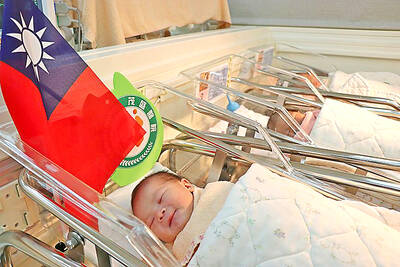
AGING: As of last month, people aged 65 or older accounted for 20.06 percent of the total population and the number of couples who got married fell by 18,685 from 2024 Taiwan has surpassed South Korea as the country least willing to have children, with an annual crude birthrate of 4.62 per 1,000 people, Ministry of the Interior data showed yesterday. The nation was previously ranked the second-lowest country in terms of total fertility rate, or the average number of children a woman has in her lifetime. However, South Korea’s fertility rate began to recover from 2023, with total fertility rate rising from 0.72 and estimated to reach 0.82 to 0.85 by last year, and the crude birthrate projected at 6.7 per 1,000 people. Japan’s crude birthrate was projected to fall below six,
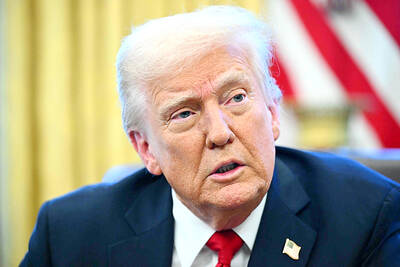
US President Donald Trump in an interview with the New York Times published on Thursday said that “it’s up to” Chinese President Xi Jinping (習近平) what China does on Taiwan, but that he would be “very unhappy” with a change in the “status quo.” “He [Xi] considers it to be a part of China, and that’s up to him what he’s going to be doing, but I’ve expressed to him that I would be very unhappy if he did that, and I don’t think he’ll do that. I hope he doesn’t do that,” Trump said. Trump made the comments in the context
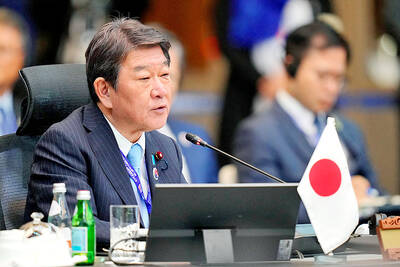
SELF-DEFENSE: Tokyo has accelerated its spending goal and its defense minister said the nation needs to discuss whether it should develop nuclear-powered submarines China is ramping up objections to what it sees as Japan’s desire to acquire nuclear weapons, despite Tokyo’s longstanding renunciation of such arms, deepening another fissure in the two neighbors’ increasingly tense ties. In what appears to be a concerted effort, China’s foreign and defense ministries issued statements on Thursday condemning alleged remilitarism efforts by Tokyo. The remarks came as two of the country’s top think tanks jointly issued a 29-page report framing actions by “right-wing forces” in Japan as posing a “serious threat” to world peace. While that report did not define “right-wing forces,” the Chinese Ministry of Foreign Affairs was
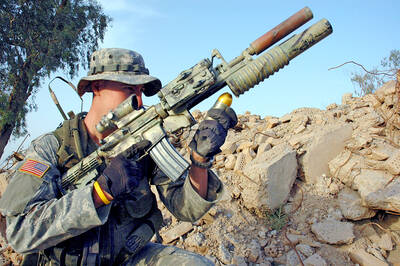
PREPAREDNESS: Given the difficulty of importing ammunition during wartime, the Ministry of National Defense said it would prioritize ‘coproduction’ partnerships A newly formed unit of the Marine Corps tasked with land-based security operations has recently replaced its aging, domestically produced rifles with more advanced, US-made M4A1 rifles, a source said yesterday. The unnamed source familiar with the matter said the First Security Battalion of the Marine Corps’ Air Defense and Base Guard Group has replaced its older T65K2 rifles, which have been in service since the late 1980s, with the newly received M4A1s. The source did not say exactly when the upgrade took place or how many M4A1s were issued to the battalion. The confirmation came after Chinese-language media reported


 RSS
RSS