


The identification of a bacterium related to the retroconversion of sex steroids might lead to treatments for hormonal problems such as baldness and menopause, a team of researchers said yesterday.
Steroids turn androgens into sex hormones such as estrogens, a process that was once thought to be irreversible, but apparently can be turned back by specific anaerobes, Academia Sinica Biodiversity Research Center deputy director Chiang Yin-ru (江殷儒) told a news conference in Taipei.
The team has found an anaerobic bacterial strain — Denitratisoma sp. strain DHT3 — that can reverse the process, turning estrogen back into androgen via a process mediated by vitamin B12, or cobalamin, he said, adding that the strain was found in silt at a sewage treatment plant in Taipei.
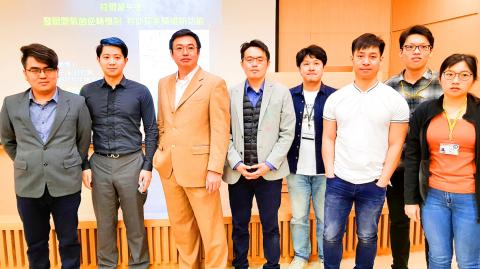
Photo: Chien Hui-ju, Taipei Times
Through genome sequencing and protein experiments, the team found that the retroconversion of estrogen into androgen is related to bacteria containing a specific enzyme (methyltransferase) with a gene named emtA, whose operation and expression involve vitamin B12 and estrogen, he said.
As emtA also exists in the anaerobic environment of the human gut, the retroconversion of estrogen might also happen in humans, he added.
Studies have suggested — without knowing the bacterial players or mechanism involved — that gut microbiota could affect a host’s sex steroid profile, he said, adding that the team’s study sheds new light on the subject.
Specific hormones regulate the development and maintenance of male and female characteristics, and the team’s research signals potential new treatments for menopause, baldness and prostate cancers through probiotics, Chiang said.
The team is attempting to isolate and characterize the hormone-
transforming anaerobes to develop such probiotics, Chiang said, adding that he is collaborating with Chang Gung Memorial Hospital on experiments.
The team’s study, “Retroconversion of estrogens into androgens by bacteria via a cobalamin-mediated methylation,” was published in the journal Proceedings of the National Academy of Sciences on Jan. 21.
The lead author, Wang Po-hsiang (王柏翔), worked with Chiang at the research center and is now working at Japan’s Tokyo Institute of Technology.
National Taiwan University fisheries science professor Lee Tzong-huei (李宗徽) also contributed to the study.
The journal published a commentary on the team’s article, titled “Anaerobic bacteria need their vitamin B12 to digest estrogen,” a week later.

Right-wing political scientist Laura Fernandez on Sunday won Costa Rica’s presidential election by a landslide, after promising to crack down on rising violence linked to the cocaine trade. Fernandez’s nearest rival, economist Alvaro Ramos, conceded defeat as results showed the ruling party far exceeding the threshold of 40 percent needed to avoid a runoff. With 94 percent of polling stations counted, the political heir of outgoing Costa Rican President Rodrigo Chaves had captured 48.3 percent of the vote compared with Ramos’ 33.4 percent, the Supreme Electoral Tribunal said. As soon as the first results were announced, members of Fernandez’s Sovereign People’s Party
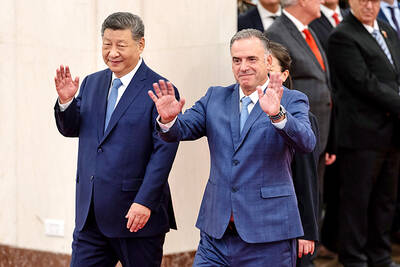
EMERGING FIELDS: The Chinese president said that the two countries would explore cooperation in green technology, the digital economy and artificial intelligence Chinese President Xi Jinping (習近平) yesterday called for an “equal and orderly multipolar world” in the face of “unilateral bullying,” in an apparent jab at the US. Xi was speaking during talks in Beijing with Uruguayan President Yamandu Orsi, the first South American leader to visit China since US special forces captured then-Venezuelan president Nicolas Maduro last month — an operation that Beijing condemned as a violation of sovereignty. Orsi follows a slew of leaders to have visited China seeking to boost ties with the world’s second-largest economy to hedge against US President Donald Trump’s increasingly unpredictable administration. “The international situation is fraught
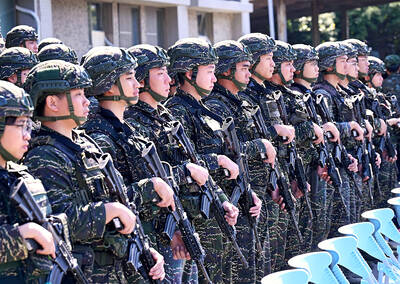
MORE RESPONSIBILITY: Draftees would be expected to fight alongside professional soldiers, likely requiring the transformation of some training brigades into combat units The armed forces are to start incorporating new conscripts into combined arms brigades this year to enhance combat readiness, the Executive Yuan’s latest policy report said. The new policy would affect Taiwanese men entering the military for their compulsory service, which was extended to one year under reforms by then-president Tsai Ing-wen (蔡英文) in 2022. The conscripts would be trained to operate machine guns, uncrewed aerial vehicles, anti-tank guided missile launchers and Stinger air defense systems, the report said, adding that the basic training would be lengthened to eight weeks. After basic training, conscripts would be sorted into infantry battalions that would take

GROWING AMBITIONS: The scale and tempo of the operations show that the Strait has become the core theater for China to expand its security interests, the report said Chinese military aircraft incursions around Taiwan have surged nearly 15-fold over the past five years, according to a report released yesterday by the Democratic Progressive Party’s (DPP) Department of China Affairs. Sorties in the Taiwan Strait were previously irregular, totaling 380 in 2020, but have since evolved into routine operations, the report showed. “This demonstrates that the Taiwan Strait has become both the starting point and testing ground for Beijing’s expansionist ambitions,” it said. Driven by military expansionism, China is systematically pursuing actions aimed at altering the regional “status quo,” the department said, adding that Taiwan represents the most critical link in China’s


 RSS
RSS