


The Central Epidemic Command Center (CECC) yesterday announced a new confirmed case of COVID-19 infection in Taiwan and raised its travel advisory for Iran to a level 3 “warning,” urging people to avoid unnecessary travel due to the increased risk of infection there.
Minister of Health and Welfare Chen Shih-chung (陳時中), who heads the CECC, said the nation’s 40th confirmed case is a woman in her 70s who lives in northern Taiwan and was a passenger on the Diamond Princess cruise ship.
She tested positive for COVID-19 on Feb. 15, when the ship was under a 14-day quarantine in Yokohama, Japan. She was hospitalized the next day and discharged after two negative test results on Feb. 25 and returned to Taiwan the next day.
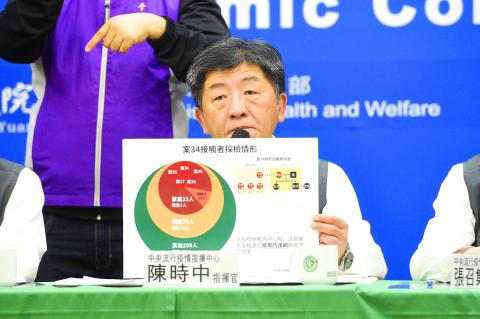
Photo: George Tsorng, Taipei Times
She wore a mask throughout the flight home and was placed in a seat with two empty rows in front of and behind her, Chen said.
She was immediately taken to a hospital for testing after arriving in Taiwan and tested positive for COVID-19 yesterday, he added.
The woman’s first test was negative. She fell between negative and positive territory in the second test and tested positive in the third test, but with a low viral load, CECC advisory specialist panel convener Chang Shan-chwen (張上淳) said.
Viral load can sometimes be very low or even undetectable toward the end of treatment, so while two consecutive negative results is the internationally accepted sign for recovery, in Taiwan, patients are discharged only after three negative results, Chang said.
For the sake of caution, the practice would continue as long as the nation has sufficient testing capacity, but it might change according to the epidemic situation, Chen said.
The crisis surrounding a cluster infection in a hospital connected to the 34th case, a woman in her 50s, has not been lifted, but the center will likely prevent the virus spreading further, he said.
Seventy-nine medical personnel who had come into close contact with the clustered cases underwent testing, returning three positive results — who became the nation’s 37th to 39th cases, announced on Saturday — and 76 negative results, Chen said.
Of the 23 relatives of the clustered cases, one tested negative and the others are being tested, and 115 of 209 other people who had come into close contact with the clustered cases tested negative, while the remaining four are waiting to be tested, he said.
The CECC has raised its travel notice for Iran in light of a high number of confirmed cases and a relatively high number of deaths there, Chen said.
The number of confirmed cases in Iran had risen to 593, including 43 deaths, as of yesterday, which is the highest number of deaths outside of China, the center said, adding that local infection is highly possible in the country.
Starting today, people who have visited Iran in the 14 days prior to arriving in Taiwan, except transit passengers, would be placed under a 14-day mandatory home quarantine, it said.
Japanese authorities have over the past few days implemented various prevention measures and the epidemic situation there is relatively stable, but disease screening at points of entry to Taiwan should still be bolstered, as people frequently travel between the two countries, Chen said.
The center has instructed the doctors at airport quarantine stations to boost screening for symptoms among people arriving from Japan and ask those with symptoms to undergo COVID-19 testing at a hospital, he said.
It also asked tour managers to ensure self-health management in their tour groups, including taking body temperatures daily and wearing masks at all times.
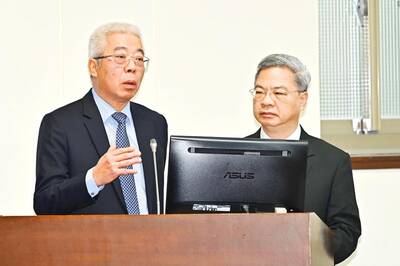
Taiwan has arranged for about 8 million barrels of crude oil, or about one-third of its monthly needs, to be shipped from the Red Sea this month to bypass the Strait of Hormuz and ease domestic supply pressures, CPC Corp, Taiwan (CPC, 台灣中油) said yesterday. The state-run oil company has worked with Middle Eastern suppliers to secure routes other than the Strait of Hormuz, through which about 20 percent of the world’s oil and liquefied natural gas typically passes, CPC chairman Fang Jeng-zen (方振仁) said at a meeting of the legislature’s Economics Committee in Taipei. Suppliers in Saudi Arabia have indicated they
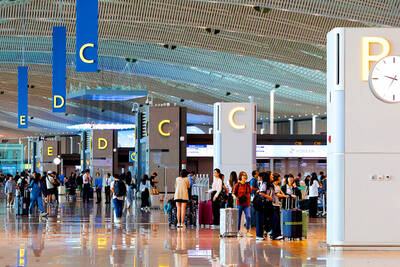
South Korea has adjusted its electronic arrival card system to no longer list Taiwan as a part of China, a move that the Ministry of Foreign Affairs said would help facilitate exchanges between the two sides. South Korea previously listed “Taiwan” as “Taiwan (China)” in the drop-down menus of its online arrival card system, where people had to fill out where they came from and their next destination. The ministry had requested South Korea make a revision and said it would change South Korea’s name on Taiwan’s online immigration system from “Republic of Korea” to “Korea (South),” should the issue not be

CCP ‘PAWN’? Beijing could use the KMT chairwoman’s visit to signal to the world that many people in Taiwan support the ‘one China’ principle, an academic said Chinese Nationalist Party (KMT) Chairwoman Cheng Li-wun (鄭麗文) yesterday arrived in China for a “peace” mission and potential meeting with Chinese President Xi Jinping (習近平), while a Taiwanese minister detailed the number of Chinese warships currently deployed around the nation. Cheng is visiting at a time of increased Chinese military pressure on Taiwan, as the opposition-dominated Legislative Yuan stalls a government plan for US$40 billion in extra defense spending. Speaking to reporters before going to the airport, Cheng said she was going on a “historic journey for peace,” but added that some people felt uneasy about her trip. “If you truly love Taiwan,

Tainan, Taipei and New Taipei City recorded the highest fines nationwide for illegal accommodations in the first quarter of this year, with fines issued in the three cities each exceeding NT$7 million (US$220,639), Tourism Administration data showed. Among them, Taipei had the highest number of illegal short-term rental units, with 410. There were 3,280 legally registered hotels nationwide in the first quarter, down by 14 properties, or 0.43 percent, from a year earlier, likely indicating operators exiting the market, the agency said. However, the number of unregistered properties rose to 1,174, including 314 illegal hotels and 860 illegal short-term rental


 RSS
RSS