


Another 65 people aboard the quarantined Diamond Princess cruise ship moored off Japan have been diagnosed with the 2019 novel coronavirus (2019-nCoV), the Japanese Ministry of Health, Labor and Welfare said yesterday, bringing the total number of known infections to 135.
The Diamond Princesss has been in quarantine since arriving off the Japanese coast early last week after the virus was detected in a former passenger who got off the ship last month in Hong Kong.
“Test results from 103 people have now come out and 65 of them are confirmed positive for the new coronavirus,” the ministry said in a statement, without giving further details such as their nationalities.
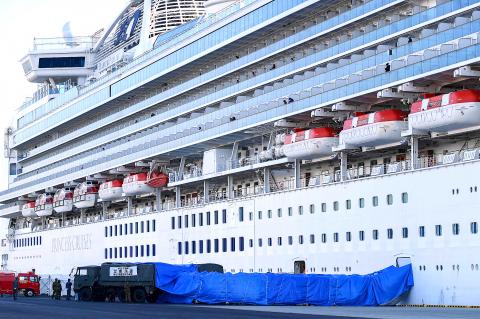
Photo: AFP
Authorities have continued to test people for the virus where “necessary, the statement added.
The cruise ship operator said 66 people had been newly diagnosed, mostly Japanese, but there were also Australians, Filipinos and a Canadian, a Brit and a Ukrainian.
There was no immediate clarity on the discrepancy between that figure and the ministry’s.
When the boat arrived off Japan, authorities initially tested nearly 300 of the 3,711 on board for the virus, gradually evacuating dozens who were infected to local medical facilities.
In recent days, testing has expanded to those with new symptoms or who had close contact with other infected passengers or crew, and several more cases were reported over the weekend.
Those who remain on the ship have been asked to stay inside their cabins and allowed only briefly onto open decks.
They have been asked to wear masks and keep a distance from each other when outside, and given thermometers to regularly monitor their temperatures.
The ship is expected to stay in quarantine until Wednesday next week, 14 days after the isolation period began.
The quarantine has made life on board the ship difficult, particularly for those in windowless interior cabins and a significant number of passengers who require medication for various chronic conditions.
The ministry yesterday said that about 600 people on board urgently needed medication, and around half received supplies over the weekend.
Japanese Minister of Health, Labor and Welfare Katsunobu Kato told reporters that discussions were ongoing about how to increase testing capacity and also whether testing would take place after passengers are released from quarantine.
The WHO confirmed in a tweet that newly diagnosed cases on the ship should not extend the length of the quarantine.
“The quarantine period of the #DiamondPrincess will come to an end on 19 February,” the WHO said in a tweet. “The period will be extended beyond the 19 Feb as appropriate only for close contacts of newly confirmed cases. They need to remain in quarantine for 14 days from last contact with a confirmed case.”
On board the ship, news of the additional infections sparked worry for some, with passenger Yardley Wong tweeting “stress and high anxiety.”
“I need to cry to get off the anxiety,” she wrote.
No Taiwanese were among the 60 new confirmed cases of the coronavirus on board the Diamond Princess, Centers for Disease Control Deputy Director-General Chuang Jen-hsiang (莊人祥) said yesterday at a news conference in Taipei.
Only one Taiwanese passenger has been confirmed to have the virus, and the Central Epidemic Command Center (CECC) would continue to communicate with Japan about bringing that passenger home, he said.
Minister of Health and Welfare Chen Shih-chung (陳時中), who heads the CECC, thanked Japanese officials for looking after the Taiwanese passengers aboard the ship.
However, while epidemic prevention requires cross-border cooperation, infected people are better treated in their home country to prevent an escalation of the outbreak, Chen said.
Additional reporting by CNA
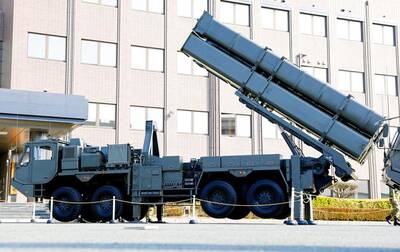
Japan has deployed long-range missiles in a southwestern region near China, the Japanese defense minister said yesterday, at a time when ties with Beijing are at their lowest in recent years. The missiles were installed in Kumamoto in the southern region of Kyushu, as Japan is attempting to shore up its military capacity as China steps up naval activity in the East China Sea. “Standoff defense capabilities enable us to counter the threat of enemy forces attempting to invade our country ... while ensuring the safety of our personnel,” Japanese Minister of Defense Shinjiro Koizumi said. “This is an extremely important initiative for

MORE POPULAR: Taiwan Pass sales increased by 59 percent during the first quarter compared with the same period last year, the Tourism Administration said The Tourism Administration yesterday said that it has streamlined the Taiwan Pass, with two versions available for purchase beginning today. The tourism agency has made the pass available to international tourists since 2024, allowing them to access the high-speed rail, Taiwan Railway Corp services, four MRT systems and four Taiwan Tourist Shuttles. Previously, five types of Taiwan Pass were available, but some tourists have said that the offerings were too complicated. The agency said only two types of Taiwan Pass would be available, starting from a three-day pass with the high-speed rail and a three-day pass with Taiwan Railway Corp. The former costs NT$2,800

POLLS CONCERNS: There are concerns within the KMT that a Cheng Li-wun-Xi Jinping meeting could trigger a voter backlash in elections in November Chinese Nationalist Party (KMT) Chairwoman Cheng Li-wun (鄭麗文) accepted an invitation from Chinese President Xi Jinping (習近平) to visit next month, her party and Chinese state media reported yesterday. Cheng, who took up her role in November last year, “gladly accepted” the invitation to lead a delegation to China, the KMT said in a statement, confirming a Xinhua news agency report. Cheng “looks forward to joint efforts by both parties to advance the peaceful development of cross-strait relations, promote cross-strait exchanges and cooperation, and work for peace in the Taiwan Strait and greater well-being for people on both sides,” the statement said. Chinese

SIGNIFICANT TO THE WORLD: The delegation’s visit aims to send a clear message that bipartisan support for Taiwan is consistent, US Senator Jeanne Shaheen said The US Senate’s bipartisan support for Taiwan remains strong and Taiwan-US ties would continue for decades to come, a US Senate delegation said in Taipei yesterday, while calling on the legislature to swiftly pass a special defense budget bill. A US delegation led by Democratic US Senator Jeanne Shaheen and Republican US Senator John Curtis — both members of the US Senate Committee on Foreign Relations — arrived in Taiwan yesterday for a two-day visit. The other senators of the delegation included Senate Taiwan Caucus cochair Thom Tillis and Senate Committee on Armed Services senior member Jacky Rosen. Shaheen told a news


 RSS
RSS