


Deaths from the 2019 novel coronavirus yesterday rose to 490 in China, while new cases on a Japanese cruise ship and in Hong Kong showed the increasing spread of the outbreak and renewed attention toward containing it.
Ten people from the cruise ship tested positive and were taken to hospital, while all 3,700 crew and passengers were to be quarantined on board for up to 14 days, Japanese Minister of Health, Labor and Welfare Katsunobu Kato said.
Hong Kong Chief Executive Carrie Lam (林鄭月娥) said that all people entering the territory from mainland China, including Hong Kong residents, would be required to undergo 14 days of quarantine.
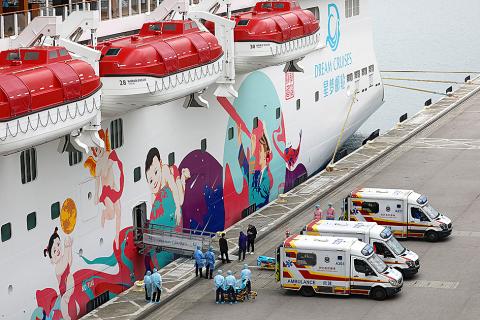
Photo: EPA-EFE
Lam said the measure are to take effect on Saturday to allow Hong Kong day travelers to make the necessary arrangements.
She also said two cruise terminals — including one where a cruise ship is under quarantine — will be shut down.
The government has been vigilant and is not shying away from introducing stringent measures to stem the spread of the virus, Lam said, after thousands of medical workers had gone on strike in the territory to demand that the border with the mainland be completely shut.
The government had kept two crossings open, in part to allow food from the mainland to enter.
Lam said that she remains optimistic that the territory could overcome the epidemic, but urged all citizens to “put aside our differences and get our act together.”
With the outbreak epicenter, Wuhan, cut off by rail, air and road to try to contain the virus, the US and other nations were organizing more evacuation flights for their citizens still in the central Chinese city.
The latest Chinese data showed an increase of 65 deaths from the previous day, all the new deaths in Wuhan. The number of new cases increased to 24,324, a rise of 3,887 from the previous day.
Outside China, at least 180 cases had been confirmed, including two fatalities, one in Hong Kong and another in the Philippines.
To treat the thousands of patients, China rushed to build hospitals and converted a gymnasium, exhibition hall and cultural center in Wuhan.
Patients were being moved into a new, 1,000-bed hospital with prefabricated wards and isolation rooms. A 1,500-bed hospital also specially built opens in days.
The hospitals, in converted public spaces to treat patients with mild symptoms, have a total of 3,400 beds, the simple cots placed in tight rows in cavernous rooms without any barriers.
One man, Fang Bin, said that he saw wards so crowded during a visit to Wuhan No. 5 Hospital on Saturday last week that some patients were forced to sit on the ground.
“There are too many patients, it’s overcrowded,” Fang said.
He said he was taken from his home and questioned by police after he posted a video of what he saw online.
South Korea raised its total to 18, with the new cases raising concern about the illness spreading from nations other than China.
The South Korean Centers for Disease Control and Prevention said that a man who attended a business conference in Singapore met a Malaysian there who had the virus.
Another case confirmed yesterday was the daughter of a woman who contracted the coronavirus when traveling in Thailand.

CROSS-STRAIT COLLABORATION: The new KMT chairwoman expressed interest in meeting the Chinese president from the start, but she’ll have to pay to get in Beijing allegedly agreed to let Chinese Nationalist Party (KMT) Chairwoman Cheng Li-wun (鄭麗文) meet with Chinese President Xi Jinping (習近平) around the Lunar New Year holiday next year on three conditions, including that the KMT block Taiwan’s arms purchases, a source said yesterday. Cheng has expressed interest in meeting Xi since she won the KMT’s chairmanship election in October. A source, speaking on condition of anonymity, said a consensus on a meeting was allegedly reached after two KMT vice chairmen visited China’s Taiwan Affairs Office Director Song Tao (宋濤) in China last month. Beijing allegedly gave the KMT three conditions it had to

STAYING ALERT: China this week deployed its largest maritime show of force to date in the region, prompting concern in Taipei and Tokyo, which Beijing has brushed off Deterring conflict over Taiwan is a priority, the White House said in its National Security Strategy published yesterday, which also called on Japan and South Korea to increase their defense spending to help protect the first island chain. Taiwan is strategically positioned between Northeast and Southeast Asia, and provides direct access to the second island chain, with one-third of global shipping passing through the South China Sea, the report said. Given the implications for the US economy, along with Taiwan’s dominance in semiconductors, “deterring a conflict over Taiwan, ideally by preserving military overmatch, is a priority,” it said. However, the strategy also reiterated
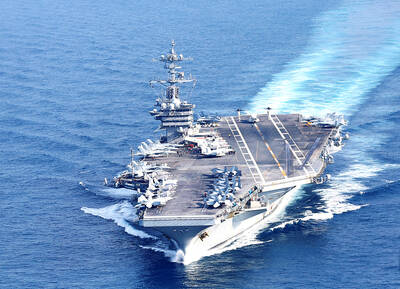
‘BALANCE OF POWER’: Hegseth said that the US did not want to ‘strangle’ China, but to ensure that none of Washington’s allies would be vulnerable to military aggression Washington has no intention of changing the “status quo” in the Taiwan Strait, US Secretary of Defense Pete Hegseth said on Saturday, adding that one of the US military’s main priorities is to deter China “through strength, not through confrontation.” Speaking at the annual Reagan National Defense Forum in Simi Valley, California, Hegseth outlined the US Department of Defense’s priorities under US President Donald Trump. “First, defending the US homeland and our hemisphere. Second, deterring China through strength, not confrontation. Third, increased burden sharing for us, allies and partners. And fourth, supercharging the US defense industrial base,” he said. US-China relations under
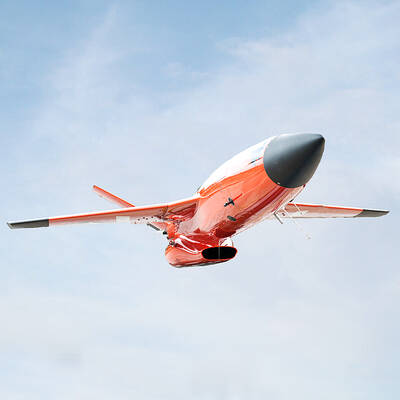
The Chien Feng IV (勁蜂, Mighty Hornet) loitering munition is on track to enter flight tests next month in connection with potential adoption by Taiwanese and US armed forces, a government source said yesterday. The kamikaze drone, which boasts a range of 1,000km, debuted at the Taipei Aerospace and Defense Technology Exhibition in September, the official said on condition of anonymity. The Chungshan Institute of Science and Technology and US-based Kratos Defense jointly developed the platform by leveraging the engine and airframe of the latter’s MQM-178 Firejet target drone, they said. The uncrewed aerial vehicle is designed to utilize an artificial intelligence computer


 RSS
RSS