


A number of people have been summoned for questioning as the judiciary cracks down on online rumors regarding the 2019 novel coronavirus (2019-nCoV) outbreak.
People must fact-check and verify with local health authorities when discussing information on the outbreak, Criminal Investigation Bureau officer Chen Pei-te (陳培德) said yesterday, adding that circulating misinformation is punishable by fines of up to NT$3 million (US$99,174).
A Yunlin County woman surnamed Shih (施) was summoned for questioning for claiming on Facebook that the hospital to which she took her baby for a vaccine had a confirmed 2019-nCoV patient, Chen said.

Photo: CNA
“Shih was asked by a friend, whom she told that the patient with the ‘Wuhan virus’ was at Chiayi Christian Hospital. This was not true, resulting in an investigation by Yunlin prosecutors,” Chen said.
In another case, people disseminated online that Taichung’s China Medical University Hospital had three confirmed 2019-nCoV patients who were under medical quarantine and that hospital staff were hiding the information from the public, bureau officials said.
Two people who shared the stories with their friends on social media were summoned for questioning by Taichung prosecutors yesterday, after the Centers for Disease Control (CDC) verified that there were no such patients at either hospital and deemed them rumors, Chen said.
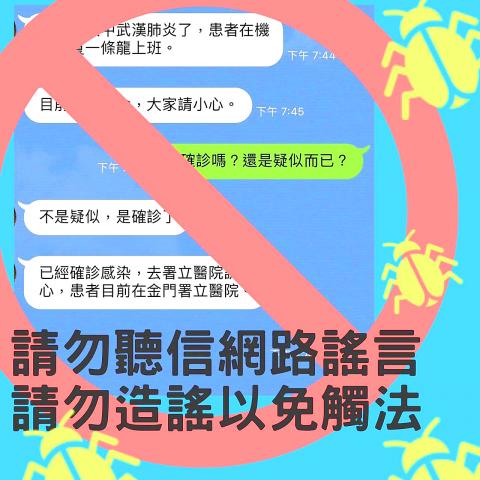
Screen grab from Facebook
As of press time last night, the CDC and local health authorities nationwide had filed reports with the bureau and other law enforcement agencies regarding 12 cases of misinformation or rumors about the outbreak. Investigators have identified eight people for questioning and investigation by public prosecutors.
These people could have contravened the Communicable Disease Control Act (傳染病防治法), Article 63 of which stipulates that “persons who disseminate rumors or incorrect information concerning epidemic conditions of communicable diseases, resulting in damages to the public or others, shall be fined up to NT$3 million.”
As of press time, there were 10 confirmed 2019-nCoV cases in Taiwan, the CDC said.
Separately yesterday, the Ministry of Justice said in a statement that all prosecutors’ offices and judicial agencies have been ordered to collaborate with local police to conduct checks of stores and warehouses to ensure there is no hoarding of masks or other medical items.
Article 61 of the act stipulates that during epidemic situations, “individuals who hoard resources that the competent authorities have already started to requisite for purposes of price speculation or to force up prices under serious circumstances” could face a jail term of up to seven years and fines of up to NT$5 million, it said.
People who have been infected must follow orders from health authorities to prevent transmission to other people, it added, citing Article 62 of the act, which stipulates that failure “to comply with instructions by the competent authorities and have thus infected others shall be sentenced to imprisonment for up to three years, criminal detention, or a fine up to NT$500,000.”
‘UNFRIENDLY’: Changing the nationality listing of Taiwanese residents to ‘China’ goes against EU foreign policy as well as democratic and human rights principles, MOFA said Taiwan yesterday called on Denmark to correct its designation of the nationality of Taiwanese residents as “China” or face retaliatory measures. The Danish government in 2024 changed the nationality of Taiwanese citizens on their residence permits from “Taiwan” to “China.” The decision goes against EU foreign policy and contravenes democratic and human rights principles, Ministry of Foreign Affairs (MOFA) spokesman Hsiao Kuang-wei (蕭光偉) said. Denmark should present a solution acceptable to Taiwan as soon as possible and correct the erroneous designation to preserve the longstanding friendship between the two nations, Hsiao said. The issue could damage Denmark’s image and business reputation in Taiwan,

KEY INDUSTRY: The vice premier discussed a plan to create a non-red drone supply chain by next year, which has been allocated a budget of more than NT$7.2 billion The government has budgeted NT$44.2 billion (US$1.38 billion) to cultivate Taiwan’s uncrewed aerial vehicle (UAV) industry over the next five years, which would make the nation a major player in the industry’s democratic supply chain in the Asia-Pacific region, Premier Cho Jung-tai (卓榮泰) said yesterday. Cho made the remarks during a visit to the facilities of Cub Elecparts Inc (為升電裝). Democratic Progressive Party (DPP) Legislator Chen Su-yueh (陳素月) and Chinese Nationalist Party (KMT) Legislator Hsieh Yi-fong (謝依鳳) also participated in the trip. Cub Elecparts has transitioned from the automotive industry to the defense industry, which is the top priority among the nation’s
SOUTH KOREA DISPUTE: If Seoul continues to ignore its request, Taiwan would change South Korea’s designation on its arrival cards, the foreign ministry said If South Korea does not reply appropriately to a request to correct Taiwan’s name on its e-Arrival card system before March 31, the government would take corresponding measures to change how South Korea is labeled on the online Taiwan Arrival Card system, the Ministry of Foreign Affairs said yesterday. South Korea’s e-Arrival card system lists Taiwan as “China (Taiwan)” in the “point of departure” and “next destination” fields. Taipei has asked Seoul to change the wording. Since March 1, South Koreans who hold government-issued Alien Resident Certificates (ARC) have been identified as from “South Korea” rather than the “Republic of Korea,” the
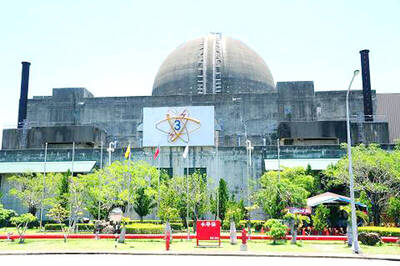
SUFFICIENT: The president said Taiwan has enough oil for next month, with reserves covering more than 100 days and natural gas enough for 12 to 14 days A restart plan for the Guosheng Nuclear Power Plant in New Taipei City’s Wanli District (萬里) and the Ma-anshan Nuclear Power Plant in Pingtung County’s Hengchun Township (恆春) would be submitted to the Nuclear Safety Commission by the end of the month, President William Lai (賴清德) said yesterday, reversing the government’s policy to abolish nuclear energy. On May 17 last year, Taiwan shut down its last nuclear reactor and became the first non-nuclear nation in East Asia, fulfilling the Democratic Progressive Party (DPP) government’s pledge of a “nuclear-free homeland.” Even without nuclear power, Taiwan can maintain a stable electricity supply until 2032,


 RSS
RSS