


A dangerous fire yesterday flared up in southeastern Australia even as cooler conditions elsewhere allowed authorities to begin assessing the damage from heatwave-spurred blazes that swept through two states on Saturday.
Officials told residents and others in the New South Wales (NSW) town of Eden to leave immediately and head north if they did not have a bushfire response plan.
“If your plan is to leave, or you are not prepared, leave toward Merimbula or Pambula,” the NSW Rural Fire Service said in an alert.
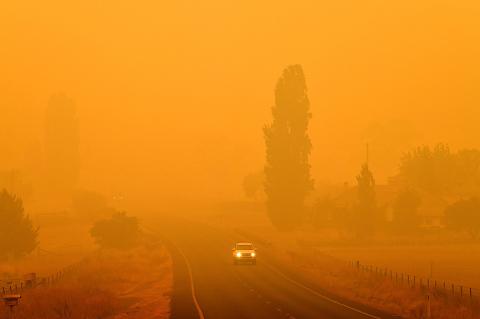
Photo: AFP
Tens of thousands of homes in NSW and Victoria states were without power yesterday as a large-scale military and police effort continued to provide supplies and evacuate thousands of people who have been trapped for days in coastal towns by the fires.
Initial estimates put damaged or destroyed properties in the hundreds, but authorities said the mass evacuations by residents of at-risk areas appear to have prevented major loss of life.
Twenty-four people have been killed since the start of this year’s wildfire season.
On Saturday, Australian Prime Minister Scott Morrison announced that 3,000 army, navy and air force reservists would be thrown into the battle against the fires.
However, the decision attracted complaints that he had taken too long to act.
NSW Rural Fire Service Commissioner Shane Fitzsimmons said he learned of the deployment through media reports.
“It is fair to say it was disappointing and some surprise to hear about these things through public announcements in the middle of what was one of our worst days this season with the second-highest number of concurrent emergency warning fires ever in the history of New South Wales,” he said.
Yesterday’s cooler temperatures and light rain forecast in some coastal areas in coming days could bring some relief, but officials said that would not be enough to bring the almost 200 fires still burning under control.
Fire officials said the next major flashpoint would come later in the week, but it was too early to gauge the likely severity of the threat.
“The weather activity we’re seeing, the extent and spread of the fires, the speed at which they’re going, the way in which they are attacking communities who have never ever seen fire before is unprecedented,” NSW Premier Gladys Berejiklian said.
Meanwhile, at least half of Australia’s only disease-free koala population, a key “insurance” for the species’ future, is feared dead, with more badly hurt after bushfires swept through an island sanctuary, rescuers said.
Kangaroo Island, a popular tourist attraction off the coast of South Australia, is home to many wild populations of native animals, including the much-loved koala, where the populated was estimated at 50,000.
Massive bushfires have flared up in the vast country’s southeast in a months-long crisis, killing nearly half a billion native animals in NSW alone, scientists have estimated.
Conditions have been particularly severe in the past few days, with a blaze on Kangaroo Island spreading rapidly and razing 170,000 hectares — one-third of the island — on Friday.
“Over 50 percent [of the population] has been lost,” Sam Mitchell of Kangaroo Island Wildlife Park, which is raising funds to care for the injured koalas, told reporters. “Injuries are extreme. Others have been left with no habitat to go back to, so starvation will be an issue in coming weeks.”
The koalas cannot be removed from the island due to their disease-free status, the state government said
Additional reporting by AP

SILENCING CRITICS: In addition to blocking Taiwan, China aimed to prevent rights activists from speaking out against authoritarian states, a Cabinet department said The Ministry of Foreign Affairs (MOFA) yesterday condemned transnational repression by Beijing after RightsCon, a major digital human rights conference scheduled to be held in Zambia this week, was abruptly canceled due to Chinese pressure over Taiwanese participation. This year’s RightsCon, the world’s largest conference discussing issues “at the intersection of human rights and technology,” was scheduled to take place from tomorrow to Friday in Lusaka, and expected to draw 2,600 in-person attendees from 150 countries, along with 1,100 online participants. However, organizers were forced to cancel the event due to behind-the-scenes pressure from China, the ministry said, expressing its “strongest condemnation”
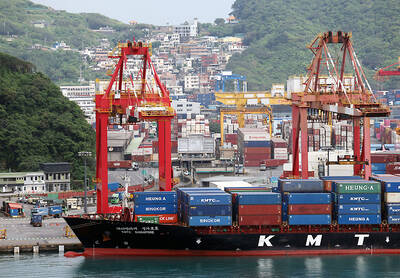
Taiwan’s economy grew far faster than expected in the first quarter, as booming demand for artificial intelligence (AI) applications drove a surge in exports, spilling over into investment and consumption, the Directorate-General of Budget, Accounting and Statistics (DGBAS) said yesterday. GDP growth was 13.69 percent year-on-year during the January-to-March period, beating the DGBAS’ February forecast by 2.23 percentage points and marking the most robust growth in nearly four decades, DGBAS senior official Chiang Hsin-yi (江心怡) told a news conference in Taipei. The result was powered by exports, which remain the backbone of Taiwan’s economy, Chiang said. Outbound shipments jumped 51.12 percent year-on-year to
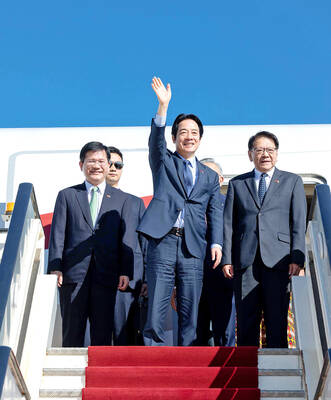
DELAYED BUT DETERMINED: The president’s visit highlights Taiwan’s right to international engagement amid regional pressure from China President Willaim Lai (賴清德) yesterday arrived in Eswatini, more than a week after his planned visit to Taiwan’s sole African ally was suspended because of revoked overflight permits. “The visit, originally scheduled for April 22, was postponed due to unforeseen external factors,” Lai wrote on social media. “After several days of careful arrangements by our diplomatic and national security teams, we successfully arrived today.” Lai said he looked forward to further deepening Taiwan-Eswatini relations through closer cooperation in the economy, agriculture, culture and education, as well as advancing the nation’s international partnerships. The president was initially scheduled to arrive in time to celebrate
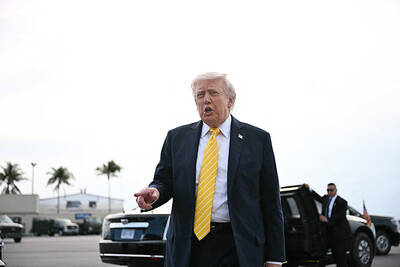
Iran’s Islamic Revolutionary Guard Corp (IRGC) yesterday said the US faced a choice between an “impossible” military operation or a “bad deal” with Tehran, after US President Donald Trump disparaged Iran’s latest peace proposal. Negotiations between the two countries have been deadlocked since a ceasefire came into effect on April 8, with only one round of direct peace talks held so far. Iran’s Tasnim and Fars news agencies reported that Tehran had submitted a 14-point proposal to mediator Pakistan, but Trump was quick to cast doubt on it. “I will soon be reviewing the plan that Iran has just sent to us, but


 RSS
RSS