


Chief of the General Staff General Shen Yi-ming (沈一鳴), who was killed yesterday in a helicopter crash in New Taipei City, had been in charge of the Ministry of National Defense’s General Staff Headquarters since July last year, succeeding retiring admiral Lee Hsi-ming (李喜明).
The 62-year-old air force general and his entourage were on a routine pre-Lunar New Year mission to visit troops at Dongaoling Base (東澳嶺) in Yilan County.
Prior to his taking up the General Staff Headquarters post, he had served for 15 months as vice minister of national defense, and from Feb. 1, 2015, to March 1 last year as air force commander-general. He was administrative deputy minister of defense before that.
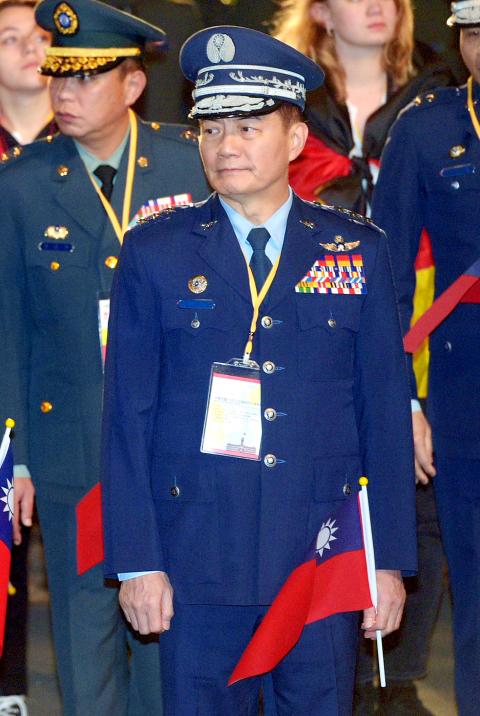
Photo: Chang Chia-ming, Taipei Times
As air force commander, Shen promoted joint operations training, and disaster prevention and rescue.
After graduating from the Republic of China Air Force Academy in 1979, Shen was posted to the Great Desert Program, working with the Saudi Arabian government in Yemen Arab Republic until the Saudi Arabian government transferred diplomatic recognition from the Republic of China to the People’s Republic of China in 1990.
At the time of his death, Shen was the officer from that program still on active duty.
He graduated from the Air Command and Staff College in 1992, and following France’s sale of Mirage 2000-5 jets to Taiwan in the late 1990s, Shen was among the first group of Taiwanese pilots sent to France for training. He later served as instructor for other air force pilots.
He went on to study at the US Air Force’s Air War College in Montgomery, Alabama, graduating in 2002.
Alexander Huang (黃介正), a strategic studies professor at Tamkang University who had known Shen for a decade, yesterday told The Associated Press that the general had stood out as a pilot and an officer.
“He was very calm and very stable, and unlike other army guys he was always smiling, so he [had] got a specific leadership style that also made him a popular leader in the entire military,” Huang said.
Shen was very disciplined, well-versed in knowledge of modern digital devices, to the extent that he could show his younger subordinates a trick or two, and was physically fit, receiving full marks during his annual physicals as air force commander, sources said.
Those familiar with Shen said that he valued the importance of scientific proof and professional analysis.
A military source said Shen’s fluency in foreign languages, as well as his knowledge of military affairs and diplomatic relations, made him a great choice as chief of general staff and to help promote the government’s Indo-Pacific strategy.
Deputy Chief of General Staff General Liu Chih-pin (劉志斌) last night was named acting chief of general staff to ensure the military’s capability to continue its operations as normal.
Additional reporting by CNA

A signaling system malfunction disrupted high-speed rail (HSR) services beginning at 8am today, with trains temporarily reduced to three northbound and three southbound trains per hour as authorities conduct inspections. The malfunction occurred on a section of track in Miaoli County during pre-operation checks early this morning, forcing northbound and southbound trains to use a single track, the HSR operator said. The regular schedule has been replaced with three hourly trains offering only nonreserved seating in each direction, stopping at every station, it said, adding that business class cars would still have reserved seating. Departures from terminal stations are scheduled at the top

DRONE CENTRAL: Taiwan aims to become Asia’s democratic hub for drones, with most exports focused on high-quality military-grade models, an official said Taiwan’s drone industry is expected to expand significantly by 2030, producing 100,000 units per month and exporting half of them, the Ministry of Economic Affairs said yesterday. Current drone production capacity is about 15,000 units per month, but the industry can quickly scale up as demand increases, Industrial Development Administration Director-General Chiou Chyou-huey (邱求慧) told a news conference in Taipei. Taiwan’s drone output grew 2.5-fold last year to NT$12.9 billion (US$408.3 million) under a government program to develop the uncrewed vehicle sector, he said. The Executive Yuan in October last year approved plans to invest NT$44.2 billion into domestic production of uncrewed aerial

Taiwan is still in the process of assessing the possibility of recruiting workers from Eswatini, the Ministry of Foreign Affairs said yesterday, adding that its goal is to help Eswatini upgrade its vocational training centers. If there are plans to recruit workers from Eswatini, safeguarding national security, protecting public health and ensuring the employment rights of Taiwanese would be prerequisites, Department of West Asian and African Affairs Director-General Yen Chia-liang (顏嘉良) told a news conference. Key considerations would also include filling labor shortages in specific industries, and fostering bilateral professional and technical exchanges, he said. Yen was asked about the progress of labor
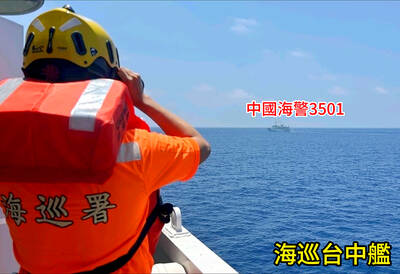
VERBOSE VESSELS: A CGA cutter and a China Coast Guard exchanged verbal barbs for more than a day in Taiwanese-controlled waters before the Chinese vessel left The Taiwanese and Chinese coast guards had a standoff near the strategically located Pratas Islands (Dongsha Islands, 東沙群島) in the north of the South China Sea, the Coast Guard Administration (CGA) said yesterday. The two sides engaged in intense radio exchanges over sovereignty claims during the 33-hour standoff. China Coast Guard vessel 3501 eventually left the restricted waters, 26.6 nautical miles (49.2km) west of the Pratas Islands, at 5pm yesterday, the CGA said. Lying approximately between southern Taiwan and Hong Kong, the Taiwan-controlled Pratas are seen by some security experts as vulnerable to Chinese attack due to their distance — more than


 RSS
RSS