


Kaohsiung Mayor Han Kuo-yu (韓國瑜), the Chinese Nationalist Party’s (KMT) presidential candidate, yesterday urged supporters to vote for him in the Jan. 11 elections and give him the chance to serve Taiwanese and stimulate the economy.
Han made the remarks as he took the stage to address a crowd after a march in Kaohsiung hosted by his campaign team, which said that 350,000 people were in attendance.
Han originally planned to lead the march, which started at Aozihdi Forest Park (凹子底森林公園) in Kaohsiung’s Gushan District (鼓山), but changed his plans at the last minute at the advice of aides over security concerns and instead waited at its final destination.
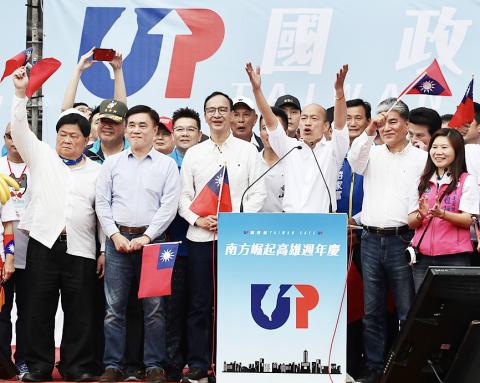
Photo: CNA
He thanked supporters and the city’s residents for electing him as mayor last year.
Kaohsiung has not been the center of such attention in more than a century, with supporters from the city and elsewhere attending the event packing the Kaohsiung MRT metropolitan rail system, Han said, adding that local hotels have been booked solid for two straight days.
“We have restored the honor of Kaohsiung” through the efforts of the Kaohsiung City Government and residents over the past year, he said.
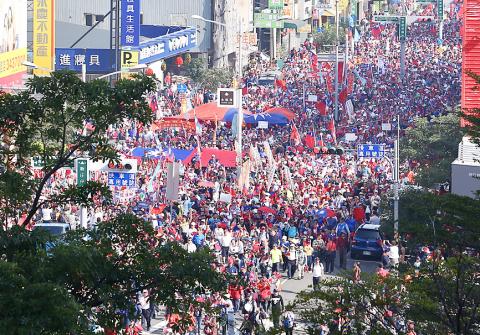
Photo: CNA
Han extolled the virtues of his presidential platform, promising a clean government, as well as to defend Taiwan’s sovereignty, ensure that its people are wealthy, seek talented people for government service, be aware of people’s difficulties and, most importantly, foster youth talent.
He said that if people vote for him and the KMT, he would show them that he can be trusted to boost Taiwan’s economy.
Deputy Kaohsiung Mayor Yeh Kuang-shih (葉匡時), who attended the event in a show of support, said that “the Democratic Progressive Party [DPP] controls the media, but it cannot control people’s desire to know the truth.”
“The DPP’s continued efforts to slander Mayor Han cannot hide the fact that he is just and honorable,” he said. “Nor can the DPP hide its corruption, ineptitude and poor governance by spreading money around.”
Han has only led Kaohsiung for one year and has already surpassed the performances of his predecessors, Yeh said.
He cited smooth roads devoid of potholes, brighter lights and a 20 percent increase in tourists in the first half of Han’s term as successes.
Despite a lack of cross-strait exchanges “due to hostility against China by President Tsai Ing-wen’s (蔡英文) administration,” Kaohsiung has nonetheless seen the number of visitors increase by 10 percent, Yeh said.
The city has also seen a twofold increase in produce exports and air pollution monitors have not once exceeded standards, he said.
Asked about a remark by former premier William Lai (賴清德), the DPP’s vice presidential candidate, that he has “transformed from a warm guy to an angry man,” former premier Simon Chang (張善政), the KMT’s vice presidential candidate, said that the DPP was to blame for his transformation, calling on the public to vote it out of power.
Former New Taipei City mayor Eric Chu (朱立倫), who is now Han’s campaign director, said that the DPP has been relentlessly slandering Han instead of crowing about its own triumphs, because it has no achievements to claim.
Chu called for people to support Han and the KMT in next month’s presidential and legislative elections.

‘NO SECURITY RISK’: The Railway Bureau reassured the public that the technicians’ activities were limited to technical guidance and did not involve sensitive systems The Railway Bureau yesterday said it had invited eight Chinese technicians to assist with an airport MRT construction project. The bureau issued the confirmation after an Internet user said Chinese nationals had entered the construction zone of Taiwan Taoyuan International Airport’s Terminal 3 project. They asked why “individuals from an enemy state” were allowed access to such a major national infrastructure project, which raised serious concerns over Taiwan’s industrial safety, sensitive systems and information security. The bureau’s Northern Region Engineering Branch Office said subcontractor Taiwan Handle Industrial Co (台灣手把工業) of the Taoyuan airport MRT’s “Contract No. CU05 Project A14 Station Civil, MEP &

The National Chungshan Institute of Science and Technology yesterday showcased its locally developed variants of the Vision 60 robotic patrol dog, which it plans to deploy on the nation’s outlying territories in the South China Sea. The variants were produced under the Joint Lab project — created by the institute and domestic companies — and assembled with domestically produced motors, lenses and artificial intelligence (AI) systems alongside licensed tech from the US, Missile and Rocket Systems Research Division deputy director Jen Kuo-kang (任國光) told the media event at a military base in Taipei’s Dazhi (大直) area. Taiwan has built up its strengths

TIT-FOR-TAT: The US allegedly revoked the visa of a Chinese national working at Xinhua News Agency in the US in response to Beijing’s expulsion of Vivian Wang The Presidential Office yesterday condemned China for expelling a New York Times correspondent from Beijing following the newspaper’s interview with President William Lai (賴清德), saying the move highlighted Beijing’s suppression of press freedom and its threat to international news media. Taiwan has noted a series of recent incidents in which Beijing used similar tactics to “threaten and pressure international media outlets and journalists,” Presidential Office spokeswoman Karen Kuo (郭雅慧) said in a statement. “This concerns not only press freedom and freedom of expression, but also the safety of journalists, and Taiwan and relevant partners are paying close attention to the situation,” she

NOT IMMEDIATE: Taiwan has a chance to appeal the proposed 10 percent tariff before it starts, while other countries face a 12.5 percent tariff from the trade office Taiwan is among 60 economies determined by the US to have failed to impose or enforce a ban on the importation of goods produced with forced labor, according to a notice released on Tuesday by the Office of the US Trade Representative (USTR), which proposed imposing an additional 10 percent or more tariff on them. The USTR in a statement said that following an investigation, it had determined under Section 301 of the Trade Act of 1974 that the failure of the 60 economies to impose and effectively enforce a prohibition on the importation of goods produced with forced labor is


 RSS
RSS