


New Party legislator-at-large nominee Chiu Yi (邱毅) has been called a “traitor” on social media after appearing on Chinese television twice over the past week discussing Taiwan’s military defense systems.
Appearing on China Central Television (CCTV) political talk show The Two Sides of the Strait (海峽兩岸), Chiu discussed the navy’s Kao Hsiung LST-542-class tank landing ship, its missile and radar systems, as well as the military’s missile deployments in Taipei.
Speaking on the program on Friday, Chiu said that the Military Police Command’s deployment in October of Kestrel missiles at key government buildings in Taipei was ordered by President Tsai Ing-wen (蔡英文) out of fear of a “decapitation strike” by the Chinese People’s Liberation Army (PLA).
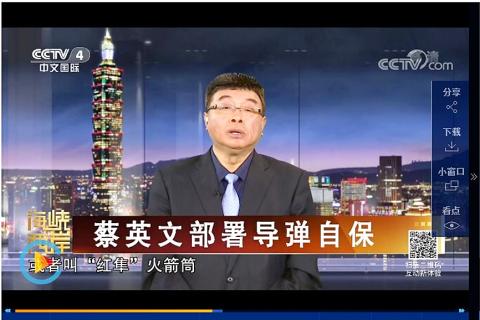
Photo: screen grab by Chung Li-hua, Taipei Times
Government reports calling the Kestrel missiles “anti-tank missiles” were an exaggeration, Chiu said.
The Kestrel would be incapable of piercing the armor of China’s Type 98 and Type 99 tanks, he said.
However, the missiles — which were developed by the Chungshan Institute of Science and Technology — would be effective against light tanks or armored vehicles, he said.
While reports said the missiles would help defend government institutions, they were intended to protect only the president, and would be used for the defense of the Presidential Office Building and Tsai’s official residence, he said.
This is further evidenced by the formation of the Quick Reaction Company at the 202nd Military Police Command Headquarters in Taipei, the commander of which is a woman, Chiu said.
Appearing on the program again on Sunday, Chiu said that while the Kao Hsiung has a phased array radar system and a vertical launching system — which are standard equipment on destroyers worldwide — the systems aboard the Kao Hsiung are outdated.
Taiwanese media have reported on close US-Taiwan relations, with Washington helping Taipei with its indigenous shipbuilding program and providing technological assistance, which has become a bragging point for Tsai, Chiu said.
Tsai has been imploring the public to stand united against China and assuring them that the Taiwanese military can resist a PLA invasion, he said.
Both remarks are merely campaign promises ahead of the Jan. 11 elections, Chiu added.
The Ministry of National Defense yesterday said that Chiu’s actions should be “strongly discouraged” and advised the public against discussing or speculating about military deployments or adjustments, which the nation’s security depends on.
The public should keep in mind that the Chinese Communist Party has never renounced the use of force against Taiwan, it said.
The ministry has “absolute confidence” that it can protect the nation, it added.
Additional reporting by Aaron Tu

‘NO SECURITY RISK’: The Railway Bureau reassured the public that the technicians’ activities were limited to technical guidance and did not involve sensitive systems The Railway Bureau yesterday said it had invited eight Chinese technicians to assist with an airport MRT construction project. The bureau issued the confirmation after an Internet user said Chinese nationals had entered the construction zone of Taiwan Taoyuan International Airport’s Terminal 3 project. They asked why “individuals from an enemy state” were allowed access to such a major national infrastructure project, which raised serious concerns over Taiwan’s industrial safety, sensitive systems and information security. The bureau’s Northern Region Engineering Branch Office said subcontractor Taiwan Handle Industrial Co (台灣手把工業) of the Taoyuan airport MRT’s “Contract No. CU05 Project A14 Station Civil, MEP &

Taiwan is still in the process of assessing the possibility of recruiting workers from Eswatini, the Ministry of Foreign Affairs said yesterday, adding that its goal is to help Eswatini upgrade its vocational training centers. If there are plans to recruit workers from Eswatini, safeguarding national security, protecting public health and ensuring the employment rights of Taiwanese would be prerequisites, Department of West Asian and African Affairs Director-General Yen Chia-liang (顏嘉良) told a news conference. Key considerations would also include filling labor shortages in specific industries, and fostering bilateral professional and technical exchanges, he said. Yen was asked about the progress of labor

A US uncrewed surface vessel (USV) encountered multiple Chinese warships during an autonomous transit of the Taiwan Strait, US defense company Seasats said in a statement on Wednesday. Seasats announced that a Lightfish USV had completed the first autonomous transit of the Taiwan Strait. Over five days, the USV traversed the entire length of the Strait while constantly monitoring surface vessel traffic, the company said. The Lightfish encountered multiple Chinese warships, one of which was a Chinese People’s Liberation Army Navy (PLAN) Type 056 corvette, it said. The Chinese vessels were operating “well within Taiwan’s exclusive economic zone without transmitting their identity via the
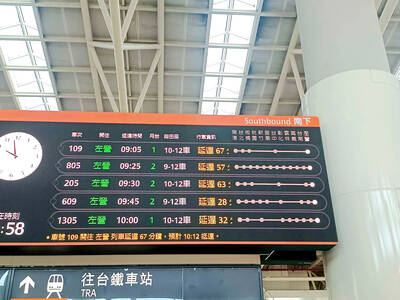
The nation’s usually punctual high-speed rail system yesterday was hit by major disruptions after all scheduled services were canceled and replaced with three hourly trains offering only non-reserved seating, affecting more than 200,000 passengers. Preliminary findings indicate the disruption was caused by a faulty power module in a track switch control cabinet, Taiwan High-Speed Rail Corp (THSRC) said, adding that as a full system inspection could only be conducted after operations end for the day, a decision on whether normal service would resume today would be announced before the first train departs. During a routine inspection early yesterday, a switch signal abnormality


 RSS
RSS