


British Prime Minister Boris Johnson’s Conservative Party has won a thumping majority of seats in Britain’s Parliament — a decisive outcome to a Brexit-dominated election that should allow Johnson to fulfill his plan to take the UK out of the EU next month.
With 649 of the 650 results declared yesterday, the Conservatives had 364 seats and the main opposition Labour Party 203.
“We did it — we pulled it off, didn’t we?” Johnson told supporters. “We broke the gridlock, we ended the deadlock, we smashed the roadblock!”
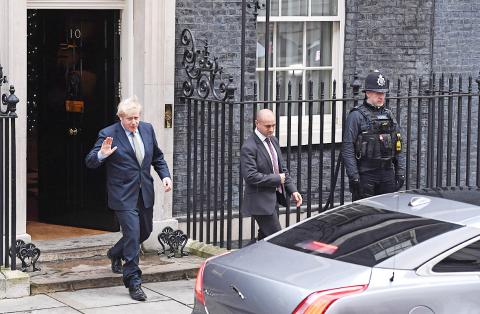
Photo: EPA-EFE
The victory makes Johnson the most electorally successful Conservative leader since former British prime minister Margaret Thatcher.
It was a disaster for Labour leader Jeremy Corbyn, who faced calls for his resignation even as the results rolled in.
US President Donald Trump congratulated Johnson on Twitter and said that “Britain and the United States will now be free to strike a massive new trade deal after Brexit.”
Corbyn called the result “very disappointing” for his party and said he would not lead Labour into another election, although he said he would lead a period of “reflection” rather than quit immediately.
Results poured in early yesterday showing a substantial shift in support to the Conservatives from Labour. In the previous election in 2017, the Conservatives won 318 seats and Labour 262.
The result this time delivered the biggest Tory majority since Thatcher’s 1980s heyday, and Labour’s lowest number of seats since 1935.
The Scottish National Party won 48 of Scotland’s 59 seats, up from 35 in 2017, a result that will embolden its demands for a new referendum on Scottish independence.
The Liberal Democrats had only 11 seats. Liberal Democrats leader Jo Swinson stepped down after losing in her own Scottish constituency.
The decisive Conservative showing vindicated Johnson’s decision to press for Thursday’s early election, which was held nearly two years ahead of schedule.
He said that if the Conservatives won a majority, he would get Parliament to ratify his Brexit divorce deal and take the UK out of the EU by the current Jan. 31 deadline.
Senior Johnson aide Dominic Cummings said that the opponents of the Conservatives were not listening to the public outside of London.
“After the shock of the referendum, MPs and journalists should have taken a deep breath and had a lot of self-reflection of why they misunderstood what was going on in the country, but instead a lot of people just doubled down on their own ideas,” Cummings told reporters. “That’s why something like this happens against expectations.”

CROSS-STRAIT COLLABORATION: The new KMT chairwoman expressed interest in meeting the Chinese president from the start, but she’ll have to pay to get in Beijing allegedly agreed to let Chinese Nationalist Party (KMT) Chairwoman Cheng Li-wun (鄭麗文) meet with Chinese President Xi Jinping (習近平) around the Lunar New Year holiday next year on three conditions, including that the KMT block Taiwan’s arms purchases, a source said yesterday. Cheng has expressed interest in meeting Xi since she won the KMT’s chairmanship election in October. A source, speaking on condition of anonymity, said a consensus on a meeting was allegedly reached after two KMT vice chairmen visited China’s Taiwan Affairs Office Director Song Tao (宋濤) in China last month. Beijing allegedly gave the KMT three conditions it had to

STAYING ALERT: China this week deployed its largest maritime show of force to date in the region, prompting concern in Taipei and Tokyo, which Beijing has brushed off Deterring conflict over Taiwan is a priority, the White House said in its National Security Strategy published yesterday, which also called on Japan and South Korea to increase their defense spending to help protect the first island chain. Taiwan is strategically positioned between Northeast and Southeast Asia, and provides direct access to the second island chain, with one-third of global shipping passing through the South China Sea, the report said. Given the implications for the US economy, along with Taiwan’s dominance in semiconductors, “deterring a conflict over Taiwan, ideally by preserving military overmatch, is a priority,” it said. However, the strategy also reiterated

‘BALANCE OF POWER’: Hegseth said that the US did not want to ‘strangle’ China, but to ensure that none of Washington’s allies would be vulnerable to military aggression Washington has no intention of changing the “status quo” in the Taiwan Strait, US Secretary of Defense Pete Hegseth said on Saturday, adding that one of the US military’s main priorities is to deter China “through strength, not through confrontation.” Speaking at the annual Reagan National Defense Forum in Simi Valley, California, Hegseth outlined the US Department of Defense’s priorities under US President Donald Trump. “First, defending the US homeland and our hemisphere. Second, deterring China through strength, not confrontation. Third, increased burden sharing for us, allies and partners. And fourth, supercharging the US defense industrial base,” he said. US-China relations under
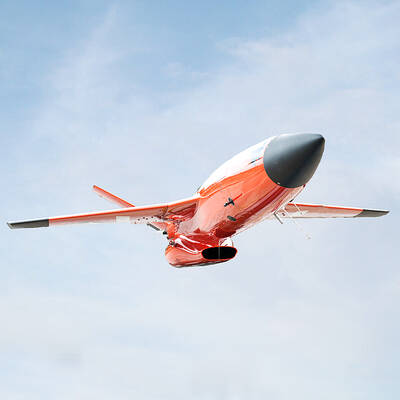
The Chien Feng IV (勁蜂, Mighty Hornet) loitering munition is on track to enter flight tests next month in connection with potential adoption by Taiwanese and US armed forces, a government source said yesterday. The kamikaze drone, which boasts a range of 1,000km, debuted at the Taipei Aerospace and Defense Technology Exhibition in September, the official said on condition of anonymity. The Chungshan Institute of Science and Technology and US-based Kratos Defense jointly developed the platform by leveraging the engine and airframe of the latter’s MQM-178 Firejet target drone, they said. The uncrewed aerial vehicle is designed to utilize an artificial intelligence computer


 RSS
RSS