

Government efforts to prevent African swine fever from spreading to Taiwan during the Lunar New Year holiday next year would be more challenging than this year, as the virus has infected more nations, Council of Agriculture (COA) Minister Chen Chi-chung (陳吉仲) said yesterday.
This year, Taiwan only had to guard against the outbreak in China, but since then, the virus has spread to 10 East Asian nations, he said while inspecting quarantine procedures for parcels from abroad at Chunghwa Post Co’s (中華郵政) mail processing center in Taipei.
Travelers carrying hams, sausages and other cured products from overseas are the largest source of illegal meat products and could affect epidemic prevention efforts during the Lunar New Year, which falls on Jan. 25, said Chen, who is also the head of the central emergency operation center for African swine fever in Taiwan.
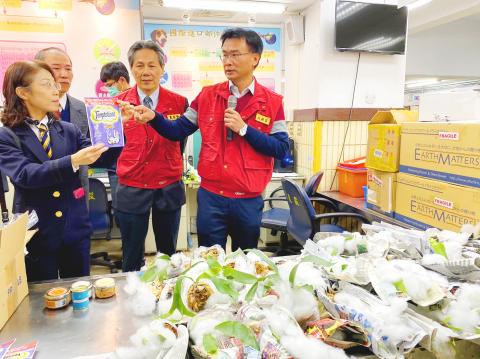
Photo: Hsiao Yu-hsin, Taipei Times
Parcel deliveries are the second-largest source, he added.
Statistics showed that from August last year to October, more than 400 parcels were found to contain illegal meat products, he said.
During the Mid-Autumn Festival period in September, eight times as many parcels were found to have breached regulations, he added.
As the peak season for gift-giving during the Lunar New Year approaches, the government is concerned that Taiwanese or foreign visitors unaware of the situation could order or send meat products via mail, he said.
Once found, such parcels are destroyed or returned, he said.
The Act for Prevention and Control of Infectious Animal Disease (動物傳染病防治條例) also stipulates that e-commerce platforms cannot sell meat products from areas where there has been an outbreak of African swine fever, he said, adding that violators could be fined NT$30,000 to NT$150,000.
Amendments to the act passed by the Legislative Yuan are to take effect on Friday, he said.
From Dec. 14 last year, when the fine for travelers carrying illegal meat products into Taiwan was raised, to the end of last month, the highest number of breaches have come from travelers from China with 560 cases, followed by those from Vietnam with 50, South Korea with 12 and the Philippines with 10, said Tung Hao-te (董好德), head of the Bureau of Animal and Plant Health Inspection and Quarantine’s Keelung branch.
A total of 632 cases incurred NT$200,000 fines, he said, adding that September had the highest number of violations in a single month, mainly due to the Mid-Autumn Festival gift-giving tradition.
From August last year to October, 7,182.74kg of pork or products containing pork that were not quarantined were found, he said.
Additional reporting by CNA

The Hualien District Prosecutors’ Office yesterday launched an investigation following allegations by a former foreign correspondent in Taiwan of widespread vote-buying in Hualien County. In an interview with Formosa TV (FTV, 民視) aired on Saturday, former Financial Times Taiwan correspondent Kathrin Hille spoke about Taiwan’s democracy and said that she now lives in rural Hualien, where “all the votes are bought.” Neighbors would talk about who had come by and leave cash on the table showing “how much each vote was worth that year,” Hille said. The practice needs to be addressed, considering Taiwan has been a democracy for many
SAFETY RISKS: A Taiwanese man who was traveling to Shanghai for business was allegedly questioned for six hours due to his past work for Amnesty International The Mainland Affairs Council (MAC) urged Taiwanese to exercise caution when considering trips to China after a Taiwanese man was allegedly questioned for six hours in Shanghai over past work with Amnesty International. The council on Saturday said in a report that 426 Taiwanese have gone missing or been detained or had their freedom of movement restricted in China since Jan. 1, 2024. The figure is up by seven from the previous week. New Chinese entry and exit regulations are due to take effect on Sept. 15, the council said. Of the 426 cases, 160 people have gone missing, up
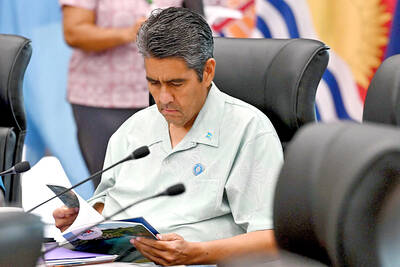
Palau’s president yesterday called for a “unified” Pacific response to a missile test by China in July, while Taiwan and its Pacific allies a day earlier at the Pacific Islands Forum (PIF) reaffirmed their commitment to peace, stability and prosperity. China gave only a handful of nations short notice before test-firing an intercontinental ballistic missile in July, sparking condemnation from several Pacific leaders. The 18-member PIF being held in Palau was expected to release a communique after press time last night, with a formal response to the test possibly included. Palau, which invited Taiwan to attend sideline events as an aid partner, urged

DEFENSE PROCUREMENT: The Pentagon has told a US congressional hearing that Taiwan has ‘top priority worldwide’ in the delivery of Harpoon missile systems The US Navy and Boeing Co have conducted a series of tests for land-based Harpoon anti-ship missile system being supplied to Taiwan and released footage showing the system striking a target vessel at sea. The weapons system and support equipment tested were reportedly tailored for Taiwan, while the first launch vehicles and other components have already begun arriving in Taiwan, with the full delivery of 100 systems scheduled to be completed by the end of 2028. Pentagon officials have previously told a US congressional hearing that Taiwan has “top priority worldwide” in the delivery of Harpoon missile systems, with production


 RSS
RSS