


A team led by Academia Sinica researchers yesterday said that it had solved a mystery surrounding the causes of ankylosing spondylitis, a spinal disease that tends to affect men aged between 20 and 40.
The disease usually starts with inflammation of the pelvic area, extending to the vertebral column, causing severe and chronic pain, Academia Sinica doctoral student Liu Chin-hsiu (劉津秀) told a news conference in Taipei.
The team discovered that the disease is triggered by a genetic pathway linked to a specific enzyme, said the rheumatology and immunology physician at Taipei Tzu Chi Hospital, who seven years ago enrolled in the doctoral program led by Genomics Research Center professor Lin Kuo-i (林國儀) hoping to find better cures for her patients with the disease.
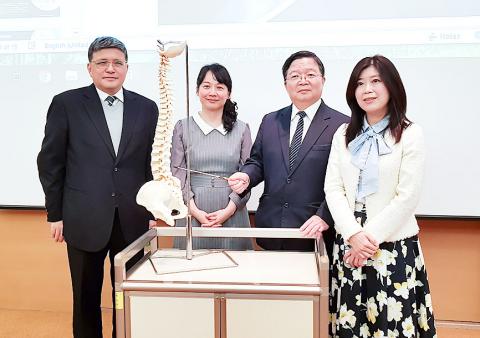
Photo: Chien Hui-ju, Taipei Times
Nearly 70,000 Taiwanese are affected by the disease, three times as many men as women, Liu said.
They rely on anti-inflammation drugs to alleviate the pain and some have undergone spinal surgery, but the disease’s pathogenesis had not been confirmed, except that it might be hereditary, she said.
The team found that an enzyme — tissue-nonspecific alkaline phosphatase (TNAP) — was activated when the HLA-B27 gene triggered a series of abnormal signal transductions, she said.
The gene had previously been linked to the disease, but it was not known how it was caused, Liu said.
After studying 154 serum samples provided by Taipei Tzu Chi Hospital and 184 samples provided by Raj Sengupta at the Royal National Hospital for Rheumatic Diseases in the UK, the team found that TNAP can cause bone spurs and be viewed as a disease progression biomarker, she said.
Given that existing drugs — levamisole and pamidronate — have proven effective in restricting TNAP, they could possibly be utilized to produce drugs that target the spinal disease, she added.
Chen Ing-ho (陳英和) of Hualien Tzu Chi Hospital provided the team with biopsies from his spinal surgeries, while China Medical University physician Hung Shih-chieh (洪士杰) helped to establish mesenchymal stem cells from the tissues, Lin said.
With those samples, the team conducted experiments on mice to observe the generation of pathogenic bone cells and the effect of TNAP, she said.
The team detailed its findings in a paper published in the online version of the Journal of Clinical Investigation on Nov. 4, with Liu listed as the lead author.
Nature Reviews Rheumatology published a peer review of the paper three weeks later.

CROSS-STRAIT COLLABORATION: The new KMT chairwoman expressed interest in meeting the Chinese president from the start, but she’ll have to pay to get in Beijing allegedly agreed to let Chinese Nationalist Party (KMT) Chairwoman Cheng Li-wun (鄭麗文) meet with Chinese President Xi Jinping (習近平) around the Lunar New Year holiday next year on three conditions, including that the KMT block Taiwan’s arms purchases, a source said yesterday. Cheng has expressed interest in meeting Xi since she won the KMT’s chairmanship election in October. A source, speaking on condition of anonymity, said a consensus on a meeting was allegedly reached after two KMT vice chairmen visited China’s Taiwan Affairs Office Director Song Tao (宋濤) in China last month. Beijing allegedly gave the KMT three conditions it had to

STAYING ALERT: China this week deployed its largest maritime show of force to date in the region, prompting concern in Taipei and Tokyo, which Beijing has brushed off Deterring conflict over Taiwan is a priority, the White House said in its National Security Strategy published yesterday, which also called on Japan and South Korea to increase their defense spending to help protect the first island chain. Taiwan is strategically positioned between Northeast and Southeast Asia, and provides direct access to the second island chain, with one-third of global shipping passing through the South China Sea, the report said. Given the implications for the US economy, along with Taiwan’s dominance in semiconductors, “deterring a conflict over Taiwan, ideally by preserving military overmatch, is a priority,” it said. However, the strategy also reiterated

‘BALANCE OF POWER’: Hegseth said that the US did not want to ‘strangle’ China, but to ensure that none of Washington’s allies would be vulnerable to military aggression Washington has no intention of changing the “status quo” in the Taiwan Strait, US Secretary of Defense Pete Hegseth said on Saturday, adding that one of the US military’s main priorities is to deter China “through strength, not through confrontation.” Speaking at the annual Reagan National Defense Forum in Simi Valley, California, Hegseth outlined the US Department of Defense’s priorities under US President Donald Trump. “First, defending the US homeland and our hemisphere. Second, deterring China through strength, not confrontation. Third, increased burden sharing for us, allies and partners. And fourth, supercharging the US defense industrial base,” he said. US-China relations under

The Chien Feng IV (勁蜂, Mighty Hornet) loitering munition is on track to enter flight tests next month in connection with potential adoption by Taiwanese and US armed forces, a government source said yesterday. The kamikaze drone, which boasts a range of 1,000km, debuted at the Taipei Aerospace and Defense Technology Exhibition in September, the official said on condition of anonymity. The Chungshan Institute of Science and Technology and US-based Kratos Defense jointly developed the platform by leveraging the engine and airframe of the latter’s MQM-178 Firejet target drone, they said. The uncrewed aerial vehicle is designed to utilize an artificial intelligence computer


 RSS
RSS