


Taiwan has sent 8,600 tonnes of food to Haiti and plans to send more next year, the Ministry of Foreign Affairs said yesterday.
The nation’s ally is facing a food crisis and a year of protests demanding that Haitian President Jovenel Moise step down over allegations of corruption.
Haiti needs international support to tackle the unfolding humanitarian crisis, Moise was quoted as saying by Reuters on Monday, adding that he was holding closed-door talks with civil society groups and opposition members to create a government of unity.
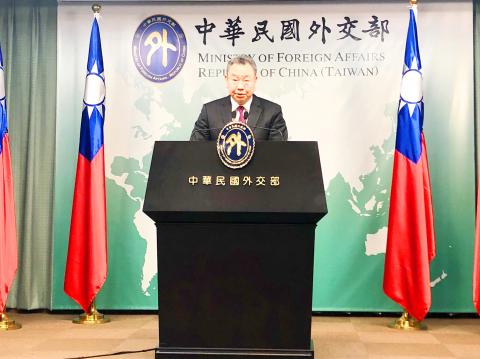
Photo: Lu Yi-hsuan, Taipei Times
Many international organizations continue to offer aid to Haiti, Department of Latin American and Caribbean Affairs Director-General Alexander Yui (俞大㵢) told a news briefing in Taipei.
To help alleviate Haiti’s humanitarian emergency, Taiwan has offered 8,600 tonnes of food this year and plans to provide more than 10,000 tonnes next year based on the nation’s needs, he said.
The ministry has relayed food through the US-based non-profit organization Food for the Poor, in addition to Taiwan’s embassy in Haiti, he said.
In related news, the ministry reaffirmed the nation’s diplomatic ties with the Marshall Islands, responding to speculation that relations might change after the Pacific ally held a general election on Monday.
Two Pacific island nations, Kiribati and the Solomon Islands, in September switched recognition from Taipei to Beijing, leaving Taiwan with 15 formal allies.
The Marshall Islands is still counting votes and relations with Taiwan were not among the issues in the election, ministry spokeswoman Joanne Ou (歐江安) said in a statement.
Marshall Islands President Hilda Heine last month met with President Tsai Ing-wen (蔡英文) in Taipei, after Tsai visited her country in March, she said.
China’s aggressive expansionism in the Pacific, along with its financial luring and unsubstantial aid to Pacific nations, has alarmed the global community, Ou said.
Taiwan would continue to improve collaborations with allies and like-minded countries to defend democracy and stability in the region, she said.

CROSS-STRAIT COLLABORATION: The new KMT chairwoman expressed interest in meeting the Chinese president from the start, but she’ll have to pay to get in Beijing allegedly agreed to let Chinese Nationalist Party (KMT) Chairwoman Cheng Li-wun (鄭麗文) meet with Chinese President Xi Jinping (習近平) around the Lunar New Year holiday next year on three conditions, including that the KMT block Taiwan’s arms purchases, a source said yesterday. Cheng has expressed interest in meeting Xi since she won the KMT’s chairmanship election in October. A source, speaking on condition of anonymity, said a consensus on a meeting was allegedly reached after two KMT vice chairmen visited China’s Taiwan Affairs Office Director Song Tao (宋濤) in China last month. Beijing allegedly gave the KMT three conditions it had to
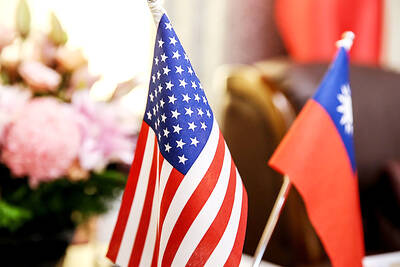
STAYING ALERT: China this week deployed its largest maritime show of force to date in the region, prompting concern in Taipei and Tokyo, which Beijing has brushed off Deterring conflict over Taiwan is a priority, the White House said in its National Security Strategy published yesterday, which also called on Japan and South Korea to increase their defense spending to help protect the first island chain. Taiwan is strategically positioned between Northeast and Southeast Asia, and provides direct access to the second island chain, with one-third of global shipping passing through the South China Sea, the report said. Given the implications for the US economy, along with Taiwan’s dominance in semiconductors, “deterring a conflict over Taiwan, ideally by preserving military overmatch, is a priority,” it said. However, the strategy also reiterated
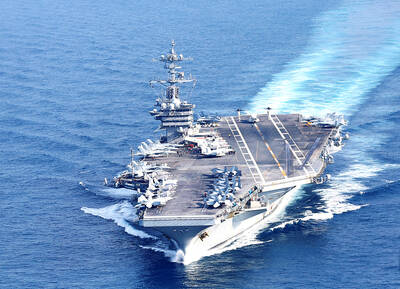
‘BALANCE OF POWER’: Hegseth said that the US did not want to ‘strangle’ China, but to ensure that none of Washington’s allies would be vulnerable to military aggression Washington has no intention of changing the “status quo” in the Taiwan Strait, US Secretary of Defense Pete Hegseth said on Saturday, adding that one of the US military’s main priorities is to deter China “through strength, not through confrontation.” Speaking at the annual Reagan National Defense Forum in Simi Valley, California, Hegseth outlined the US Department of Defense’s priorities under US President Donald Trump. “First, defending the US homeland and our hemisphere. Second, deterring China through strength, not confrontation. Third, increased burden sharing for us, allies and partners. And fourth, supercharging the US defense industrial base,” he said. US-China relations under
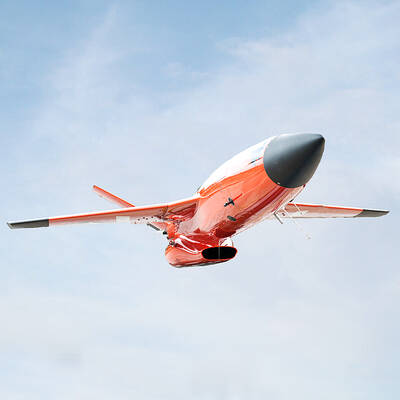
The Chien Feng IV (勁蜂, Mighty Hornet) loitering munition is on track to enter flight tests next month in connection with potential adoption by Taiwanese and US armed forces, a government source said yesterday. The kamikaze drone, which boasts a range of 1,000km, debuted at the Taipei Aerospace and Defense Technology Exhibition in September, the official said on condition of anonymity. The Chungshan Institute of Science and Technology and US-based Kratos Defense jointly developed the platform by leveraging the engine and airframe of the latter’s MQM-178 Firejet target drone, they said. The uncrewed aerial vehicle is designed to utilize an artificial intelligence computer


 RSS
RSS