


Kaohsiung Mayor Han Kuo-yu (韓國瑜), the Chinese Nationalist Party’s (KMT) presidential candidate, reportedly purchased a house in Taipei’s Nangang District (南港) for more than NT$70 million (US$2.3 million at the current exchange rate) in 2011, which contradicts his campaign image as an “everyman,” the Democratic Progressive Party (DPP) caucus said yesterday.
Details of the property purchase were exposed yesterday by the Chinese-language Next Magazine.
Han on Monday uploaded to Facebook a video of himself doing laundry and on Thursday last week he used a public washroom at a Taoyuan gas station, which KMT Legislator Apollo Chen (陳學聖) said demonstrated the mayor’s “charm.”
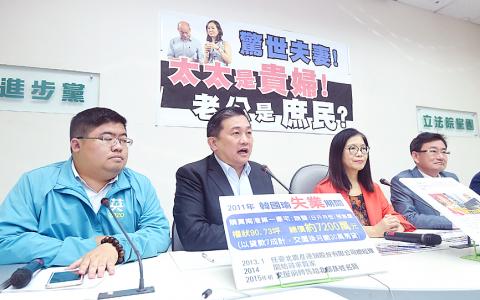
Photo: Liao Chen-huei, Taipei Times
Han’s campaign team are attempting to portray the mayor as an everyday person, media reports have said.
Han should be more responsible in the buildup to the Jan. 11 elections and should avoid causing disruptive class conflict, DPP Legislator Kuan Bi-ling (管碧玲) said at a news conference in Taipei.
Kuan was joined by DPP legislators Wang Ting-yu (王定宇), Tsai Yi-yu (蔡易餘), Huang Kuo-shu (黃國書) and Lee Chun-yi (李俊俋).
Hon Hai Precision Industry Co (鴻海精密) founder Terry Gou (郭台銘) had also commented that the atmosphere surrounding the election was “like a class struggle” when he decided not to run as an independent presidential candidate, Kuan said, adding that Han’s attempt to portray an “everyman” image has been his strategy since he ran for mayor last year, when he ate minced pork rice and drank bottled water while meeting voters.
Wang asked how Han and his wife, Lee Chia-fen (李佳芬), were able to purchase such an expensive home in 2011 when Han was unemployed if the couple were just “everyday people.”
He asked why the couple would sell the property at a loss in 2014, when Han was head of Taipei Agricultural Products Marketing Corp (台北農產公司), and then do the same when they sold a farmhouse in Yunlin County this year for less than its market value.
The property sales were “very much contrary to common sense,” he said.
The image of the couple as “everyday people” is also contradicted by their ownership of Victoria Academy bilingual school, which has very high tuition fees, Tsai said.
Han’s campaign office spokeswoman Ho Ting-huan (何庭歡) said that Han’s and Lee’s sale of the Nangang property at a loss was due to them having underestimated the financial burden of the property.
The couple were forced to sell to recuperate their losses, she said, adding that “everyday people have the right to buy and sell property.”
Additional reporting by CNA

‘NO SECURITY RISK’: The Railway Bureau reassured the public that the technicians’ activities were limited to technical guidance and did not involve sensitive systems The Railway Bureau yesterday said it had invited eight Chinese technicians to assist with an airport MRT construction project. The bureau issued the confirmation after an Internet user said Chinese nationals had entered the construction zone of Taiwan Taoyuan International Airport’s Terminal 3 project. They asked why “individuals from an enemy state” were allowed access to such a major national infrastructure project, which raised serious concerns over Taiwan’s industrial safety, sensitive systems and information security. The bureau’s Northern Region Engineering Branch Office said subcontractor Taiwan Handle Industrial Co (台灣手把工業) of the Taoyuan airport MRT’s “Contract No. CU05 Project A14 Station Civil, MEP &

The National Chungshan Institute of Science and Technology yesterday showcased its locally developed variants of the Vision 60 robotic patrol dog, which it plans to deploy on the nation’s outlying territories in the South China Sea. The variants were produced under the Joint Lab project — created by the institute and domestic companies — and assembled with domestically produced motors, lenses and artificial intelligence (AI) systems alongside licensed tech from the US, Missile and Rocket Systems Research Division deputy director Jen Kuo-kang (任國光) told the media event at a military base in Taipei’s Dazhi (大直) area. Taiwan has built up its strengths

NOT IMMEDIATE: Taiwan has a chance to appeal the proposed 10 percent tariff before it starts, while other countries face a 12.5 percent tariff from the trade office Taiwan is among 60 economies determined by the US to have failed to impose or enforce a ban on the importation of goods produced with forced labor, according to a notice released on Tuesday by the Office of the US Trade Representative (USTR), which proposed imposing an additional 10 percent or more tariff on them. The USTR in a statement said that following an investigation, it had determined under Section 301 of the Trade Act of 1974 that the failure of the 60 economies to impose and effectively enforce a prohibition on the importation of goods produced with forced labor is
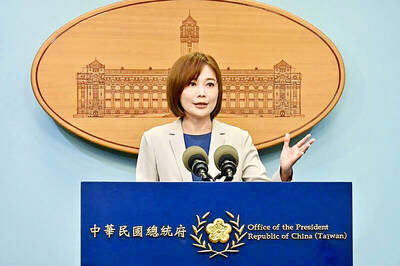
TIT-FOR-TAT: The US allegedly revoked the visa of a Chinese national working at Xinhua News Agency in the US in response to Beijing’s expulsion of Vivian Wang The Presidential Office yesterday condemned China for expelling a New York Times correspondent from Beijing following the newspaper’s interview with President William Lai (賴清德), saying the move highlighted Beijing’s suppression of press freedom and its threat to international news media. Taiwan has noted a series of recent incidents in which Beijing used similar tactics to “threaten and pressure international media outlets and journalists,” Presidential Office spokeswoman Karen Kuo (郭雅慧) said in a statement. “This concerns not only press freedom and freedom of expression, but also the safety of journalists, and Taiwan and relevant partners are paying close attention to the situation,” she


 RSS
RSS