


Two Americans and a British scientist won the Nobel Prize for Physiology or Medicine for discovering how the body’s cells sense and react to oxygen levels, work that has paved the way for new strategies to fight anemia, cancer and other diseases, the Nobel Committee said.
William Kaelin Jr of Harvard University, Gregg Semenza of Johns Hopkins University and Peter Ratcliffe at the Francis Crick Institute in Britain and Oxford University are to share the 9 million kronor (US$918,000) cash award, the Karolinska Institute said.
It is the 110th time the prize has been awarded since 1901.

Photo: AFP
Their work has “greatly expanded our knowledge of how physiological response makes life possible,” the committee said, adding that the scientists identified the biological machinery that regulates how genes respond to varying levels of oxygen.
That response is key to things like producing red blood cells, generating new blood vessels and fine-tuning the immune system.
The Nobel Committee said scientists are focused on developing drugs that can treat diseases by either activating or blocking the body’s oxygen-sensing machinery.
The oxygen response is hijacked by cancer cells, for example, which stimulate formation of blood vessels to help themselves grow.
People with kidney failure often get hormonal treatments for anemia, but the work of the new laureates points the way toward new treatments, Nils-Goran Larsson of the Nobel committee said.
Reached at his home, Kaelin said he was half-asleep yesterday morning when the telephone rang. It was Stockholm.
“I was aware as a scientist that if you get a phone call at 5am with too many digits, it’s sometimes very good news, and my heart started racing. It was all a bit surreal,” he said.
Kaelin said he is not sure yet how he will spend the prize money, but “obviously I’ll try to put it to some good cause.”
Ratcliffe told Sweden’s news agency TT that “when I started my research I also had no idea that it would result in this.”
The impact of oxygen on cells “has not always been a trendy area to research, and some people have doubted them during the journey,” he said.
The physics prize is to be handed out today, followed by the chemistry prize tomorrow.
The literature prizes — one for this year and one for last year — are to be awarded on Thursday, the peace prize is to be announced on Friday and the economics prize is to be awarded on Monday next week.
The laureates are to receive their awards at ceremonies in Stockholm and Oslo on Dec. 10.

A magnitude 7.0 earthquake struck off Yilan at 11:05pm yesterday, the Central Weather Administration (CWA) said. The epicenter was located at sea, about 32.3km east of Yilan County Hall, at a depth of 72.8km, CWA data showed There were no immediate reports of damage. The intensity of the quake, which gauges the actual effect of a seismic event, measured 4 in Yilan County area on Taiwan’s seven-tier intensity scale, the data showed. It measured 4 in other parts of eastern, northern and central Taiwan as well as Tainan, and 3 in Kaohsiung and Pingtung County, and 2 in Lienchiang and Penghu counties and 1
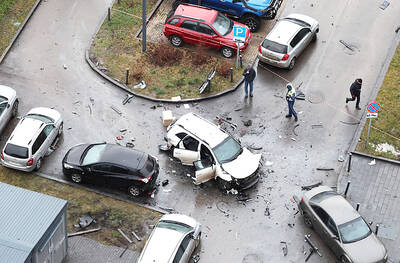
A car bomb killed a senior Russian general in southern Moscow yesterday morning, the latest high-profile army figure to be blown up in a blast that came just hours after Russian and Ukrainian delegates held separate talks in Miami on a plan to end the war. Kyiv has not commented on the incident, but Russian investigators said they were probing whether the blast was “linked” to “Ukrainian special forces.” The attack was similar to other assassinations of generals and pro-war figures that have either been claimed, or are widely believed to have been orchestrated, by Ukraine. Russian Lieutenant General Fanil Sarvarov, 56, head
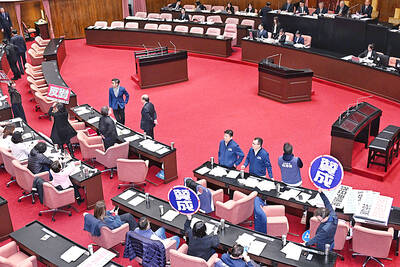
‘POLITICAL GAME’: DPP lawmakers said the motion would not meet the legislative threshold needed, and accused the KMT and the TPP of trivializing the Constitution The Legislative Yuan yesterday approved a motion to initiate impeachment proceedings against President William Lai (賴清德), saying he had undermined Taiwan’s constitutional order and democracy. The motion was approved 61-50 by lawmakers from the main opposition Chinese Nationalist Party (KMT) and the smaller Taiwan People’s Party (TPP), who together hold a legislative majority. Under the motion, a roll call vote for impeachment would be held on May 19 next year, after various hearings are held and Lai is given the chance to defend himself. The move came after Lai on Monday last week did not promulgate an amendment passed by the legislature that

FOREIGN INTERFERENCE: Beijing would likely intensify public opinion warfare in next year’s local elections to prevent Lai from getting re-elected, the ‘Yomiuri Shimbun’ said Internal documents from a Chinese artificial intelligence (AI) company indicated that China has been using the technology to intervene in foreign elections, including propaganda targeting Taiwan’s local elections next year and presidential elections in 2028, a Japanese newspaper reported yesterday. The Institute of National Security of Vanderbilt University obtained nearly 400 pages of documents from GoLaxy, a company with ties to the Chinese government, and found evidence that it had apparently deployed sophisticated, AI-driven propaganda campaigns in Hong Kong and Taiwan to shape public opinion, the Yomiuri Shimbun reported. GoLaxy provides insights, situation analysis and public opinion-shaping technology by conducting network surveillance


 RSS
RSS