


Monaco on Tuesday became the first nation in Europe to inaugurate a 5G mobile phone network based on technology from Chinese firm Huawei Technologies Co Ltd (華為), which is seen by the US as a major security risk.
As mobile operators shift away from slower 3G and 4G networks, Europe has been torn over its approach to the Chinese giant, which is a pioneer in 5G technology.
In September last year, Monaco Telecom, which is owned by French billionaire Xavier Niel, signed an agreement with Huawei to make the tiny principality the first nation in Europe fully covered by 5G.

Photo: AFP
“We are the first state to be entirely covered by a 5G network,” Monaco Telecom president Etienne Franzi said at the inauguration ceremony.
“In Monaco, the 5G is the promise of a better quality of life for all and exceptional opportunities,” Monaco Country Chief Digital Officer Frederic Genta said.
For Huawei vice president Guo Ping (郭平), the rollout in Monaco is a major opportunity, despite the small size of territory covered.
“It allows us to make a shop window in a number of areas, notably linking 5G development to this intelligent state,” he said. “It can serve as a model for other operators and states.”
Monaco Telecom director-general Martin Peronnet in May defended the decision to work with the Chinese supplier.
“There are many countries and operators that are in the process of finalizing a 5G rollout with Huawei or who have already done so,” he said.
Before the deployment, the operator worked to update its equipment and deploy 5G-compatible antennae, saying that it had put in place the necessary security measures to protect its systems.
Huawei’s involvement in 5G networks has become an increasingly political issue after Washington raised concerns over potential security risks and pushed its closest allies to reject the Chinese firm.
The company says it has signed 50 contracts for 5G worldwide, including 28 with European operators.
South Korea has already announced complete nationwide 5G coverage, while smaller Europe nations such as Switzerland, Finland and Estonia have only just started deploying the technology.
Germany is only now handing out frequencies to operators and France should follow in the final quarter of the year.
Last month, an internal report by the GSM Association, which represents mobile network operators around the world, found that banning Huawei and fellow Chinese equipment maker ZTE Corp (中興通訊) from Europe’s 5G rollout would cost European operators up to 55 billion euros (US$61.69 billion).
It would also slow down the rollout of 5G networks in Europe and lead to reduced take-up, which would further increase the productivity gap between the EU and the US, the report said.

SILENCING CRITICS: In addition to blocking Taiwan, China aimed to prevent rights activists from speaking out against authoritarian states, a Cabinet department said The Ministry of Foreign Affairs (MOFA) yesterday condemned transnational repression by Beijing after RightsCon, a major digital human rights conference scheduled to be held in Zambia this week, was abruptly canceled due to Chinese pressure over Taiwanese participation. This year’s RightsCon, the world’s largest conference discussing issues “at the intersection of human rights and technology,” was scheduled to take place from tomorrow to Friday in Lusaka, and expected to draw 2,600 in-person attendees from 150 countries, along with 1,100 online participants. However, organizers were forced to cancel the event due to behind-the-scenes pressure from China, the ministry said, expressing its “strongest condemnation”
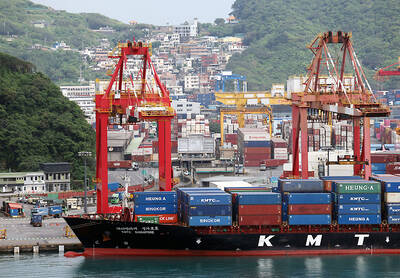
Taiwan’s economy grew far faster than expected in the first quarter, as booming demand for artificial intelligence (AI) applications drove a surge in exports, spilling over into investment and consumption, the Directorate-General of Budget, Accounting and Statistics (DGBAS) said yesterday. GDP growth was 13.69 percent year-on-year during the January-to-March period, beating the DGBAS’ February forecast by 2.23 percentage points and marking the most robust growth in nearly four decades, DGBAS senior official Chiang Hsin-yi (江心怡) told a news conference in Taipei. The result was powered by exports, which remain the backbone of Taiwan’s economy, Chiang said. Outbound shipments jumped 51.12 percent year-on-year to
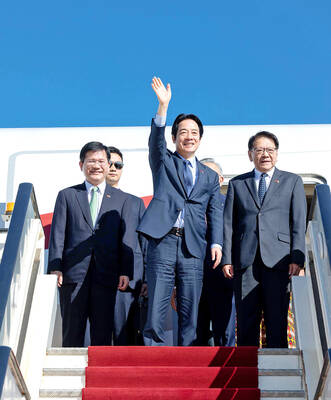
DELAYED BUT DETERMINED: The president’s visit highlights Taiwan’s right to international engagement amid regional pressure from China President Willaim Lai (賴清德) yesterday arrived in Eswatini, more than a week after his planned visit to Taiwan’s sole African ally was suspended because of revoked overflight permits. “The visit, originally scheduled for April 22, was postponed due to unforeseen external factors,” Lai wrote on social media. “After several days of careful arrangements by our diplomatic and national security teams, we successfully arrived today.” Lai said he looked forward to further deepening Taiwan-Eswatini relations through closer cooperation in the economy, agriculture, culture and education, as well as advancing the nation’s international partnerships. The president was initially scheduled to arrive in time to celebrate
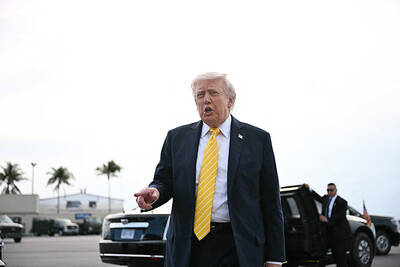
Iran’s Islamic Revolutionary Guard Corp (IRGC) yesterday said the US faced a choice between an “impossible” military operation or a “bad deal” with Tehran, after US President Donald Trump disparaged Iran’s latest peace proposal. Negotiations between the two countries have been deadlocked since a ceasefire came into effect on April 8, with only one round of direct peace talks held so far. Iran’s Tasnim and Fars news agencies reported that Tehran had submitted a 14-point proposal to mediator Pakistan, but Trump was quick to cast doubt on it. “I will soon be reviewing the plan that Iran has just sent to us, but


 RSS
RSS