


Kaohsiung Mayor Han Kuo-yu (韓國瑜) won the mayoral election on Nov. 24 last year with the help of “a campaign of social media manipulation orchestrated by a mysterious, seemingly professional cybergroup from China,” Foreign Policy magazine said in an article published on Wednesday.
In the article, titled “Chinese cyber-operatives boosted Taiwan’s insurgent candidate,” Paul Huang (黃翔暐), a Taipei-based freelance journalist and writer and Kaohsiung native, wrote: “Barely six months into office, Kaohsiung Mayor Han Kuo-yu is already eyeing a run for the presidency in 2020 and is seen as the godsend that Beijing has been waiting for: the emergence of a populist, pro-China candidate in Taiwan.”
Despite “strong suspicions of Chinese interference” in the local elections held on Nov. 24 last year and a decline in President Tsai Ing-wen’s (蔡英文) popularity, “few expected the DPP [Democratic Progressive Party] would lose Kaohsiung,” he wrote.

Photo: Hung Ting-hung, Taipei Times
In contrast to the DPP’s Chen Chi-mai (陳其邁), “an experienced, if somewhat bland, legislator,” Han was “an outsider to Kaohsiung politics whose pro-China rhetoric seemed out of touch with the city’s fierce pro-independent ethos,” he wrote.
The Chinese Nationalist Party (KMT) “only nominated him because it was considered a long-shot race,” he wrote, citing a KMT member with knowledge of the matter.
“At a glance, it would appear as if a populist candidate, riding on an incumbent president’s unpopularity, defied unfavorable electoral odds through his charisma and the sheer power of social media. That’s not an uncommon story. But that’s not the whole of the tale here,” he wrote.
At the end of the election campaign, Han’s Facebook account had accumulated 500,000 followers, twice that of Chen’s, while an unofficial Facebook group called “Han Kuo-yu Fans For Victory! Holding up a Blue Sky!” created on April 10 last year had more than 61,000 members by election day, he wrote.
Members of the unofficial group “promoted Han through posting talking points, memes, and very often fake news attacking Han’s opponent Chen, the DPP government, and anyone who said a bad word about Han,” he wrote.
Of the six administrators listed on the group page in November last year, Huang said he had identified three corresponding profiles on LinkedIn.
All three profiles claimed to be Tencent Holdings Ltd (騰訊) employees and Peking University alumni, he wrote.
Two of the LinkedIn profiles wrote in their descriptions the phrase “worked in public relations for many foreign companies,” he wrote.
A LinkedIn search for this phrase gave 249 more results, “every single one sharing identical characteristics, including mugshot-style photos cropped from decades-old graduation pictures and claims of being Tencent employees and Peking University graduates,” he wrote, adding that the profiles have “some telltale signs of being fakes.”
National Chung Cheng University assistant professor Lin Ying-yu (林穎佑) “believes the cybergroup can be traced back to the Strategic Support Force of China’s army,” he wrote.
However, a Political Warfare Bureau psychological operations officer who declined to be named says the group was “likely a private team contracted through a Chinese company rather than being a dedicated military or intelligence unit in itself — albeit with the Chinese government ultimately pulling the strings,” he writes.
Lin and other experts “say there were many other groups, pages, content farms, and platforms out there beyond Facebook that Beijing used to propel Han to electoral success,” he wrote.
Huang wrote that while there is “no evidence Han himself colluded with this group or any other,” he was “certainly aware that his support online was somewhat mysterious.”

AGING: As of last month, people aged 65 or older accounted for 20.06 percent of the total population and the number of couples who got married fell by 18,685 from 2024 Taiwan has surpassed South Korea as the country least willing to have children, with an annual crude birthrate of 4.62 per 1,000 people, Ministry of the Interior data showed yesterday. The nation was previously ranked the second-lowest country in terms of total fertility rate, or the average number of children a woman has in her lifetime. However, South Korea’s fertility rate began to recover from 2023, with total fertility rate rising from 0.72 and estimated to reach 0.82 to 0.85 by last year, and the crude birthrate projected at 6.7 per 1,000 people. Japan’s crude birthrate was projected to fall below six,
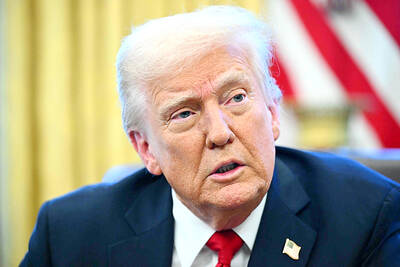
US President Donald Trump in an interview with the New York Times published on Thursday said that “it’s up to” Chinese President Xi Jinping (習近平) what China does on Taiwan, but that he would be “very unhappy” with a change in the “status quo.” “He [Xi] considers it to be a part of China, and that’s up to him what he’s going to be doing, but I’ve expressed to him that I would be very unhappy if he did that, and I don’t think he’ll do that. I hope he doesn’t do that,” Trump said. Trump made the comments in the context
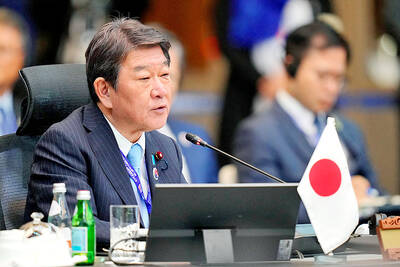
SELF-DEFENSE: Tokyo has accelerated its spending goal and its defense minister said the nation needs to discuss whether it should develop nuclear-powered submarines China is ramping up objections to what it sees as Japan’s desire to acquire nuclear weapons, despite Tokyo’s longstanding renunciation of such arms, deepening another fissure in the two neighbors’ increasingly tense ties. In what appears to be a concerted effort, China’s foreign and defense ministries issued statements on Thursday condemning alleged remilitarism efforts by Tokyo. The remarks came as two of the country’s top think tanks jointly issued a 29-page report framing actions by “right-wing forces” in Japan as posing a “serious threat” to world peace. While that report did not define “right-wing forces,” the Chinese Ministry of Foreign Affairs was

PREPAREDNESS: Given the difficulty of importing ammunition during wartime, the Ministry of National Defense said it would prioritize ‘coproduction’ partnerships A newly formed unit of the Marine Corps tasked with land-based security operations has recently replaced its aging, domestically produced rifles with more advanced, US-made M4A1 rifles, a source said yesterday. The unnamed source familiar with the matter said the First Security Battalion of the Marine Corps’ Air Defense and Base Guard Group has replaced its older T65K2 rifles, which have been in service since the late 1980s, with the newly received M4A1s. The source did not say exactly when the upgrade took place or how many M4A1s were issued to the battalion. The confirmation came after Chinese-language media reported


 RSS
RSS