


German warships could be sent through the Taiwan Strait to challenge Beijing’s claims over international waterways, which would mark a departure of Germany’s decades-long non-confrontation policy, US media outlet Politico’s European branch said yesterday.
German officials last week confirmed, after discussing the issue with the German Federal Ministry of Defense, that such plans were being considered, said an article by John Vinocur, former executive editor and vice president of the International Herald Tribune.
Should the administration of German Chancellor Angela Merkel go ahead with the plan, Germany would be challenging the French opinion that Germany is running a “non-combat army” while openly backing allies, Vinocur said.

Photo: EPA-EFE
However, the plan would be provocative to those in Germany who favor non-aggression, he said.
Vinocur cited as examples of Germany’s reluctance to engage in conflicts the withdrawal of its navy from the combat zone during the Libyan intervention in 2011, caveats on its troop deployments in Afghanistan and its decision not to directly participate in attacks on the Islamic State group in Syria — unlike its NATO neighbors Belgium, the Netherlands, Denmark and France.
Reasons to go ahead with the plan would include improving US-German relations — especially after a recently announced six-month suspension to US tariffs on German vehicles — and one-upping France, which claims to have the only functioning military in the EU, Vinocur said.
France in April sent a frigate through the Taiwan Strait, which was shadowed by the Chinese military and resulted in Beijing lodging official protests with Paris regarding its “illegal passage” through the waterway.
Later that month, the US dispatched two destroyers through the Taiwan Strait, which a US official said demonstrated “the US’ commitment to a free and open Indo-Pacific.”
While Vinocur applauded some elements in Germany’s military for attempting to challenge the slight on the country for a “hide-under-the-bed routine,” he said that the chances of the Merkel administration going ahead with the plan “are not overwhelmingly promising.”
“Germany is politically riven to the state of instability,” Vinocur said, citing Merkel’s “paralytic” coalition with the Social Democratic Party being likely to dissolve and the growth of popularity of the Green Party.
Merkel’s chosen successor, Christian Democratic Union leader Annegret Kramp-Karrenbauer, is increasingly unpopular with the German public, Vinocur said, citing a poll last week showing that 70 percent of Germans think she is not up to the task.
Economically, Germany is looking at a 0.6 percent fall in GDP, with no signs of improvement next year, he said, citing Association of German Chambers of Industry and Commerce reports.
Against that backdrop, launching a naval operation in the Taiwan Strait would be a groundbreaking, but unfamiliar act of valor that would first require the German Navy to get that far, he added.
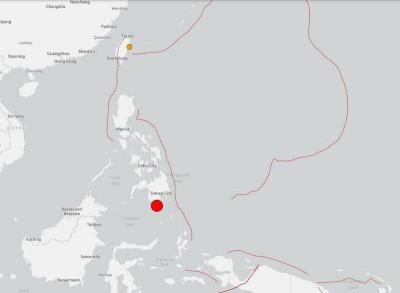
A magnitude 7.8 earthquake struck off the southern coast of Mindanao in the Philippines at 7:38am today, prompting the US Tsunami Warning System to issue an alert for neighboring countries, including Taiwan. The system issued a purple alert indicating a "tsunami threat." The potential threat zone includes Taiwan, the Philippines, Papua New Guinea, Yap and Palau. Philippine authorities were assessing the damage from the quake, with the office of civil defense seeking to verifying initial reports that 15 people had been killed and 129 injured in the region, mostly from falling debris. Arlene Hollero, disaster chief of Maasim town in the Philippines' Sarangani Province,
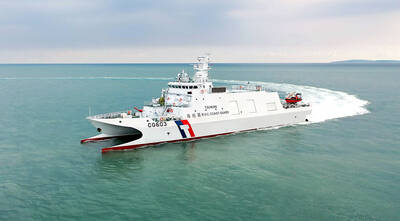
‘GRAY ZONE’ PRESSURE: Beijing’s activities are intended to create the deceitful impression that China has jurisdiction over the area around Taiwan, the CGA said Taiwan’s rights over its territorial waters and exclusive economic zone must not be violated by any country, the Mainland Affairs Council said yesterday, adding that it will not accept any unprovoked actions. The council issued the remarks in response to the China Coast Guard conducting maritime enforcement drills near eastern Taiwan and claiming to fully exercise China’s maritime administrative law enforcement authority. The Coast Guard Administration (CGA) has been closely monitoring the situation and is taking concrete steps to defend the nation’s sovereignty and secure its waters, the council said. China has no sovereign rights over the waters off eastern
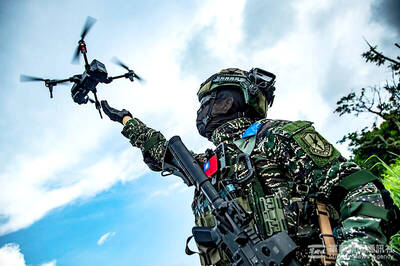
RESILIENCE: Taiwan plays a key role in semiconductors, energy, information infrastructure and advanced manufacturing, AIT Director Raymond Greene said Taiwan’s continued investment in deterrence and resilience remains vital, especially in uncrewed systems and other emerging technologies, American Institute in Taiwan (AIT) Director Raymond Greene said yesterday. Greene made the remarks at the annual National Strategic Summit on Supply Chain Resilience held by the Research Institute for Democracy, Society and Emerging Technology (DSET), a government-backed think tank. As Taiwan last year became the US’ fourth-largest trading partner and supply chain security is becoming more important, cooperation in emerging technologies continues to deepen between the two countries, he said. The US is committed to accelerating innovation, building key infrastructure, strengthening cooperation

The National Chungshan Institute of Science and Technology yesterday showcased its locally developed variants of the Vision 60 robotic patrol dog, which it plans to deploy on the nation’s outlying territories in the South China Sea. The variants were produced under the Joint Lab project — created by the institute and domestic companies — and assembled with domestically produced motors, lenses and artificial intelligence (AI) systems alongside licensed tech from the US, Missile and Rocket Systems Research Division deputy director Jen Kuo-kang (任國光) told the media event at a military base in Taipei’s Dazhi (大直) area. Taiwan has built up its strengths


 RSS
RSS