


Lawmakers yesterday amended the Act Governing Relations Between the People of the Taiwan Area and the Mainland Area (台灣地區與大陸地區人民關係條例) to include legislative oversight and referendums before the government can sign a political agreement with China.
The amended act includes a new Article 5-3, which stipulates that the Executive Yuan must submit a signing plan and a political impact assessment report to the Legislative Yuan at least 90 days before it is scheduled to begin negotiations with the Chinese government.
The plan must obtain the approval of three-quarters of lawmakers in a legislative meeting attended by at least three-quarters of all lawmakers, the amendment says.
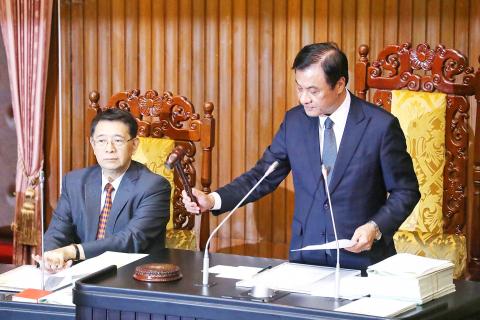
Photo: CNA
A political agreement, as defined by the amendment, is one that would have a major constitutional or political effect.
The amendment stipulates that the agency in charge of signing an agreement must carry out negotiations according to the plan and give timely reports to the legislature, which may summon the agency for a briefing.
The Executive Yuan could terminate the negotiations should they prove unfeasible, or the Legislative Yuan could veto them if at least half of lawmakers vote to do so, it says.
If the two sides of the Taiwan Strait work out a draft agreement, the Executive Yuan should deliver it to the president within 15 days, and publish the draft in its entirety within 15 days of the president signing off on a potential deal, the amendment says.
Legislative committees must then hold a public hearing to gather public opinions about the possible political implications of the draft before sending it to a plenary session for review, it says.
The draft agreement would then need to gain the backing of at least 75 percent of lawmakers during a plenary session with at least 75 percent attendance, the amendment says.
It would then be required to pass a national referendum by garnering the votes of at least half of all eligible voters, it says.
If the referendum is passed, the two sides may formally sign an agreement, which would take effect after it is signed by the president, the amendment says.
The nation’s sovereignty and statehood, or proposals to alter or abrogate the nation’s free, democratic and constitutional system, must not be a subject of cross-strait negotiations, it says.
Any political agreement that contravenes the article would be annulled, it says.
The amendment was sponsored by the Democratic Progressive Party (DPP) caucus, which revised a version originally submitted by the Cabinet to make it clearer.
DPP caucus director-general Kuan Bi-ling (管碧玲) said the way in which the act was previously written would allow the Executive Yuan to sign a political agreement with China of its own accord and “notify” the legislature later, which was a “shortcut” that Chinese Nationalist Party (KMT) Chairman Wu Den-yih (吳敦義) and other proponents of a peace agreement with China — “including all KMT presidential hopefuls” — sought to exploit.
DPP Legislator Liu Shih-fang (劉世芳) said that some mayors and commissioners have advocated signing a peace agreement with China after Chinese President Xi Jinping (習近平) in a speech on Jan. 2 proposed imposing a “one country, two systems” framework on Taiwan and said that China would not renounce the use of force to annex Taiwan.
“The amendment reflects the public opinion that cross-strait relations are not dictated by Mr Xi on the other side of the Strait, but are decided by all 23 million Taiwanese,” she said.
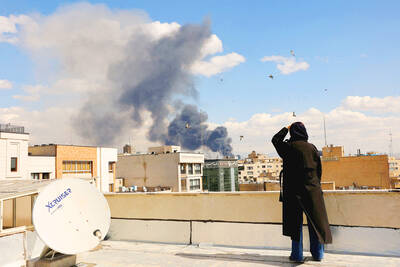
CHAOS: Iranians took to the streets playing celebratory music after reports of Khamenei’s death on Saturday, while mourners also gathered in Tehran yesterday Iranian Supreme Leader Ayatollah Ali Khamenei was killed in a major attack on Iran launched by Israel and the US, throwing the future of the Islamic republic into doubt and raising the risk of regional instability. Iranian state television and the state-run IRNA news agency announced the 86-year-old’s death early yesterday. US President Donald Trump said it gave Iranians their “greatest chance” to “take back” their country. The announcements came after a joint US and Israeli aerial bombardment that targeted Iranian military and governmental sites. Trump said the “heavy and pinpoint bombing” would continue through the week or as long

An Emirates flight from Dubai arrived at Taiwan Taoyuan International Airport yesterday afternoon, the first service of the airline since the US and Israel launched strikes against Iran on Saturday. Flight EK366 took off from the United Arab Emirates (UAE) at 3:51am yesterday and landed at 4:02pm before taxiing to the airport’s D6 gate at Terminal 2 at 4:08pm, data from the airport and FlightAware, a global flight tracking site, showed. Of the 501 passengers on the flight, 275 were Taiwanese, including 96 group tour travelers, the data showed. Tourism Administration Deputy Director-General Huang He-ting (黃荷婷) greeted Taiwanese passengers at the airport and
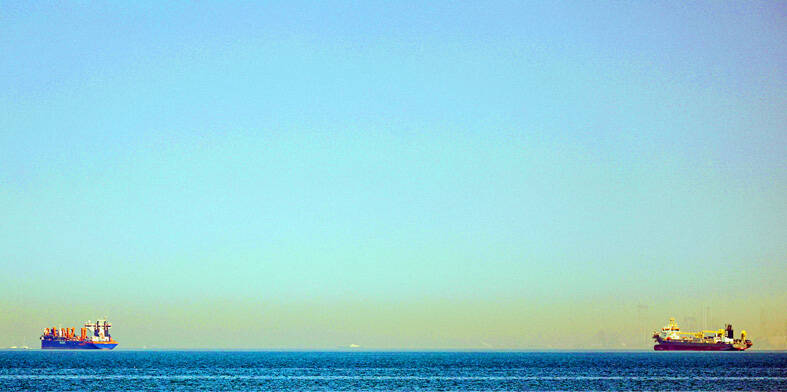
State-run CPC Corp, Taiwan (CPC, 台灣中油) yesterday said that it had confirmed on Saturday night with its liquefied natural gas (LNG) and crude oil suppliers that shipments are proceeding as scheduled and that domestic supplies remain unaffected. The CPC yesterday announced the gasoline and diesel prices will rise by NT$0.2 and NT$0.4 per liter, respectively, starting Monday, citing Middle East tensions and blizzards in the eastern United States. CPC also iterated it has been reducing the proportion of crude oil imports from the Middle East and diversifying its supply sources in the past few years in response to geopolitical risks, expanding
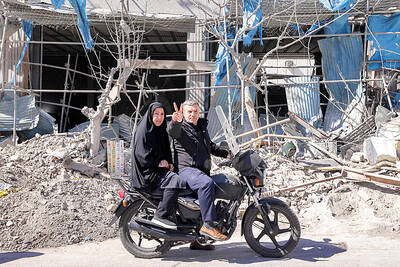
STRAIT OF HORMUZ: In the case of a prolonged blockade by Iran, Taiwan would look to sources of LNG outside the Middle East, including Australia and the US Taiwan would not have to ration power due to a shortage of natural gas, Minister of Economic Affairs Kung Ming-hsin (龔明鑫) said yesterday, after reports that the Strait of Hormuz was closed amid the conflict in the Middle East. The government has secured liquefied natural gas (LNG) supplies for this month and contingency measures are in place if the conflict extends into next month, Kung told lawmakers. Saying that 25 percent of Taiwan’s natural gas supplies are from Qatar, Chinese Nationalist Party (KMT) caucus secretary-general Lin Pei-hsiang (林沛祥) asked about the situation in light of the conflict. There would be “no problems” with


 RSS
RSS