


The US on Wednesday issued an executive order apparently aimed at banning Huawei Technologies Co (華為) equipment from US networks and said it was subjecting the Chinese firm to strict export controls.
Huawei would be the largest business ever subjected to the controls, a law enforcement measure that requires it to obtain US government approval on purchases of US technology, said Kevin Wolf, a former US assistant secretary of commerce for export administration.
“It’s going to have ripple effects through the entire global telecommunications network, because Huawei affiliates all over the planet depend on US content to function and if they can’t get the widget or the part or the software update to keep functioning, then those systems go down,” he said.
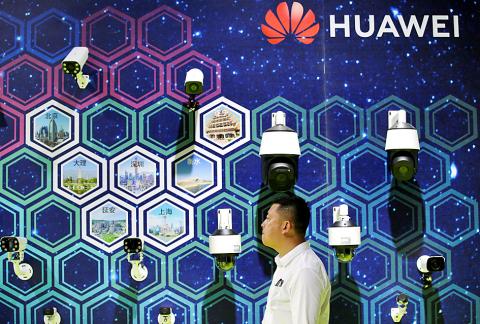
Photo: Reuters
Asked if that could include barring Google from selling its Android operating system, which Huawei uses on its handsets, Wolf said it would be premature to say until he has seen a published order from the US Department of Commerce’s Bureau of Industry and Security.
The executive order declares a national economic emergency that empowers the government to ban the technology and services of “foreign adversaries” deemed to pose “unacceptable risks” to national security.
It gives the department 150 days to come up with regulations.
The export restriction is “a grave escalation with China that at minimum plunges the prospect of continued trade negotiations into doubt,” Eurasia Group analysts said in a report.
It appears that the law invoked in the order, the US’ 1977 International Emergency Economic Powers Act, has never before been declared in a way that affects an entire commercial sector.
It has routinely been used to freeze the assets of designated terrorists and drug traffickers, and impose embargoes on hostile former governments.
Huawei said that blocking it from doing business in the US would hamper the introduction of next-generation communications technology.
“We are ready and willing to engage with the US government and come up with effective measures to ensure product security,” the company said in a statement.
The restrictions “will not make the US more secure or stronger,” the company said.
The US would be limited to “inferior, yet more expensive alternatives,” which would hurt companies and consumers, it added.
A senior US administration official, who briefed reporters on condition of anonymity, said in a hastily arranged call that the order was “company and country agnostic,” and would not be retroactive.
Officials said that “interim regulations” were expected before final rules were set, but were vague on what that meant.
“It signals to US friends and allies how far Washington is willing to go to block Huawei,” Council on Foreign Relations cybersecurity director Adam Segal said.
Many in Europe have resisted a fierce US diplomatic campaign to institute a wholesale ban on the company’s equipment in their 5G wireless networks.
Segal said that with US-China trade talks at a standstill, the White House “felt the time had finally come to pull the trigger.”
It is a “low-cost signal of resolve from the [US President Donald] Trump administration,” Segal said, adding that there is little at stake economically.
Huawei said it supplies 45 of the world’s top 50 phone companies, but only about 2 percent of telecom equipment purchased by North American carriers in 2017 was Huawei-made.
The domestic economic impact would be restricted mostly to small rural carriers for whom Huawei equipment has been attractive because of its lower costs, potentially making it more difficult to expand access to speedy Internet in rural areas.
AGING: As of last month, people aged 65 or older accounted for 20.06 percent of the total population and the number of couples who got married fell by 18,685 from 2024 Taiwan has surpassed South Korea as the country least willing to have children, with an annual crude birthrate of 4.62 per 1,000 people, Ministry of the Interior data showed yesterday. The nation was previously ranked the second-lowest country in terms of total fertility rate, or the average number of children a woman has in her lifetime. However, South Korea’s fertility rate began to recover from 2023, with total fertility rate rising from 0.72 and estimated to reach 0.82 to 0.85 by last year, and the crude birthrate projected at 6.7 per 1,000 people. Japan’s crude birthrate was projected to fall below six,
Conflict with Taiwan could leave China with “massive economic disruption, catastrophic military losses, significant social unrest, and devastating sanctions,” a US think tank said in a report released on Monday. The German Marshall Fund released a report titled If China Attacks Taiwan: The Consequences for China of “Minor Conflict” and “Major War” Scenarios. The report details the “massive” economic, military, social and international costs to China in the event of a minor conflict or major war with Taiwan, estimating that the Chinese People’s Liberation Army (PLA) could sustain losses of more than half of its active-duty ground forces, including 100,000 troops. Understanding Chinese
US President Donald Trump in an interview with the New York Times published on Thursday said that “it’s up to” Chinese President Xi Jinping (習近平) what China does on Taiwan, but that he would be “very unhappy” with a change in the “status quo.” “He [Xi] considers it to be a part of China, and that’s up to him what he’s going to be doing, but I’ve expressed to him that I would be very unhappy if he did that, and I don’t think he’ll do that. I hope he doesn’t do that,” Trump said. Trump made the comments in the context
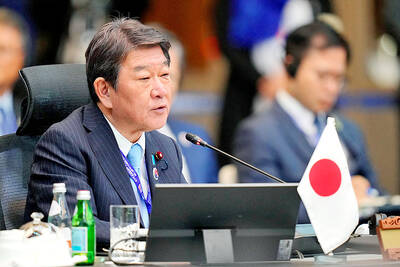
SELF-DEFENSE: Tokyo has accelerated its spending goal and its defense minister said the nation needs to discuss whether it should develop nuclear-powered submarines China is ramping up objections to what it sees as Japan’s desire to acquire nuclear weapons, despite Tokyo’s longstanding renunciation of such arms, deepening another fissure in the two neighbors’ increasingly tense ties. In what appears to be a concerted effort, China’s foreign and defense ministries issued statements on Thursday condemning alleged remilitarism efforts by Tokyo. The remarks came as two of the country’s top think tanks jointly issued a 29-page report framing actions by “right-wing forces” in Japan as posing a “serious threat” to world peace. While that report did not define “right-wing forces,” the Chinese Ministry of Foreign Affairs was


 RSS
RSS