


The Ministry of Education yesterday proclaimed academic and cultural exchanges by students and teachers with Chinese Communist Party-affiliated institutions a breach of the Act Governing Relations Between the People of the Taiwan Area and the Mainland Area (台灣地區與大陸地區人民關係條例) punishable by a NT$500,000 (US$16,152) fine.
Officials discovered that some schools have become sister schools with Communist Youth League academies, while others have sent interns to China’s state-run China Central Television and the People’s Daily, Department of International and Cross-strait Education Director-General Lai Hsin-jen (賴信任) said.
The ministry has asked the schools to correct the situation and vowed to impose a fine if the infractions persist, Lai said.
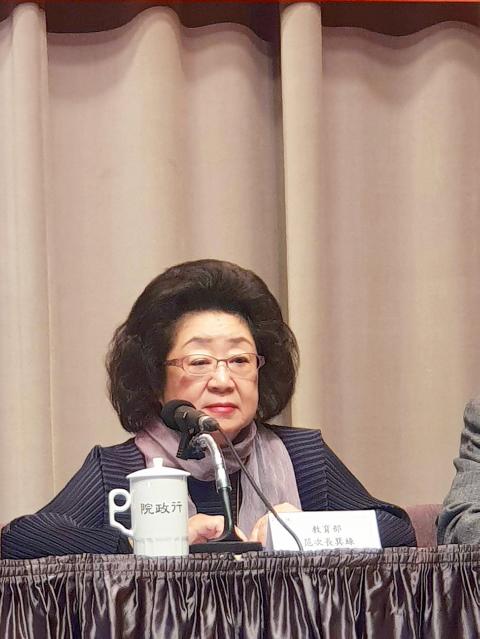
Photo: Lee Hsin-fang, Taipei Times
The ministry also plans to meet with the Mainland Affairs Council and schools to discuss China’s “united front” tactics targeting teachers in the areas of culture and education, Deputy Minister of Education Fan Sun-lu (范巽綠) said.
The problem is “very complicated,” Fan told a news conference in Taipei after an Executive Yuan meeting.
The ministry is to meet with the council regularly to discuss the latest developments and actions by China that are “clearly ‘united front’ tactics,” as well as other sensitive topics, she said.
The ministry would try to gain a better understanding of the overall state of exchanges between Chinese and Taiwanese schools, teachers and students, Fan said, adding that it would later discuss the matter with schools.
She said she believes that schools, universities and colleges have the same level of vigilance as the government, and understand that cultural and educational “united front” tactics are not the same as academic exchanges and need to differentiate between the two.
Asked whether Taiwanese teachers would be allowed to accept invitations to visit China on trips whose expenses excluding airfare would be covered by local organizers, Fan said that the matter would need to be discussed with the council, because the government would need to get a grasp on the circumstances of such a visit.
The question was likely a reference to reports that the Zhonghua Cultural Relics Exchange Association and the Shaanxi Province Cultural Relics Exchange Association had asked Taipei-based Sheen Chuen-Chi Cultural and Educational Foundation to co-organize a “Zhonghua history and culture workshop” in China’s Shaanxi and Gansu provinces.
Taiwanese high-school Chinese-language and history teachers were reportedly invited to give lectures and participate in discussions at the workshop, which is to start on July 2 and end on July 9.
The trip would also include visits to tourist attractions, such as the Shaanxi History Museum, anonymous sources said.
Teachers would only need to pay NT$18,000 for the airfare, as well as a NT$5,000 administrative fee, the source said, adding that the Chinese organizers would cover their accommodation, food and transportation expenses.
According to information obtained by the council, Chinese National Cultural Heritage Administration Director Liu Yuzhu (劉玉珠) also serves as the president of the Zhonghua Cultural Relics Exchange Association.
Under such circumstances, it would be inappropriate for Taiwanese teachers to accept an invitation, a national security official said on condition of anonymity.
The ministry should formulate a clear policy and administrative measures to counter such efforts, the official said.
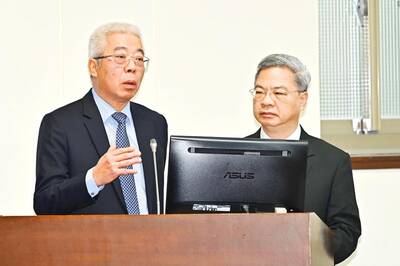
Taiwan has arranged for about 8 million barrels of crude oil, or about one-third of its monthly needs, to be shipped from the Red Sea this month to bypass the Strait of Hormuz and ease domestic supply pressures, CPC Corp, Taiwan (CPC, 台灣中油) said yesterday. The state-run oil company has worked with Middle Eastern suppliers to secure routes other than the Strait of Hormuz, through which about 20 percent of the world’s oil and liquefied natural gas typically passes, CPC chairman Fang Jeng-zen (方振仁) said at a meeting of the legislature’s Economics Committee in Taipei. Suppliers in Saudi Arabia have indicated they

South Korea has adjusted its electronic arrival card system to no longer list Taiwan as a part of China, a move that the Ministry of Foreign Affairs said would help facilitate exchanges between the two sides. South Korea previously listed “Taiwan” as “Taiwan (China)” in the drop-down menus of its online arrival card system, where people had to fill out where they came from and their next destination. The ministry had requested South Korea make a revision and said it would change South Korea’s name on Taiwan’s online immigration system from “Republic of Korea” to “Korea (South),” should the issue not be

CCP ‘PAWN’? Beijing could use the KMT chairwoman’s visit to signal to the world that many people in Taiwan support the ‘one China’ principle, an academic said Chinese Nationalist Party (KMT) Chairwoman Cheng Li-wun (鄭麗文) yesterday arrived in China for a “peace” mission and potential meeting with Chinese President Xi Jinping (習近平), while a Taiwanese minister detailed the number of Chinese warships currently deployed around the nation. Cheng is visiting at a time of increased Chinese military pressure on Taiwan, as the opposition-dominated Legislative Yuan stalls a government plan for US$40 billion in extra defense spending. Speaking to reporters before going to the airport, Cheng said she was going on a “historic journey for peace,” but added that some people felt uneasy about her trip. “If you truly love Taiwan,

Tainan, Taipei and New Taipei City recorded the highest fines nationwide for illegal accommodations in the first quarter of this year, with fines issued in the three cities each exceeding NT$7 million (US$220,639), Tourism Administration data showed. Among them, Taipei had the highest number of illegal short-term rental units, with 410. There were 3,280 legally registered hotels nationwide in the first quarter, down by 14 properties, or 0.43 percent, from a year earlier, likely indicating operators exiting the market, the agency said. However, the number of unregistered properties rose to 1,174, including 314 illegal hotels and 860 illegal short-term rental


 RSS
RSS