


Kaohsiung Mayor Han Kuo-yu (韓國瑜) yesterday struck a different tone on the Chinese Nationalist Party’s (KMT) presidential primary, saying that he would respect any arrangements made by KMT headquarters or the Central Standing Committee, including pitting him against other aspirants in a public opinion poll.
“Given the current situation, I cannot be included in opinion polls on the presidential election,” Han said. “As Kaohsiung mayor, I shoulder the expectations of Kaohsiung residents.”
“If party headquarters or the Central Standing Committee needs Han Kuo-yu in some way to make all kinds of arrangements, including opinion polls, I will respect” their decision, he said.
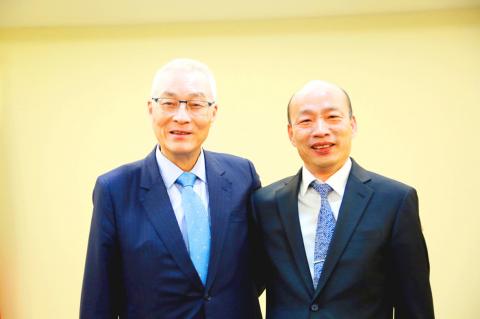
Photo: CNA
He made the remarks following a closed-door meeting with KMT Chairman Wu Den-yih (吳敦義) at party headquarters in Taipei.
He also thanked Wu, first for nominating him as KMT Kaohsiung chapter chairman and then the Kaohsiung mayoral candidate in last year’s local elections.
Han said that he, Wu, and KMT vice chairmen Hau Lung-bin (郝龍斌) and Tseng Yung-chuan (曾永權) agreed at the meeting that the party must concentrate all their strength and unite ahead of next year’s presidential election, thereby protecting the Republic of China.
Responding to reporters’ questions on whether he would be the KMT’s candidate if he emerged as the front-runner in polls, Han only said: “What I just said was something I have never said before.”
Asked whether he and Wu talked about other KMT members who have expressed an interest in joining the KMT primary or how the primary would be conducted, Han said the model for yesterday’s meeting would be followed by other potential candidates.
He denied that his relationship with Wu had soured, saying that he is on friendly terms with his “former boss,” with whom he had a cordial meeting.
Asked whether he would make any clearer move to make known his desire to join the KMT primary, he said that with the party’s nomination rules still in limbo, he could only respect KMT headquarters’ decisions.
KMT Organizational Development Committee director Lee Che-hua (李哲華) said that the party is inclining toward drafting primary rules that the race be solely based on opinion polls.
Wu is to meet separately in the coming days with former New Taipei City mayor Eric Chu (朱立倫), KMT Legislator Wang Jin-pyng (王金平), Hon Hai Precision Industry Co (鴻海精密) chairman Terry Gou (郭台銘) and former Taipei County commissioner Chou Hsi-wei (周錫瑋), all of whom have publicly stated their intention to take part in the primary, to seek their opinions on the primary rules, Lee said.
The primary rules and schedule could be passed by the Central Standing Committee by the middle of this month, while the KMT’s presidential candidate could be selected in early July and approved during the KMT National Congress on July 28, he added.
Additional reporting by Shih Hsiao-kuang

A signaling system malfunction disrupted high-speed rail (HSR) services beginning at 8am today, with trains temporarily reduced to three northbound and three southbound trains per hour as authorities conduct inspections. The malfunction occurred on a section of track in Miaoli County during pre-operation checks early this morning, forcing northbound and southbound trains to use a single track, the HSR operator said. The regular schedule has been replaced with three hourly trains offering only nonreserved seating in each direction, stopping at every station, it said, adding that business class cars would still have reserved seating. Departures from terminal stations are scheduled at the top

Taiwan is still in the process of assessing the possibility of recruiting workers from Eswatini, the Ministry of Foreign Affairs said yesterday, adding that its goal is to help Eswatini upgrade its vocational training centers. If there are plans to recruit workers from Eswatini, safeguarding national security, protecting public health and ensuring the employment rights of Taiwanese would be prerequisites, Department of West Asian and African Affairs Director-General Yen Chia-liang (顏嘉良) told a news conference. Key considerations would also include filling labor shortages in specific industries, and fostering bilateral professional and technical exchanges, he said. Yen was asked about the progress of labor

VERBOSE VESSELS: A CGA cutter and a China Coast Guard exchanged verbal barbs for more than a day in Taiwanese-controlled waters before the Chinese vessel left The Taiwanese and Chinese coast guards had a standoff near the strategically located Pratas Islands (Dongsha Islands, 東沙群島) in the north of the South China Sea, the Coast Guard Administration (CGA) said yesterday. The two sides engaged in intense radio exchanges over sovereignty claims during the 33-hour standoff. China Coast Guard vessel 3501 eventually left the restricted waters, 26.6 nautical miles (49.2km) west of the Pratas Islands, at 5pm yesterday, the CGA said. Lying approximately between southern Taiwan and Hong Kong, the Taiwan-controlled Pratas are seen by some security experts as vulnerable to Chinese attack due to their distance — more than

A US uncrewed surface vessel (USV) encountered multiple Chinese warships during an autonomous transit of the Taiwan Strait, US defense company Seasats said in a statement on Wednesday. Seasats announced that a Lightfish USV had completed the first autonomous transit of the Taiwan Strait. Over five days, the USV traversed the entire length of the Strait while constantly monitoring surface vessel traffic, the company said. The Lightfish encountered multiple Chinese warships, one of which was a Chinese People’s Liberation Army Navy (PLAN) Type 056 corvette, it said. The Chinese vessels were operating “well within Taiwan’s exclusive economic zone without transmitting their identity via the


 RSS
RSS