


Japanese Emperor Akihito yesterday announced his abdication at a palace ceremony in his final address, as the nation embraced the end of his reign with reminiscence and hope for a new era.
“Today, I am concluding my duties as the emperor,” Akihito said as he stood in front of the throne, while other members of the royal family and top government officials watched.
“Since ascending the throne 30 years ago, I have performed my duties as the emperor with a deep sense of trust in and respect for the people, and I consider myself most fortunate to have been able to do so. I sincerely thank the people who accepted and supported me in my role as the symbol of the state,” Akihito said.
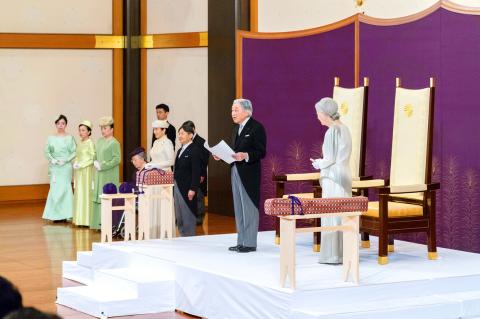
Photo: AP / The Imperial Household Agency of Japan
As he walked out of the room following his speech and officials were taking away the imperial regalia in a box, Akihito turned around, paused and bowed to the audience.
His reign ran through midnight, when his son Crown Prince Naruhito, who observed Akihito’s abdication ceremony, becomes the new emperor and his era begins.
Naruhito formally ascends the Chrysanthemum throne today.
In a separate ceremony he is to receive the imperial regalia of sword and jewel, as well as the imperial seals, as proof of his succession as the nation’s 126th emperor, according to official palace count, which historians say could include mythical figures until about the 5th century.
Naruhito’s wife, Masako, and daughter, Aiko, are barred from the ceremony, because they are female members of the royal family, a palace tradition that the government upheld, despite criticism that it is out of step with modern values.
Many people gathered outside the palace compound hours before the ceremony, despite unseasonably wet and cold weather, and even though they were not allowed to look inside.
“We came because today is the last day of [the emperor’s era of] Heisei, and we feel nostalgic,” said Akemi Yamauchi, 55, standing outside the palace with her husband.
“We like the current emperor. He has worked hard for the people, he is very thoughtful, and kind to everyone,” said her husband, Kaname.
Messages have come from global leaders.
South Korean President Moon Jae-in expressed gratitude in a letter to Akihito for his emphasis on peace and contributions to developing relations between Seoul and Tokyo.
US President Donald Trump expressed appreciation for his contribution to the two countries’ close relations.
Trump had a courtesy meeting with Akihito during his 2017 Japan visit and will be the first foreign leader to meet the new emperor this month.
Japanese television talk shows displayed a countdown to the midnight transition, and programming was dominated by the abdication and looking back at major events in Akihito’s era, including a massive 2011 tsunami, a deadly earthquake in Kobe in 1995 and the Tokyo subway nerve gas attack in 1995 that shook Japan’s sense of safety and confidence.
Security was extremely tight around the palace and across downtown Tokyo, with thousands of police mobilized.
Police arrested a man on Monday night on suspicion of placing a pair of kitchen knives last week on the school desk used by Akihito’s grandson.
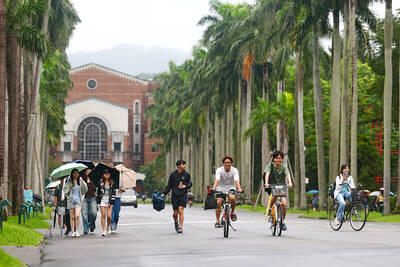
National Taiwan University (NTU) yesterday said it disqualified a person from an entrance examination for using AI smart glasses to cheat, along with two others for making untruthful statements in their curriculum vitae. The three applicants were given null scores, Taiwan’s highest-ranked university said, calling on prospective students to be honest in the admissions process. NTU registrar Lee Hung-sen (李宏森) said that the cheating applicant wore a hat and thick-rimmed glasses to the second written exam for medical school, claiming that they felt cold. Suspicions were aroused when the applicant stared oddly at the test for long stretches while steadily bringing the paper
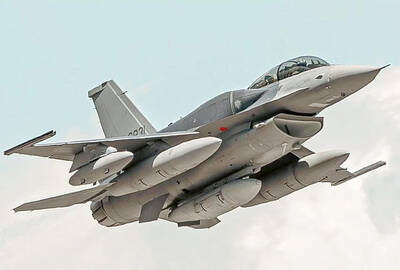
66 FIGHTER JETS: The aircraft is likely undergoing preparations for its transfer to Taiwan — a significant step forward in the nation’s modernization program, a lawmaker said The first of Taiwan’s order of F-16V Block 70 aircraft has been sighted in Texas ahead of delivery, Democratic Progressive Party (DPP) Legislator Wang Ting-yu (王定宇) said. Taiwan’s first F-16V Block 70 two-seat aircraft, tail number 6831, was seen flying from Lockheed Martin’s production facility in Greenville, South Carolina, to Naval Air Station Joint Reserve Base Fort Worth in Texas, Wang wrote on Facebook yesterday. The plane is likely undergoing preparations for its transfer to Taiwan, marking a significant step forward in the Republic of China Air Force’s modernization program, Wang said, citing military analysts. The F-16V Block 70 is a new-build version
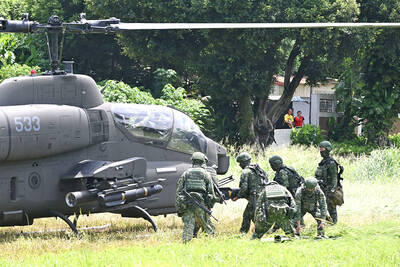
MILITARY ISSUES: A partisan divide between the Cabinet and the legislature ‘raised questions about Taiwan’s ability to adequately fund its defense,’ the report said Taiwan’s defense budget, military personnel numbers and resilience are challenges to its ability to meet national defense goals, the US Naval Institute said in a report published on Tuesday. In response to the perception of a growing military threat posed by China, Taiwan has embarked on an effort to enhance the capabilities needed to deter an attempt by Beijing to annex the nation by force, the institute said in the US Congressional Research Service report, titled Taiwan: Defense and Military Issues, which was filed on Thursday last week. Taiwan’s defense budget increased by about 7.5 percent from 2024 to last year, it
NOT JUST NUMBERS: What matters to intelligence work is crucial, reliable information, so even a few credible leads can be highly valuable to national security, a legislator said The National Security Bureau (NSB) yesterday said it has finished the establishment of an information-reporting channel for Chinese nationals, the aim of which is to broaden intelligence gathering on China’s political, military, economic and social developments. Chinese nationals can submit information on the Web page, https://report.nsb.gov.tw, the NSB said in a statement. The move aims to expand the bureau’s diverse intelligence sources and is pursuant to the National Intelligence Services Act (國家情報工作法), it said, adding that it referenced practices adopted by intelligence agencies in the US, the UK and Israel. An increasing number of people are approaching Taiwanese agencies to provide information, as


 RSS
RSS