


Hon Hai Precision Industry Co (鴻海集團) chairman Terry Gou (郭台銘) yesterday said that he would make a decision in the next couple of days on whether to run for president in next year’s election.
Gou made the remarks on the sidelines of the Indo-Pacific Security Dialogue in Taipei.
Asked whether he is mulling a presidential campaign, Gou said that he barely slept on Monday night, as next year’s presidential race is a critical one and could decide the next two decades of Taiwan’s politics, economics and national defense.
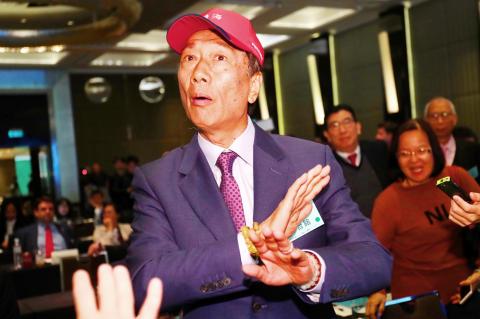
Photo: CNA
“I asked myself this all of last night: It would be unnecessary if I am only seeking to occupy the top office, but if I am here to get things done, what are the things I am going to do?” Gou said.
Gou, the wealthiest man in Taiwan and the 257th worldwide with a net worth of US$7.7 billion, said that people must ask themselves what they can do for the younger generation, whose fate is to be determined in the next two decades.
Gou said that if he decided to run for president, he would join the Chinese Nationalist Party’s (KMT) presidential primary and would not accept direct recruitment.
Pressed on when he would make a decision, Gou said that he wanted to listen to the opinions expressed at the dialogue and talk about the matter “tomorrow or later,” adding that he could make a decision within the next two days.
Asked whether he would be willing to pass on the torch at Hon Hai, known internationally as Foxconn Technology Group (富士康科技集團), Gou said that he has always planned to retire after 50 years of working and that he has over the past 45 years endeavored to train young talent in his business empire.
“If I learn how to let go, they will learn how to grow. Not just in Hon Hai, many more young people in Taiwan need help,” Gou said.
The tycoon later caused a scene by storming out after accusing a group of Taiwanese and US lawmakers of failing to answer his question due to time constraints at the question-and-answer session of the forum’s Taiwan-US congressional dialogue.
Democratic Progressive Party (DPP) Legislator Hsiao Bi-khim (蕭美琴) was the only panelist who responded to Gou’s question on whether it was Washington or Beijing that holds the key to Taiwan’s participation in international economic events, but Gou criticized her for not looking at him when answering, which he said was disrespectful.
“I am going to tell the White House that this is what the DPP is like. This is not a dialogue. What is the point of me being here if this is just an echo chamber,” Gou said.
It was the second day that Gou had appeared at political events that brought together high-level officials from Taiwan and the US to commemorate the 40th anniversary of the US’ Taiwan Relations Act.
He made headlines on Monday when he attended a forum at National Taiwan University and asked AIT Chairman James Moriarty whether the US would endorse a certain candidate in next year’s presidential election and if it would allow Taiwan to elect its own leader.
A US agency directly contacted the Prospect Foundation and asked it to invite Gou to yesterday’s forum, hinting at the conglomerate’s close ties with Washington, said a source with knowledge of the matter, who spoke on condition of anonymity.
“It is apparent that Gou is here for [political] maneuvering [to pave the way] for a presidential bid,” the source said.
Asked about Gou’s potential presidential bid on the sidelines of the forum, President Tsai Ing-wen (蔡英文), who delivered a speech at the event, declined to comment on “a KMT matter.”
However, Tsai, who is vying for the DPP’s nomination to seek re-election, said that she would respect Gou’s decision.
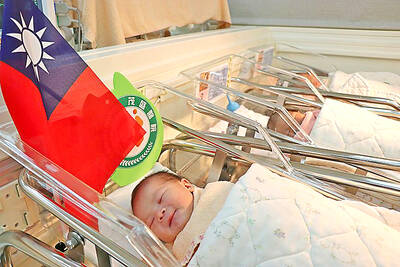
AGING: As of last month, people aged 65 or older accounted for 20.06 percent of the total population and the number of couples who got married fell by 18,685 from 2024 Taiwan has surpassed South Korea as the country least willing to have children, with an annual crude birthrate of 4.62 per 1,000 people, Ministry of the Interior data showed yesterday. The nation was previously ranked the second-lowest country in terms of total fertility rate, or the average number of children a woman has in her lifetime. However, South Korea’s fertility rate began to recover from 2023, with total fertility rate rising from 0.72 and estimated to reach 0.82 to 0.85 by last year, and the crude birthrate projected at 6.7 per 1,000 people. Japan’s crude birthrate was projected to fall below six,
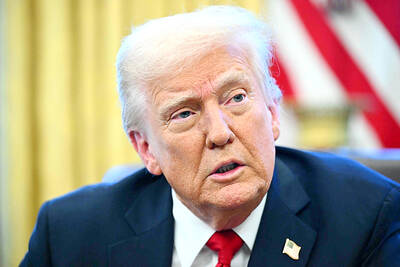
US President Donald Trump in an interview with the New York Times published on Thursday said that “it’s up to” Chinese President Xi Jinping (習近平) what China does on Taiwan, but that he would be “very unhappy” with a change in the “status quo.” “He [Xi] considers it to be a part of China, and that’s up to him what he’s going to be doing, but I’ve expressed to him that I would be very unhappy if he did that, and I don’t think he’ll do that. I hope he doesn’t do that,” Trump said. Trump made the comments in the context
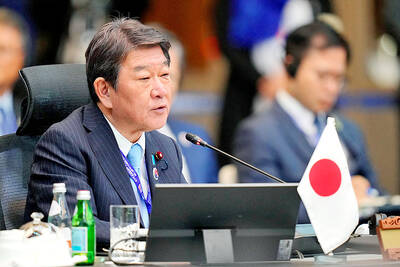
SELF-DEFENSE: Tokyo has accelerated its spending goal and its defense minister said the nation needs to discuss whether it should develop nuclear-powered submarines China is ramping up objections to what it sees as Japan’s desire to acquire nuclear weapons, despite Tokyo’s longstanding renunciation of such arms, deepening another fissure in the two neighbors’ increasingly tense ties. In what appears to be a concerted effort, China’s foreign and defense ministries issued statements on Thursday condemning alleged remilitarism efforts by Tokyo. The remarks came as two of the country’s top think tanks jointly issued a 29-page report framing actions by “right-wing forces” in Japan as posing a “serious threat” to world peace. While that report did not define “right-wing forces,” the Chinese Ministry of Foreign Affairs was

PREPAREDNESS: Given the difficulty of importing ammunition during wartime, the Ministry of National Defense said it would prioritize ‘coproduction’ partnerships A newly formed unit of the Marine Corps tasked with land-based security operations has recently replaced its aging, domestically produced rifles with more advanced, US-made M4A1 rifles, a source said yesterday. The unnamed source familiar with the matter said the First Security Battalion of the Marine Corps’ Air Defense and Base Guard Group has replaced its older T65K2 rifles, which have been in service since the late 1980s, with the newly received M4A1s. The source did not say exactly when the upgrade took place or how many M4A1s were issued to the battalion. The confirmation came after Chinese-language media reported


 RSS
RSS