


China Airlines (中華航空), one of Taiwan’s major carriers, is to offer an additional direct flight to Palau from June 1, bringing the total number of weekly flights to four, President Tsai Ing-wen (蔡英文) told Palauan President Tommy Remengesau on Friday.
Tsai, who is in Palau on the first leg of a visit to three Pacific island allies, said that she delivered the good news to Remengesau, hoping that it would prompt more Taiwanese to visit the Pacific nation.
China Airlines, which is partly state-owned, currently offers three direct flights per week between Taiwan Taoyuan International Airport and Roman Tmetuchl International Airport near Koro.

Photo: EPA-EFE / Presidential Office / Handout
The airline began providing charter flights between the two nations in 2008 and scheduled services in 2009.
The average passenger load on the regular flights has reached about 80 percent over the past year, the airline said earlier this year.
Palau’s economy relies heavily on tourism and in the past few years a large percentage of visitors have been Chinese.
Beijing is widely believed to be trying to woo Taiwan’s remaining 17 allies, including six in the Pacific.
In late 2017, China banned Chinese travel agencies from arranging group tours to Palau, apparently to pressure the island nation to switch diplomatic recognition from Taipei to Beijing.
However, Palau has maintained diplomatic ties with Taiwan.
It is hoped that the extra China Airlines flight will attract more Taiwanese travelers visit to Palau, but it is unclear whether there would be enough to fill the loss in Chinese tourists.
Tsai made the announcement at a signing ceremony for an agreement on sea patrol cooperation between the two nations.
Under the pact, Taiwan’s 1,800-tonne Hsun Hu No. 7 patrol frigate participated in a joint marine patrol exercise with Palauan vessels yesterday, said Coast Guard Administration (CGA) Director-General Chen Kuo-en (陳國恩), a member of Tsai’s entourage.
With the sea patrol cooperation accord, the two nations would also join hands to fight cross-border maritime crimes and protect each other’s fishing boats, Chen said.
Thanks to the cooperation, Taiwanese patrol boats would also be able to dock in Palau to replenish supplies during missions, Chen said, adding that the two nations would also conduct training and exchanges of sea patrol personnel.
Yesterday’s drill, which focused on marine rescue operations, was the first of its kind between Taiwan and Palau, CGA Fleet Branch head Hsieh Ching-chin (謝慶欽) said.
Tsai is to head to Nauru for a visit today and tomorrow, before traveling to the Marshall Islands on Tuesday to attend the first Pacific Women Leaders’ Coalition Conference.
It is her sixth overseas trip since taking office in May 2016.
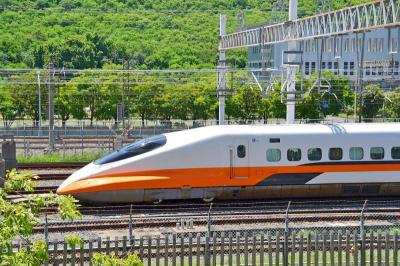
A signaling system malfunction disrupted high-speed rail (HSR) services beginning at 8am today, with trains temporarily reduced to three northbound and three southbound trains per hour as authorities conduct inspections. The malfunction occurred on a section of track in Miaoli County during pre-operation checks early this morning, forcing northbound and southbound trains to use a single track, the HSR operator said. The regular schedule has been replaced with three hourly trains offering only nonreserved seating in each direction, stopping at every station, it said, adding that business class cars would still have reserved seating. Departures from terminal stations are scheduled at the top

Taiwan is still in the process of assessing the possibility of recruiting workers from Eswatini, the Ministry of Foreign Affairs said yesterday, adding that its goal is to help Eswatini upgrade its vocational training centers. If there are plans to recruit workers from Eswatini, safeguarding national security, protecting public health and ensuring the employment rights of Taiwanese would be prerequisites, Department of West Asian and African Affairs Director-General Yen Chia-liang (顏嘉良) told a news conference. Key considerations would also include filling labor shortages in specific industries, and fostering bilateral professional and technical exchanges, he said. Yen was asked about the progress of labor

A US uncrewed surface vessel (USV) encountered multiple Chinese warships during an autonomous transit of the Taiwan Strait, US defense company Seasats said in a statement on Wednesday. Seasats announced that a Lightfish USV had completed the first autonomous transit of the Taiwan Strait. Over five days, the USV traversed the entire length of the Strait while constantly monitoring surface vessel traffic, the company said. The Lightfish encountered multiple Chinese warships, one of which was a Chinese People’s Liberation Army Navy (PLAN) Type 056 corvette, it said. The Chinese vessels were operating “well within Taiwan’s exclusive economic zone without transmitting their identity via the
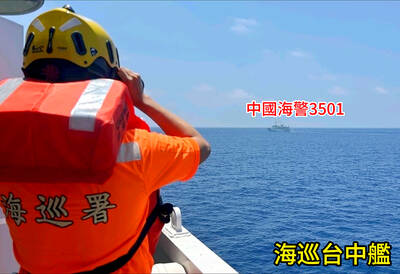
VERBOSE VESSELS: A CGA cutter and a China Coast Guard exchanged verbal barbs for more than a day in Taiwanese-controlled waters before the Chinese vessel left The Taiwanese and Chinese coast guards had a standoff near the strategically located Pratas Islands (Dongsha Islands, 東沙群島) in the north of the South China Sea, the Coast Guard Administration (CGA) said yesterday. The two sides engaged in intense radio exchanges over sovereignty claims during the 33-hour standoff. China Coast Guard vessel 3501 eventually left the restricted waters, 26.6 nautical miles (49.2km) west of the Pratas Islands, at 5pm yesterday, the CGA said. Lying approximately between southern Taiwan and Hong Kong, the Taiwan-controlled Pratas are seen by some security experts as vulnerable to Chinese attack due to their distance — more than


 RSS
RSS