


The Democratic Progressive Party (DPP) yesterday retained two legislative seats, while the Chinese Nationalist Party (KMT) lost one of the two seats it previously held in legislative by-elections held in four cities and counties.
The DPP’s Yu Tian (余天) beat the KMT’s Cheng Shih-wei (鄭世維) and independent Su Ching-yen (蘇卿彥) in New Taipei City, and the DPP’s Kuo Kuo-wen (郭國文) defeated the KMT’s Hsieh Lung-chieh (謝龍介), as well as independent candidates Chen Hsiao-yu (陳筱諭), Wu Ping-hui (吳炳輝) and Hsu Kuo-tung (徐國棟), in Tainan.
In Changhua County, the KMT’s Ko Cheng-fang (柯呈枋) bested the DPP’s Huang Chen-yen (黃振彥), the New Power Party’s Yang Tse-min (楊澤民) and independent Chi Ching-tang (紀慶堂), while independent candidate Chen Yu-chen (陳玉珍) claimed victory in Kinmen County, defeating the KMT’s Hung Li-ping (洪麗萍) and independent candidates Chen Tsang-chiang (陳滄江), Tsai Hsi-hu (蔡西湖) and Lu Kuan-yu (盧冠宇), as well as the Kinmen Kaoliang Party’s Hung Chih-heng (洪志恆).
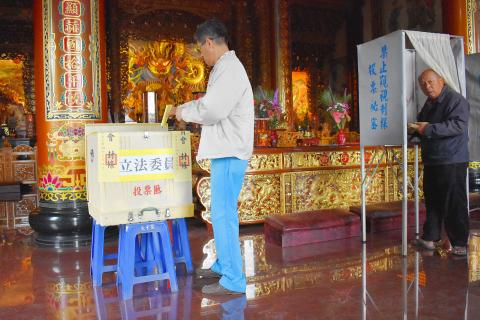
Photo: Yang Chin-cheng, Taipei Times
The by-elections were held to fill four seats vacated by lawmakers who won public posts in local elections in November last year or were stripped of their office by courts due to corruption.
Political observers had previously said that the by-elections would be a harbinger of next year’s presidential election.
The DPP and the KMT brought party heavyweights during campaigning, with President Tsai Ing-wen (蔡英文) and former premier William Lai (賴清德) lobbying for DPP candidates, and Kaohsiung Mayor Han Kuo-yu (韓國瑜) and former New Taipei City mayor Eric Chu (朱立倫) stumping for KMT candidates.
The KMT was hoping to ride the momentum it created in the local elections when it won a majority of the municipalities, while the DPP suffered a setback, the observers said.
The DPP, on the other hand, was hoping to make a comeback, they added.
At a post-election news conference at party headquarters in Taipei, DPP Secretary-General Luo Wen-jia (羅文嘉) said: “The DPP did not win — we just stopped the bleeding for now. While the outcome is encouraging, we are not calling for celebrations.”
The DPP would continue to build a coalition of individuals, organizations and parties with different ideals, but are united by a common cause, Luo said, before thanking Sunflower movement activist Lin Fei-fan (林飛帆) for stumping for Yu on Friday evening.
Asked whether the results suggested a weakening of the “Han wave,” a term that refers to Han’s reputation for energizing voters for other pan-blue political candidates, Luo said: “The only wave I care about is the democratic wave.”
KMT spokesman Ouyang Lung (歐陽龍) said that the KMT did not capture the three seats it targeted elsewhere, but held the line in Changhua County.
“Now is not the time for the KMT to be proud. We promise to the public that we will do everything in our power to nominate the best candidates for the presidency, vice presidency and lawmakers in the elections next year,” he said.
Additional reporting by Su Fun-her
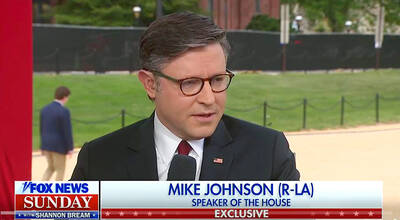
RESOLUTE BACKING: Two Republican senators are planning to introduce legislation that would impose immediate sanctions on China if it attempts to invade Taiwan US House of Representatives Speaker Mike Johnson on Sunday reaffirmed US congressional support for Taiwan, saying the US and “all freedom-loving people” have a stake in preventing China from seizing Taiwan by force. Johnson made the remarks in an interview with Fox News Sunday on US President Donald Trump’s summit with Chinese President Xi Jinping (習近平) last week. In an interview that aired on Friday on Fox News, just as Trump wrapped up a high-stakes visit to China, he said he has yet to green-light a new US$14 billion arms package to Taiwan and that it “depends on China.” “It’s a very good

DRONE CENTRAL: Taiwan aims to become Asia’s democratic hub for drones, with most exports focused on high-quality military-grade models, an official said Taiwan’s drone industry is expected to expand significantly by 2030, producing 100,000 units per month and exporting half of them, the Ministry of Economic Affairs said yesterday. Current drone production capacity is about 15,000 units per month, but the industry can quickly scale up as demand increases, Industrial Development Administration Director-General Chiou Chyou-huey (邱求慧) told a news conference in Taipei. Taiwan’s drone output grew 2.5-fold last year to NT$12.9 billion (US$408.3 million) under a government program to develop the uncrewed vehicle sector, he said. The Executive Yuan in October last year approved plans to invest NT$44.2 billion into domestic production of uncrewed aerial
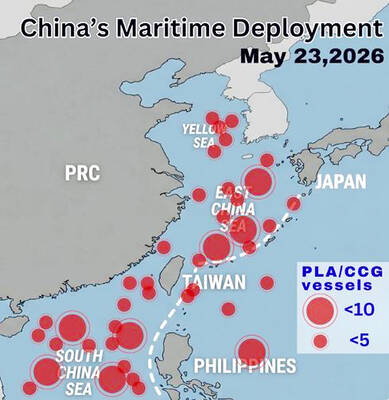
WARNING: China should stop engaging in actions that undermine regional peace and stability, as it would only build resentment among people across the Strait, the CGA said China has deployed more than 100 navy, coast guard and other vessels in waters from the Yellow Sea to the South China Sea and the western Pacific since US President Donald Trump and Chinese President Xi Jinping (習近平) met in Beijing, National Security Council Secretary-General Joseph Wu (吳釗燮) said yesterday. “In this part of the world, #China is the one & only PROBLEM wrecking the #StatusQuo & threatening regional peace & stability,” Wu wrote on X. In a separate post, he said Beijing was coercing Taiwan’s maritime domain, calling it illegal and provocative, after the Coast Guard Administration (CGA) expelled a
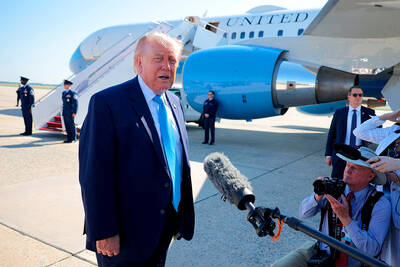
US President Donald Trump yesterday said he would speak to President William Lai (賴清德) as his administration considers whether to move ahead with a US$14 billion weapons sale to Taiwan — a potential arms deal that has drawn criticism from China. “Well, I’ll speak to him. I speak to everybody,” Trump told reporters yesterday when asked if he had any plans to call his counterpart, although he did not offer a time frame for when such a conversation could take place. Trump previously said he would speak to the person “that’s running Taiwan,” without specifying who he meant. “We have that situation very


 RSS
RSS