


The Port of Keelung last year received 1.06 million passengers, with strong growth in the number of cruise ship travelers from the Philippines, Taiwan International Ports Corp (TIPC, 台灣港務) statistics showed.
The number of cruise ship travelers to Keelung is expected to grow further this year, as four large cruise ships are scheduled to dock at the port this year, TIPC said.
They include the Explore Dream in March, Costa Venezia in April, World Dream in July and Le Laperouse in September.
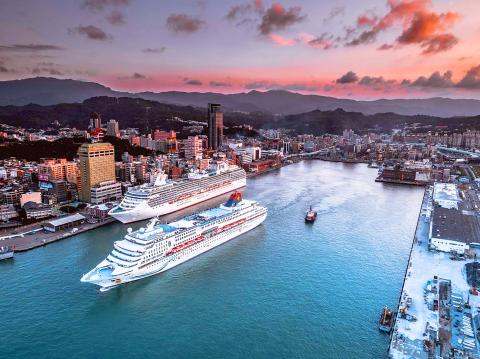
Photo courtesy of the Port of Keelung, Taiwan International Ports Corp
TIPC statistics showed that the number of passengers arriving at the port grew by 13.47 percent to reach 1.06 million last year — a new record.
The figure also topped the number of passengers accessing the ports of Hualien, Taichung and Chiayi, the company said.
TIPC attributed the increase to strong growth in the number of travelers on international cruise ships, from about 830,000 in 2017 to 940,000 last year.
The biggest growth was in the number of cruise ship travelers from the Philippines, which rose by 23 percent to about 60,000 last year.
Princess Cruises and Star Cruises have expanded their operations in Keelung, TIPC said.
Princess Cruises has dispatched the Majestic Princess to serve passengers embarking from Keelung, with the occupancy rate expected to exceed 90 percent.
Meanwhile, Star Cruises is sending its largest cruise ship — the SuperStar Virgo — to operate tours to Japan and South Korea.
Passengers on the COSCO Star (中遠之星), a cross-strait ferry, also grew from about 29,000 in 2017 to 36,000 last year, TIPC said.
In the past, the majority of passengers on cross-strait ferries were Chinese tourists, but there has been an increase in Taiwanese traveling to China, TIPC said, adding that this shows that more travelers are considering sea travel.
However, the port saw a slight decrease in tourists visiting through the fly-cruise model, from about 42,000 in 2017 to 39,000 last year, the company said.
Cruise ship tours were in high demand among Taiwanese last year, and not many extra tickets could be sold to international tourists, TIPC said.

‘NO SECURITY RISK’: The Railway Bureau reassured the public that the technicians’ activities were limited to technical guidance and did not involve sensitive systems The Railway Bureau yesterday said it had invited eight Chinese technicians to assist with an airport MRT construction project. The bureau issued the confirmation after an Internet user said Chinese nationals had entered the construction zone of Taiwan Taoyuan International Airport’s Terminal 3 project. They asked why “individuals from an enemy state” were allowed access to such a major national infrastructure project, which raised serious concerns over Taiwan’s industrial safety, sensitive systems and information security. The bureau’s Northern Region Engineering Branch Office said subcontractor Taiwan Handle Industrial Co (台灣手把工業) of the Taoyuan airport MRT’s “Contract No. CU05 Project A14 Station Civil, MEP &

The National Chungshan Institute of Science and Technology yesterday showcased its locally developed variants of the Vision 60 robotic patrol dog, which it plans to deploy on the nation’s outlying territories in the South China Sea. The variants were produced under the Joint Lab project — created by the institute and domestic companies — and assembled with domestically produced motors, lenses and artificial intelligence (AI) systems alongside licensed tech from the US, Missile and Rocket Systems Research Division deputy director Jen Kuo-kang (任國光) told the media event at a military base in Taipei’s Dazhi (大直) area. Taiwan has built up its strengths

NOT IMMEDIATE: Taiwan has a chance to appeal the proposed 10 percent tariff before it starts, while other countries face a 12.5 percent tariff from the trade office Taiwan is among 60 economies determined by the US to have failed to impose or enforce a ban on the importation of goods produced with forced labor, according to a notice released on Tuesday by the Office of the US Trade Representative (USTR), which proposed imposing an additional 10 percent or more tariff on them. The USTR in a statement said that following an investigation, it had determined under Section 301 of the Trade Act of 1974 that the failure of the 60 economies to impose and effectively enforce a prohibition on the importation of goods produced with forced labor is

RIGHT DIRECTION: Taiwan’s efforts to prevent forced labor include a proposal to ‘fully prohibit’ employers from withholding workers’ documents, an official said Taiwan is to establish a mechanism to restrict imports of goods linked to forced labor, the Executive Yuan said yesterday, after the US proposed imposing additional tariffs on Taiwanese goods over labor concerns. “The Ministry of Labor and the Ministry of Economic Affairs are to establish an interministerial review procedure,” Executive Yuan spokesperson Michelle Lee (李慧芝) said at a news briefing in Taipei. “The government is to use the Foreign Trade Act [貿易法] as the legal basis to restrict imports of goods produced with forced labor” and bring its supply chain governance more in line with international standards on human rights, resilience


 RSS
RSS