


The Ministry of National Defense yesterday — a week after Chinese President Xi Jinping (習近平) reasserted China’s right to use force against Taiwan — made public this year’s schedule of combat drills designed to boost the military’s readiness.
The annual exercises are divided into four components, Operations and Planning Division head Major General Yeh Kuo-hui (葉國輝) said.
A month of combat readiness training is to be held in the first quarter, the month-long Han Kuang live-fire exercise in the second quarter, joint anti-landing operations in the third quarter and joint anti-airborne exercises in the fourth quarter, Yeh said, without giving a more detailed timetable.
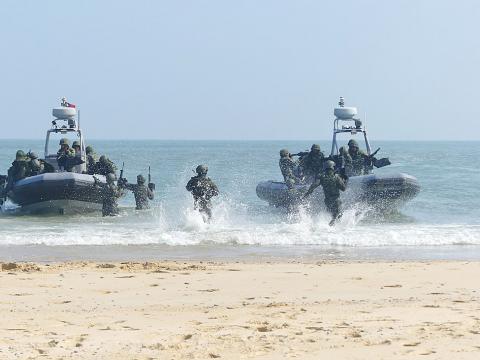
Photo: Wu Cheng-ting, Taipei Times
The drills and training routines would incorporate newly adopted tactics for defending against a possible Chinese invasion, Yeh said.
Over the past few decades, the armed forces made beach invasions the focal point of any defensive strategy, but when President Tsai Ing-wen (蔡英文) took office in May 2016, the plan for repelling a possible attack was broadened to include the outer perimeter of the nation’s coastal areas.
The military’s combat exercise schedule for this year was announced a week after Xi on Wednesday last week reissued a warning to Taiwan in an address marking the 40th anniversary of China’s “Message to Compatriots in Taiwan.”
In his speech, Xi said that China is willing to talk with any party in Taiwan to push forward the process of peaceful unification on the basis of the “one China” principle.
However, “we make no promise to renounce the use of force and reserve the option of taking all necessary means” to serve the end, Xi added.
Asked about Xi’s threat, military spokesman Major General Chen Chung-chi (陳中吉) said the training and drills being conducted are intended to prepare the armed forces to counter a possible invasion.
“We want to assure citizens that the military is constantly improving its combat preparedness and stands ready to fight for the survival of the Republic of China,” he said.

‘NO SECURITY RISK’: The Railway Bureau reassured the public that the technicians’ activities were limited to technical guidance and did not involve sensitive systems The Railway Bureau yesterday said it had invited eight Chinese technicians to assist with an airport MRT construction project. The bureau issued the confirmation after an Internet user said Chinese nationals had entered the construction zone of Taiwan Taoyuan International Airport’s Terminal 3 project. They asked why “individuals from an enemy state” were allowed access to such a major national infrastructure project, which raised serious concerns over Taiwan’s industrial safety, sensitive systems and information security. The bureau’s Northern Region Engineering Branch Office said subcontractor Taiwan Handle Industrial Co (台灣手把工業) of the Taoyuan airport MRT’s “Contract No. CU05 Project A14 Station Civil, MEP &

The National Chungshan Institute of Science and Technology yesterday showcased its locally developed variants of the Vision 60 robotic patrol dog, which it plans to deploy on the nation’s outlying territories in the South China Sea. The variants were produced under the Joint Lab project — created by the institute and domestic companies — and assembled with domestically produced motors, lenses and artificial intelligence (AI) systems alongside licensed tech from the US, Missile and Rocket Systems Research Division deputy director Jen Kuo-kang (任國光) told the media event at a military base in Taipei’s Dazhi (大直) area. Taiwan has built up its strengths

NOT IMMEDIATE: Taiwan has a chance to appeal the proposed 10 percent tariff before it starts, while other countries face a 12.5 percent tariff from the trade office Taiwan is among 60 economies determined by the US to have failed to impose or enforce a ban on the importation of goods produced with forced labor, according to a notice released on Tuesday by the Office of the US Trade Representative (USTR), which proposed imposing an additional 10 percent or more tariff on them. The USTR in a statement said that following an investigation, it had determined under Section 301 of the Trade Act of 1974 that the failure of the 60 economies to impose and effectively enforce a prohibition on the importation of goods produced with forced labor is

RIGHT DIRECTION: Taiwan’s efforts to prevent forced labor include a proposal to ‘fully prohibit’ employers from withholding workers’ documents, an official said Taiwan is to establish a mechanism to restrict imports of goods linked to forced labor, the Executive Yuan said yesterday, after the US proposed imposing additional tariffs on Taiwanese goods over labor concerns. “The Ministry of Labor and the Ministry of Economic Affairs are to establish an interministerial review procedure,” Executive Yuan spokesperson Michelle Lee (李慧芝) said at a news briefing in Taipei. “The government is to use the Foreign Trade Act [貿易法] as the legal basis to restrict imports of goods produced with forced labor” and bring its supply chain governance more in line with international standards on human rights, resilience


 RSS
RSS