


The Ministry of the Interior yesterday approved draft amendments to the Presidential and Vice Presidential Election and Recall Act (總統副總統選舉罷免法) that seek to prevent disinformation and external forces from influencing elections.
If passed by the legislature, the amendments would restrict media companies from disseminating election-related advertisements funded by groups or individuals from overseas, including China, Hong Kong and Macau.
Offenses are punishable either by a fine of NT$200,000 to NT$10 million (US$6,482 to US$324,076) or a fine double the cost of the advertisement, the ministry said.
Photo: Chiu Shu-yu, Taipei Times
“Mass media companies airing or carrying advertisements on election campaigns or campaigns to recall a government official should — in addition to current regulations that mandate transparency of the individual placing the advertisement — also make known the individual or group funding the advertisement, as well as other relevant information,” the bill says.
The ministry said it referenced the US’ Honest Ads Act when drafting the amendments.
With the planned removal of Article 52 of the Civil Servants Recall and Election Act (公職人員選舉罷免法), the ministry hopes to address similar anachronisms in the two acts, the ministry said.
The amendments also plan to restore the right to vote to people under official guardianship, as the right to vote is constitutionally guaranteed, but the guardianship system extends only to rights to property or handling contracts, the ministry said.
The amendments also seek to ban people who have been tried and convicted for contravening the National Security Act (國家安全法), the Classified National Security Information Protection Act (國家機密保護法) and the National Intelligence Services Act (國家情報工作法) from registering as a candidate for president, the ministry said.
The amendments call for the Central Election Commission to establish a system that would allow people registering to run for president or vice president to gather signatures electronically, the ministry said.
The system would prevent false signatures and external influence, the ministry added.
The amendments would mandate that only political parties that have obtained 5 percent of the total votes in the most recent legislative elections to be allowed to nominate presidential and vice presidential candidates, it said.
That would uphold the fairness of elections and recall polls, the ministry said, adding that if the Executive Yuan and the Legislative Yuan pass the amendments they would apply to the 2020 presidential and legislative elections.
LEVERAGE: China did not ‘need to fire a shot’ to deny Taiwan airspace over Africa when it owns ‘half the continent’s debt,’ a US official said, calling it economic warfare The EU has raised concerns about overflight rights following the delay of President William Lai’s (賴清德) planned state visit to the Kingdom of Eswatini after three African nations denied overflight clearance for his charter at the last minute. Taiwanese allies Paraguay and Saint Kitts and Nevis, as well as several US lawmakers and the Inter-Parliamentary Alliance on China (IPAC) condemned China for allegedly pressuring the countries. Lai was scheduled to fly directly to Taiwan’s only African ally from yesterday to Sunday to celebrate the 40th anniversary of King Mswati III’s accession and his 58th birthday, but Seychelles, Mauritius and Madagascar suddenly revoked
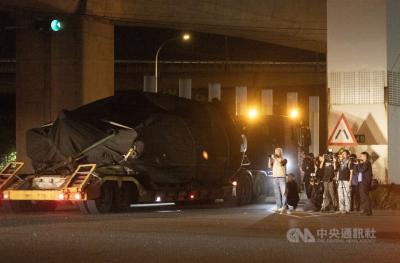
The final batch of 28 M1A2T Abrams tanks purchased from the US arrived at Taipei Port last night and were transported to the Armor Training Command in Hsinchu County’s Hukou Township (湖口), completing the military’s multi-year procurement of 108 of the tanks. Starting at 12:10am today, reporters observed more than a dozen civilian flatbed trailers departing from Taipei Port, each carrying an M1A2T tank covered with black waterproof tarps. Escorted by military vehicles, the convoy traveled via the West Coast Expressway to the Armor Training Command, with police implementing traffic control. The army operates about 1,000 tanks, including CM-11 Brave Tiger
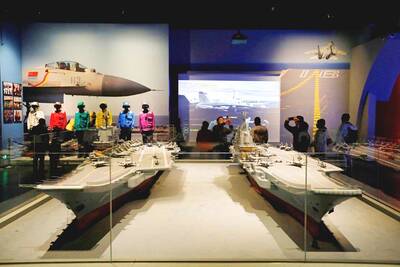
China on Wednesday teased in a video an aircraft carrier that could be its fourth, and the first using nuclear power, while making an allusion to Taiwan and vowing to further build up its islands, as it looks to boost maritime power, secure resources and bolster territorial claims. The video, issued on the eve of the 77th founding anniversary of the Chinese People’s Liberation Army Navy, featured fictional officers with names that are homophones of three commissioned aircraft carriers, the Liaoning (遼寧), Shandong (山東) and Fujian (福建). Titled Into the Deep, it showed a 19-year-old named “Hejian” (何劍) joining the group, sparking
BIG YEAR: The company said it would also release its A12 chip the same year to keep a ‘reliable stream of new silicon technologies’ flowing to its customers Taiwan Semiconductor Manufacturing Co (TSMC, 台積電) yesterday said its newest A13 chip is to enter volume production in 2029 as the chipmaker seeks to hold onto its tech leadership and demand for next-generation chips used in artificial intelligence (AI), high-performance-computing (HPC) and mobile applications. TSMC, the world’s biggest contract chipmaker, also unveiled its A12 chip at its annual technology symposium in Santa Clara, California. The A12 chip, which features TSMC’s super-power-rail technology to provide backside power delivery for AI and HPC applications, is also to enter volume production in 2029, a year after the scheduled release of the A14 chip. The technology moves


 RSS
RSS