


The Democratic Progressive Party (DPP) yesterday denied that so-called factions are distancing themselves from President Tsai Ing-wen (蔡英文), the party’s former chairperson, or trying to force her out of power.
Deputy Legislative Speaker Tsai Chi-chang (蔡其昌) made the remarks during an exclusive interview with Clara Chou (周玉蔻) on her morning show, Coco Breakfast (蔻蔻早餐).
Tsai Chi-chang denied that earlier comments he made were the former New Tide faction’s — of which he is a member — attempt to distance themselves from the president and to force her out of power.
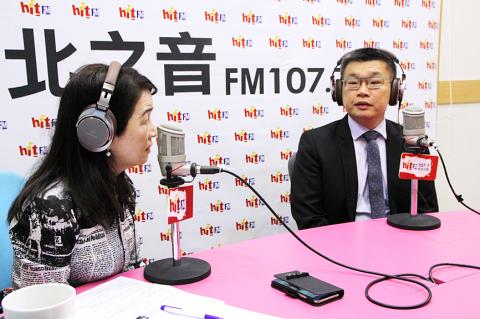
Photo courtesy of Hit FM
He on Monday said that Premier William Lai (賴清德) and Presidential Office Secretary-General Chen Chu (陳菊) — both members of the faction — would step down at an appropriate time.
The 2008 presidential elections taught the DPP the importance of unity and the party fully supports the president, Tsai Chi-chang said, adding that he supports Tsai Ing-wen running for re-election in 2020.
“No faction could stand alone if the party itself goes down; we are a single entity,” he added.
Tsai Ing-wen’s leadership could use more speedy decisionmaking and she should take the lead to communicate the party’s goals to the public, instead of spending so much time on policy research, Tsai Chi-chang said.
He made the suggestions to the president in private, he said, adding: “She listened attentively.”
While Lai feels responsible for the party’s losses in the Nov. 24 elections, there are many pressing issues left to resolve, such as a review of the budget for Executive Yuan-affiliated agencies and next year’s national budget, Tsai Chi-chang said.
A definitive time frame for Lai’s departure would only stall Cabinet proceedings, leading to a lack of progress, he said.
“Lai will state his own mind once these official affairs have concluded,” Tsai Chi-chang said, adding that to his knowledge, Lai has no intention of running for party chairman and has reiterated that he would not be running for the presidency in 2020.
Tsai Chi-chang said that he personally recommended Minister of Culture Cheng Li-chun (鄭麗君) to run for party head, but Cheng had not given him a definitive answer when he contacted her about the issue.
In an interview with the Liberty Times (the sister newspaper of the Taipei Times) later yesterday, Northern Taiwan Society chairman Lee Chuan-hsin (李川信) said that there are still two years to the next presidential election and the DPP should not jump to conclusions about its presidential nominee.
Many pan-green supporters see Tsai Ing-wen as the primary cause for the party’s defeat in last month’s elections, which has generated doubt in the pan-green camp about her being the DPP’s candidate in 2020, he said.
Lee said that many pro-local groups and pan-green supporters he has spoken with expect Lai to run for president.
It is entirely possible that Tsai Ing-wen chooses to back out of the election, Lee said, adding that should Lai step down after the Legislative Yuan passes the central government budget for fiscal 2019 next month, there is still a chance for him to build his support for a potential 2020 presidential campaign.
Additional reporting by Lee Hsin-fang

LEVERAGE: China did not ‘need to fire a shot’ to deny Taiwan airspace over Africa when it owns ‘half the continent’s debt,’ a US official said, calling it economic warfare The EU has raised concerns about overflight rights following the delay of President William Lai’s (賴清德) planned state visit to the Kingdom of Eswatini after three African nations denied overflight clearance for his charter at the last minute. Taiwanese allies Paraguay and Saint Kitts and Nevis, as well as several US lawmakers and the Inter-Parliamentary Alliance on China (IPAC) condemned China for allegedly pressuring the countries. Lai was scheduled to fly directly to Taiwan’s only African ally from yesterday to Sunday to celebrate the 40th anniversary of King Mswati III’s accession and his 58th birthday, but Seychelles, Mauritius and Madagascar suddenly revoked
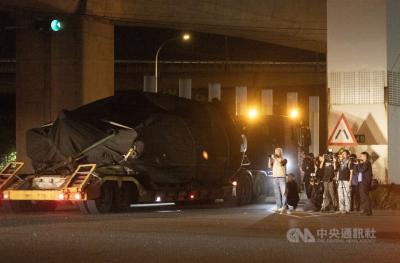
The final batch of 28 M1A2T Abrams tanks purchased from the US arrived at Taipei Port last night and were transported to the Armor Training Command in Hsinchu County’s Hukou Township (湖口), completing the military’s multi-year procurement of 108 of the tanks. Starting at 12:10am today, reporters observed more than a dozen civilian flatbed trailers departing from Taipei Port, each carrying an M1A2T tank covered with black waterproof tarps. Escorted by military vehicles, the convoy traveled via the West Coast Expressway to the Armor Training Command, with police implementing traffic control. The army operates about 1,000 tanks, including CM-11 Brave Tiger
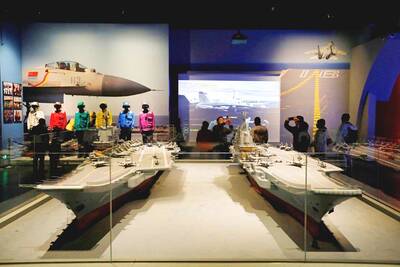
China on Wednesday teased in a video an aircraft carrier that could be its fourth, and the first using nuclear power, while making an allusion to Taiwan and vowing to further build up its islands, as it looks to boost maritime power, secure resources and bolster territorial claims. The video, issued on the eve of the 77th founding anniversary of the Chinese People’s Liberation Army Navy, featured fictional officers with names that are homophones of three commissioned aircraft carriers, the Liaoning (遼寧), Shandong (山東) and Fujian (福建). Titled Into the Deep, it showed a 19-year-old named “Hejian” (何劍) joining the group, sparking
BIG YEAR: The company said it would also release its A12 chip the same year to keep a ‘reliable stream of new silicon technologies’ flowing to its customers Taiwan Semiconductor Manufacturing Co (TSMC, 台積電) yesterday said its newest A13 chip is to enter volume production in 2029 as the chipmaker seeks to hold onto its tech leadership and demand for next-generation chips used in artificial intelligence (AI), high-performance-computing (HPC) and mobile applications. TSMC, the world’s biggest contract chipmaker, also unveiled its A12 chip at its annual technology symposium in Santa Clara, California. The A12 chip, which features TSMC’s super-power-rail technology to provide backside power delivery for AI and HPC applications, is also to enter volume production in 2029, a year after the scheduled release of the A14 chip. The technology moves


 RSS
RSS