


A vote-by-vote recount of the ballots cast in the Taipei mayoral election on Nov. 24 demanded by Chinese Nationalist Party (KMT) candidate Ting Shou-chung (丁守中) began yesterday.
Taipei Mayor Ko Wen-je (柯文哲), who won re-election, said he was not worried about the results, given that Ting’s camp had representatives monitoring the vote count on election day.
Ko garnered 580,820 votes in the five-way race, or 41.05 percent of those cast, against Ting’s 577,566 votes (40.82 percent), a margin of just 3,254 votes.
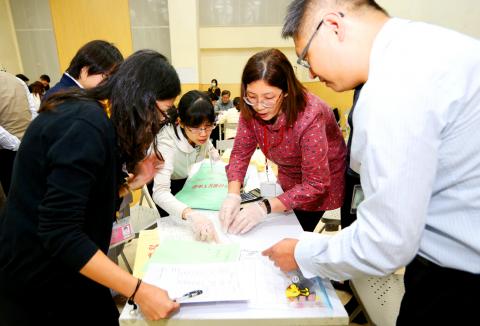
Photo: Chien Jung-fong, Taipei Times
As the nine-in-one elections were held alongside 10 referendums, voting took longer than expected, not finishing until 7:46pm in Taipei, more than three hours past the scheduled deadline.
Ballot counting took more than 10 hours and finished at about 2:30am the following day.
Many voters had complained about irregularities, such as voting and ballot counting reportedly taking place simultaneously at a polling station in Shilin District (士林), meaning that some people were able to check election results online while waiting to vote, Ting said.

Photo: Chien Jung-fong, Taipei Times
Ting and his lawyers on Wednesday applied for a recount with the Taipei District Court and paid a deposit of NT$3 per vote, or about NT$4.28 million (US$139,178).
The ballot boxes were sealed at the Taipei City Election Commission on Thursday, witnessed by the lawyers appointed by Ting and Ko, and moved yesterday morning to the Xinyi District Office Auditorium for the recount.
The court said that the recount would be done by 50 groups made up of two election clerks, a judge and a court clerk each, with lawyers appointed by Ting and Ko allowed to witness the process.
During the recount, each ballot is to be displayed by a polling clerk for the judge and lawyers to look at, Chief Judge Huang Ping-chin (黃柄縉) of the Taipei District Court’s administrative division said.
According to the Civil Servants Election and Recall Act (公職人員選舉罷免法), the recount must be finished within 20 days of the ballot boxes being sealed, or Dec. 19.
Ting said he was thankful that many lawyers had come forward to help protect Taiwan’s democracy and give the public a chance to know the truth.
Yeh Ching-yuan (葉慶元), one of Ting’s lawyers, said it had been a challenge to find enough lawyers to help after the court on Friday notified them of the recount.
Due to the small number of votes separating Ting and Ko, Ting’s team was “cautiously optimistic,” he said, adding that if three tickets per polling station were different, the results might change.
Additional reporting by CNA

PROVOCATIVE: Chinese Deputy Ambassador to the UN Sun Lei accused Japan of sending military vessels to deliberately provoke tensions in the Taiwan Strait China denounced remarks by Japan and the EU about the South China Sea at a UN Security Council meeting on Monday, and accused Tokyo of provocative behavior in the Taiwan Strait and planning military expansion. Ayano Kunimitsu, a Japanese vice foreign minister, told the Council meeting on maritime security that Tokyo was seriously concerned about the situation in the East China and South China seas, and reiterated Japan’s opposition to any attempt to change the “status quo” by force, and obstruction of freedom of navigation and overflight. Stavros Lambrinidis, head of the EU delegation to the UN, also highlighted South China Sea
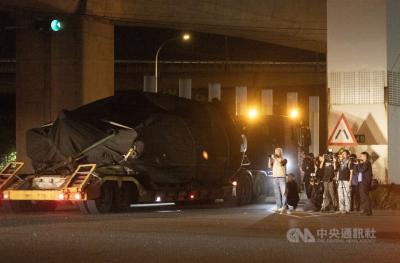
The final batch of 28 M1A2T Abrams tanks purchased from the US arrived at Taipei Port last night and were transported to the Armor Training Command in Hsinchu County’s Hukou Township (湖口), completing the military’s multi-year procurement of 108 of the tanks. Starting at 12:10am today, reporters observed more than a dozen civilian flatbed trailers departing from Taipei Port, each carrying an M1A2T tank covered with black waterproof tarps. Escorted by military vehicles, the convoy traveled via the West Coast Expressway to the Armor Training Command, with police implementing traffic control. The army operates about 1,000 tanks, including CM-11 Brave Tiger
Taiwan Semiconductor Manufacturing Co (TSMC, 台積電), the world’s largest contract chipmaker, said it expects its 2-nanometer (2nm) chip capacity to grow at a compound annual rate of 70 percent from this year to 2028. The projection comes as five fabs begin volume production of 2-nanometer chips this year — two in Hsinchu and three in Kaohsiung — TSMC senior vice president and deputy cochief operating officer Cliff Hou (侯永清) said at the company’s annual technology symposium in Silicon Valley, California, last week. Output in the first year of 2-nanometer production, which began in the fourth quarter of last year, is expected to
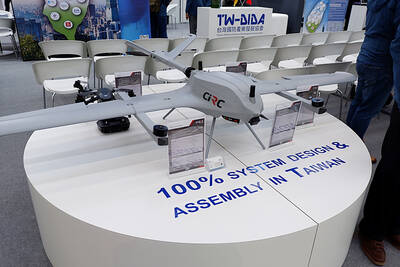
Taiwan’s drone exports surged past US$100 million in the first quarter, exceeding last year’s full-year total, with the Czech Republic emerging as the largest buyer, the Ministry of Economic Affairs said. Exports of complete drones reached US$115.85 million in the period, about 1.2 times the total recorded for all of last year, the ministry said in a report. Exports to the Czech Republic accounted for about US$100 million, far outpacing other markets. Poland, last year’s top destination, recorded about US$11.75 million in the first quarter. Taiwan’s drone exports have expanded rapidly in the past few years, with last year’s total


 RSS
RSS