


Independent Taipei mayoral candidate Wu E-yang’s (吳萼洋) remarks about the health benefits of honey lemonade drinks do not convey the complete picture, medical experts said.
At a televised debate on Saturday that involved the five Taipei mayoral candidates, Wu said that a lump underneath his left eye and a skin condition had cleared up after he stuck to a vegetarian diet for a month and drank honey lemonade.
Following the debate, online searches for “Wu E-yang” and “honey lemonade” rose significantly, according to Google Trends.
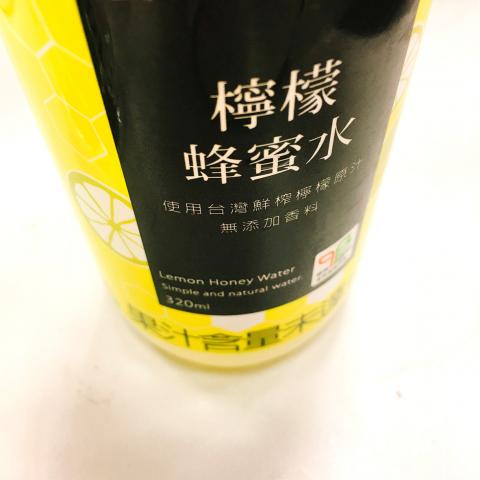
Photo: Lin Hui-chin, Taipei Times
However, Tsai Tsen-fang (蔡呈芳), a dermatologist at National Taiwan University Hospital, on Sunday said that while some types of honey have antibacterial properties and help wounds heal faster, not all honeys have these properties.
Furthermore, the honey must be pure and applied to the skin to achieve the results, Tsai said, adding that there is not sufficient evidence to support benefits linked to taking honey orally.
While some people think that lemons can help lighten and improve skin quality as they are rich in vitamin C, more research is needed to support this, Tsai said.
He said that he has not seen research supporting the claim that honey lemonade can treat lumps or pityriasis versicolor — the fungal infection Wu claimed was eliminated, which causes small patches of skin to become scaly and discolored.
Meanwhile, Taiwan Dental Association council member Chiang Hsi-jen (江錫仁) said that lemons are acidic and can erode teeth.
Failing to rinse after drinking honey lemonade could damage your teeth, Chiang said.
However, brushing after drinking honey lemonade can reduce residue on the teeth and help prevent damage, he said.
Comments in response to Wu were rife on Professional Technology Temple, the nation’s largest online bulletin board system, with some asking: “Was honey lemonade the biggest winner” at Saturday’s debate?
One netizen called Wu’s comments the “best sponsored content they have seen this year.”
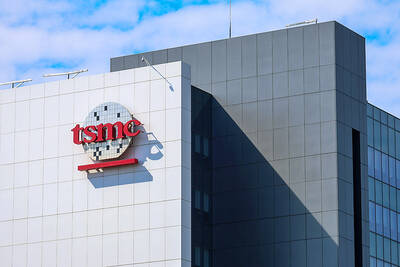
Taiwan Semiconductor Manufacturing Co (TSMC, 台積電), the world’s largest foundry service provider, yesterday said that global semiconductor revenue is projected to hit US$1.5 trillion in 2030, after the figure exceeds US$1 trillion this year, as artificial intelligence (AI) demand boosts consumption of token and compute power. “We are still at the beginning of the AI revolution, but we already see a significant impact across the whole semiconductor ecosystem,” TSMC deputy cochief operating officer Kevin Zhang (張曉強) said at the company’s annual technology symposium in Hsinchu City. “It is fair to say that in the past decade, smartphones and other mobile devices were
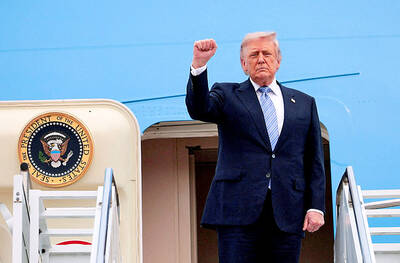
US-CHINA SUMMIT: MOFA welcomed US reassurance of no change in its Taiwan policy; Trump said he did not comment when Xi talked of opposing independence US President Donald Trump yesterday said he has not made a decision on whether to move forward with a major arms package for Taiwan after hearing concerns about it from Chinese President Xi Jinping (習近平). Trump’s comments on Taiwan came as he flew back to Washington after wrapping up critical talks in which both leaders said important progress was made in stabilizing US-China relations even as deep differences persist between the world’s two biggest powers on Iran and Taiwan. “I will make a determination,” Trump said, adding: “I’ll be making decisions. But, you know, I think the last thing we need right
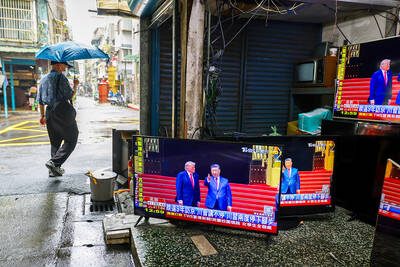
TAIWAN ISSUE: US treasury secretary Scott Bessent said on the first day of meetings that ‘it wouldn’t be a US-China summit without the Taiwan issue coming up’ There were no surprises on the first day of the summit between US President Donald Trump and Chinese President Xi Jinping (習近平), the Mainland Affairs Council (MAC) said yesterday, as the government reiterated that cross-strait stability is crucial to the Asia-Pacific region, as well as the world. As the two presidents met for a highly anticipated summit yesterday, Chinese state media reported that Xi warned Trump that missteps regarding Taiwan could push their two countries into “conflict.” Trump arrived in China with accolades for his host, calling Xi a “great leader” and “friend,” and extending an invitation to visit the White House
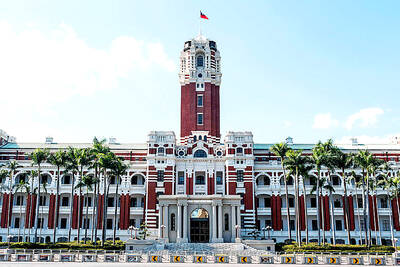
SECURITY: Taipei presses the US for arms supplies, saying the arms sales are not only a reflection of the US security commitment to Taiwan but also serve as a mutual deterrent against regional threats Taiwan is committed to preserving the cross-strait “status quo” and contributing to regional peace and stability, the Presidential Office said yesterday. “It is an undeniable fact that the Republic of China is a sovereign and independent democratic nation,” Presidential Office spokeswoman Karen Kuo (郭雅慧) reiterated, adding that Beijing has no right to claim sovereignty over Taiwan. The statements came after US President Donald Trump warned against Taiwanese independence. Trump wrapped up a state visit to Beijing on Friday, during which Chinese President Xi Jinping (習近平) had pressed him not to support Taiwan. Taiwan depends heavily on US security backing to deter China from carrying


 RSS
RSS