


The Army Command Headquarters is to earmark NT$1.6 billion (US$52 million) to build a helicopter base and helicopter hangars in Taitung County and Taichung respectively to preserve the combat capability of its rotary-wing units in case of a surprise attack by China, a Ministry of National Defense official said yesterday.
Attack helicopters, including Boeing AH-64E Apaches and Bell AH-1W Super Cobras, are to be stationed at Fong Nian Air Force Base (豐年) in Taitung County and Ching Chuan Kang Air Force Base (清泉崗) in Taichung, the official said on condition of anonymity.
According to the fiscal 2019 budget sent to the Legislative Yuan for review, the army plans to establish training bases for all kinds of helicopters under the Aviation and Special Forces Command, the official said.

Photo: George Tsorng, Taipei Times
The Taitung base would cost NT$933 million and is expected to be completed by 2023, they said.
With the establishment of the base, rotary-wing units under the command would be able to use the terrain along the coast to evacuate and preserve their combat capability in the event of a surprise attack by the Chinese People’s Liberation Army, the official said.
The base could also serve as a forward command center for disaster relief, they added.
The planned hangars at Ching Chuan Kang Air Force Base would cost NT$729 million and would also be completed by 2023, the official said.
The command’s AH-1W helicopters have been stationed at the base for some time, but they are “borrowing” the air force’s spare hangars, they said.
“Once we begin building the new hangars, helicopters under the command will have more appropriate storage space, as well as adequate maintenance capabilities,” the official said.
The upgrade would also cut down the maintenance hours that each unit needs, the official added.
In separate news, a senior government official yesterday said that the National Day Celebration Preparation Committee would on Thursday next week announce its arrangements for the Double Ten National Day celebrations.
As customary, several formations of the air force’s main fighter jets would fly over the Presidential Office Building in Taipei and people attending the celebrations, the official said.
As fighter jets travel fast and fly at high altitudes, the air force would also dispatch slower planes, such as Lockheed C-130 Hercules transport planes and Lockheed P-3C Orion maritime surveillance aircraft, which would allow the public to get a closer view of them, the official added.
Weather would be the deciding factor in determining how low the planes would fly, the official said, adding that flight safety would be the top concern.

The Tourism Administration yesterday announced that it would reward repeat international visitors with incentives of up to NT$8,000 to boost inbound tourism. The incentives are available to all international tourists, it said, adding that repeat visitors would be rewarded with NT$5,000 and would receive an additional NT$3,000 if they bring travel companions. The nation received 2,990,657 inbound visitors during the first quarter, marking a 3.8 percent increase from the same period last year, agency data showed. Japanese nationals are among groups visiting Taiwan the most. About 1.48 million Japanese tourists arrived last year, a year-on-year increase of more than 12
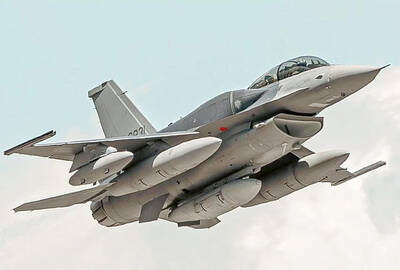
66 FIGHTER JETS: The aircraft is likely undergoing preparations for its transfer to Taiwan — a significant step forward in the nation’s modernization program, a lawmaker said The first of Taiwan’s order of F-16V Block 70 aircraft has been sighted in Texas ahead of delivery, Democratic Progressive Party (DPP) Legislator Wang Ting-yu (王定宇) said. Taiwan’s first F-16V Block 70 two-seat aircraft, tail number 6831, was seen flying from Lockheed Martin’s production facility in Greenville, South Carolina, to Naval Air Station Joint Reserve Base Fort Worth in Texas, Wang wrote on Facebook yesterday. The plane is likely undergoing preparations for its transfer to Taiwan, marking a significant step forward in the Republic of China Air Force’s modernization program, Wang said, citing military analysts. The F-16V Block 70 is a new-build version
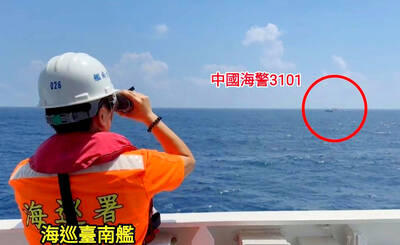
‘BRAZEN’: The holiday did not stop China from activities that infringe on Taiwan’s maritime jurisdiction, but the CGA is ready to defend the nation, Kuan Bi-ling said Beijing is intensifying maritime pressure on Taiwan, but the nation will never yield, Ocean Affairs Council Deputy Minister Sung Chen-en (宋承恩) said. The Coast Guard Administration (CGA) has adopted a “shadowing and monitoring” approach to avoid falling into a Chinese trap to escalate tensions and deepen the conflict, Sung said in an interview published yesterday in the Chinese-language Liberty Times (the Taipei Times’ sister newspaper). China Coast Guard formations patrolling waters east of Taiwan, as well as official Chinese vessels entering areas around Itu Aba Island (Taiping Island, 太平島) and Pratas Islands (Dongsha Islands, 東沙群島) show Beijing’s attempts to significantly step up
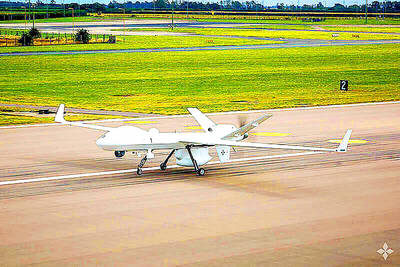
BOOST: By operating the same advanced systems as the US military, Taiwan would be better positioned to share and integrate intelligence with partners, an expert said The first batch of MQ-9B SkyGuardian drones has arrived in Taiwan, and is being assembled and tested by drone manufacturer General Atomics and the military ahead of flight trials as part of the air force’s acquisition to bolster its aerial surveillance capabilities, a source said yesterday. The air force allocated a budget of NT$21.7 billion (US$687 million) from 2022 to 2029 to procure four MQ-9B uncrewed aerial vehicles (UAVs) manufactured by General Atomics along with associated equipment such as ground control stations. The US has agreed to deliver the four MQ-9Bs to Taiwan in two batches this year and next


 RSS
RSS