


The Changhua County Government yesterday suspended power and water supply to a former Buddhist temple that was converted into a shrine to Chinese communism by a local businessman, and said it would demolish illegal buildings on the property next week.
Former military officer Wei Ming-jen (魏明仁), who works in construction, acquired a Buddhist temple in the county’s Ershuei Township (二水) seven years ago. He ousted the temple’s four nuns and began flying the national flag of the People’s Republic of China (PRC) over the complex.
The New York Times on Wednesday called Wei’s actions a move to establish “an extravagant shrine to China’s communist party.”
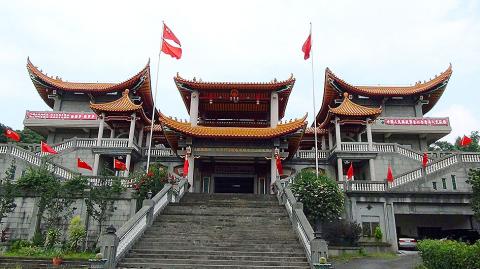
Photo: CNA
Changhua County Commissioner Wei Ming-ku (魏明谷) yesterday at a news conference in the county rejected claims by some locals and county councilors that his inaction on the issue and was “a shame on Taiwan,” saying that they were not aware of the entire story.
Wei Ming-jen, as a Taiwanese, has a right to freedom of speech, Wei Ming-ku said.
However, Wei Ming-jen’s illegal occupation of the temple and use of the area to promote Chinese political ideology has slandered national dignity and camaraderie, he said.
As such, the county government is to suspended power and water supply to the temple, Wei Ming-ku said.
Later yesterday, the county government dispatched a Department of Economic Affairs official surnamed Chao (趙) to accompany Taiwan Power Co (台電) and Taiwan Water Corp (台水) employees to the temple to sever service in preparation for next week’s demolition.
Because the complex straddles two plots of land zoned for different purposes, some of its buildings are legal and others are not, department Director Liu Yu-ping (劉玉平) said.
Buildings on 5,300m2 of land are to be demolished on Wednesday next week, Liu said, adding that the department would handle the other illegal buildings at a later date.
However, the move to demolish the complex might meet with some procedural snags, as the temple, which was built in 1920, was given historic status on Tuesday last week.
The temple and surrounding areas comprising 936m2 of land is now a heritage site, county Department of Cultural Affairs Director Chou Fu-yi (周馥儀) said.
Prior to the local government’s severing of power and water service, Wei Ming-jen yesterday told a separate news conference that he has never recognized the validity of the Republic of China government, and he aims to overthrow it.
Anyone violating his property would be “severely punished by the motherland” once both sides of the Taiwan Strait are unified, he said.
Police later took Wei Ming-jen in for questioning on the grounds that he obstructed civil servants from carrying out their duties by allegedly throwing punches at a Department of Economic Affairs official surnamed Tung (董).
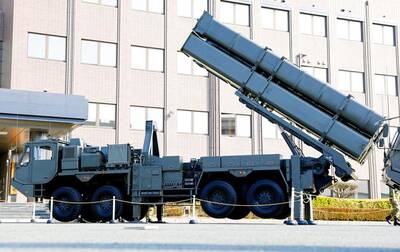
Japan has deployed long-range missiles in a southwestern region near China, the Japanese defense minister said yesterday, at a time when ties with Beijing are at their lowest in recent years. The missiles were installed in Kumamoto in the southern region of Kyushu, as Japan is attempting to shore up its military capacity as China steps up naval activity in the East China Sea. “Standoff defense capabilities enable us to counter the threat of enemy forces attempting to invade our country ... while ensuring the safety of our personnel,” Japanese Minister of Defense Shinjiro Koizumi said. “This is an extremely important initiative for
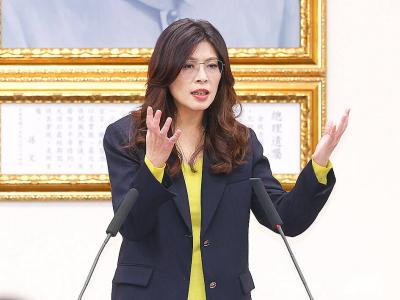
Chinese Nationalist Party (KMT) Chairwoman Cheng Li-wun (鄭麗文) today accepted an invitation from Chinese President Xi Jinping (習近平) to lead a delegation to China next month, saying she hopes to promote the peaceful development of cross-strait relations and bring stability to the Taiwan Strait. “I am grateful and happy to accept this invitation,” Cheng said in a statement from the KMT chairperson’s office. Cheng said she hopes both sides can work together to promote the peaceful development of cross-strait relations, enhance exchange and cooperation, bring stability to the Taiwan Strait and improve people’s livelihoods. At today's news conference, Cheng said any efforts to

MORE POPULAR: Taiwan Pass sales increased by 59 percent during the first quarter compared with the same period last year, the Tourism Administration said The Tourism Administration yesterday said that it has streamlined the Taiwan Pass, with two versions available for purchase beginning today. The tourism agency has made the pass available to international tourists since 2024, allowing them to access the high-speed rail, Taiwan Railway Corp services, four MRT systems and four Taiwan Tourist Shuttles. Previously, five types of Taiwan Pass were available, but some tourists have said that the offerings were too complicated. The agency said only two types of Taiwan Pass would be available, starting from a three-day pass with the high-speed rail and a three-day pass with Taiwan Railway Corp. The former costs NT$2,800

The nation’s fastest supercomputer, Nano 4 (晶創26), is scheduled to be launched in the third quarter, and would be used to train large language models in finance and national defense sectors, the National Center for High-Performance Computing (NCHC) said. The supercomputer, which would operate at about 86.05 petaflops, is being tested at a new cloud computing center in the Southern Taiwan Science Park in Tainan. The exterior of the server cabinet features chip circuitry patterns overlaid with a map of Taiwan, highlighting the nation’s central position in the semiconductor industry. The center also houses Taiwania 2, Taiwania 3, Forerunner 1 and


 RSS
RSS