


The Supreme Court yesterday upheld a guilty verdict by the Taiwan High Court against Hualien County Commissioner Fu Kun-chi (傅崐萁) for insider trading and sentenced him to eight months in prison, bringing to a close a legal battle that lasted for 14 years.
The Ministry of the Interior last night relieved Fu of his duties, effective immediately.
Fu was accused in 2005 of breaching the Securities and Exchange Act (證券交易法) by manipulating the stock price of Hold-Key Electric Wire & Cable Co Ltd (合機電線電纜) through insider trading.
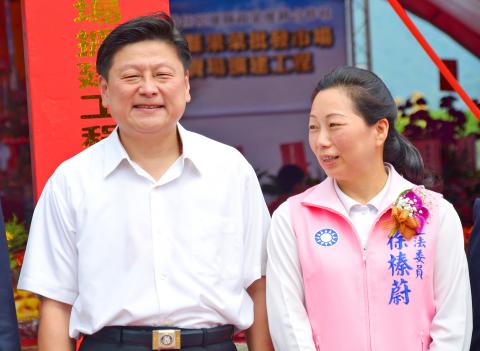
Photo: Wang Chun-chi, Taipei Times
Fu, then a People First Party legistlator, was approached by Hold-Key general manager Yang Kai-ti (楊愷悌) and deputy general manager Yu Su-yuan (余素緣), who offered him 20 million company shares at NT$15 per share, the Supreme Court ruling said.
Hold-Key had just won a bid to build an electric supply system for state-run Taiwan Power Co (台電), and Yang and Yu saw it as an opportunity to boost the company’s stock price, it said.
Fu brought in friends and stock market analyst Chang Shih-chieh (張世傑), who convinced people that the stock was a good investment, the ruling said.
The Hold-Key stock price soared from NT$15 per share in October 2003 to NT$47 per share in January 2004, earning Fu and the others a total of NT$96 million (US$3.11 million at the current exchange rate) in illicit gains, it added.
Fu was originally sentenced to one year and four months in prison by the second appellate court, but his jail term was reduced to eight months, as the case was eligible for a sentence reduction according to the Criminal Speedy Trial Act (刑事妥速審判法), yesterday’s ruling said.
The Hualien County District Prosecutors’ Office yesterday said it had received a notice from the Supreme Court to impose travel restrictions on Fu and had instructed harbor and airport authorities to deny Fu passage should he try to leave the nation.
Ministry of the Interior Department of Civil Affairs Director Lin Ching-chi (林清淇) said that Fu had been dismissed as county commissioner per Article 79 of the Local Government Act (地方制度法).
The Executive Yuan would be notified of the need to appoint an acting commissioner, as the regulations stipulate that the deputy commissioner is to be relieved of their duties as well, Lin said.
Given the timing of the Supreme Court’s announcement, the dismissal paperwork would take some time, Lin added.
While the ministry holds the right to nominate a replacement, the Executive Yuan holds the deciding vote, Lin said.
Minister of the Interior Hsu Kuo-yung (徐國勇) said the ministry had yet to nominate anyone for acting commissioner.
“The ministry must receive the court ruling before we can have the Executive Yuan approve any candidates,” Hsu said.
The acting commissioner would serve until Dec. 25 when the winner of the Nov. 24 Hualien commissioner race would assume office, Lin said.
Additional reporting by CNA

National Taiwan University (NTU) yesterday said it disqualified a person from an entrance examination for using AI smart glasses to cheat, along with two others for making untruthful statements in their curriculum vitae. The three applicants were given null scores, Taiwan’s highest-ranked university said, calling on prospective students to be honest in the admissions process. NTU registrar Lee Hung-sen (李宏森) said that the cheating applicant wore a hat and thick-rimmed glasses to the second written exam for medical school, claiming that they felt cold. Suspicions were aroused when the applicant stared oddly at the test for long stretches while steadily bringing the paper
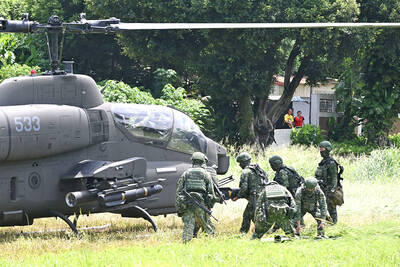
MILITARY ISSUES: A partisan divide between the Cabinet and the legislature ‘raised questions about Taiwan’s ability to adequately fund its defense,’ the report said Taiwan’s defense budget, military personnel numbers and resilience are challenges to its ability to meet national defense goals, the US Naval Institute said in a report published on Tuesday. In response to the perception of a growing military threat posed by China, Taiwan has embarked on an effort to enhance the capabilities needed to deter an attempt by Beijing to annex the nation by force, the institute said in the US Congressional Research Service report, titled Taiwan: Defense and Military Issues, which was filed on Thursday last week. Taiwan’s defense budget increased by about 7.5 percent from 2024 to last year, it
NOT JUST NUMBERS: What matters to intelligence work is crucial, reliable information, so even a few credible leads can be highly valuable to national security, a legislator said The National Security Bureau (NSB) yesterday said it has finished the establishment of an information-reporting channel for Chinese nationals, the aim of which is to broaden intelligence gathering on China’s political, military, economic and social developments. Chinese nationals can submit information on the Web page, https://report.nsb.gov.tw, the NSB said in a statement. The move aims to expand the bureau’s diverse intelligence sources and is pursuant to the National Intelligence Services Act (國家情報工作法), it said, adding that it referenced practices adopted by intelligence agencies in the US, the UK and Israel. An increasing number of people are approaching Taiwanese agencies to provide information, as

66 FIGHTER JETS: The aircraft is likely undergoing preparations for its transfer to Taiwan — a significant step forward in the nation’s modernization program, a lawmaker said The first of Taiwan’s order of F-16V Block 70 aircraft has been sighted in Texas ahead of delivery, Democratic Progressive Party (DPP) Legislator Wang Ting-yu (王定宇) said. Taiwan’s first F-16V Block 70 two-seat aircraft, tail number 6831, was seen flying from Lockheed Martin’s production facility in Greenville, South Carolina, to Naval Air Station Joint Reserve Base Fort Worth in Texas, Wang wrote on Facebook yesterday. The plane is likely undergoing preparations for its transfer to Taiwan, marking a significant step forward in the Republic of China Air Force’s modernization program, Wang said, citing military analysts. The F-16V Block 70 is a new-build version


 RSS
RSS